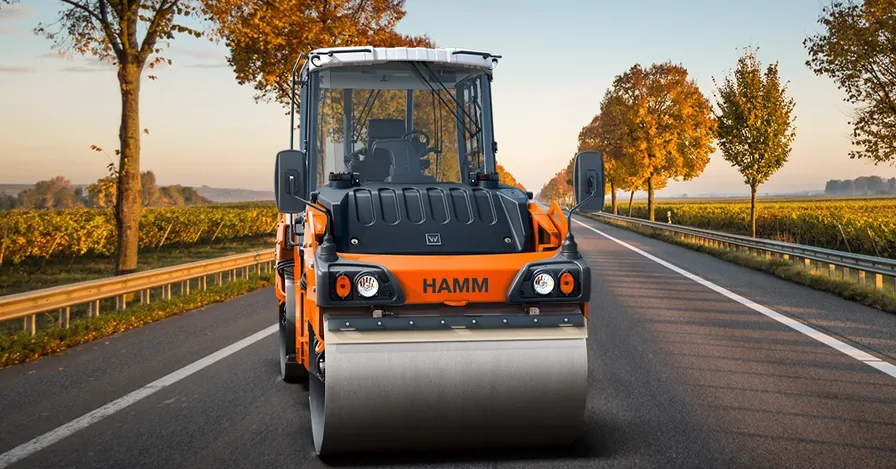
If you have been quoted for a tandem roller by one supplier and a double drum roller by another, you have been quoted for the same machine. Both terms describe a roller with two steel drums, one at the front and one at the rear, and the industry uses them interchangeably.
That machine exists for one reason: asphalt needs flat, uniform contact across its full width and along the length of the machine. A single drum roller cannot deliver that, because its rear tyres leave a different footprint from its front drum. Steel on both axles produces a consistent, repeatable surface — which is what a wearing course requires.
This guide covers how a tandem roller — or double drum roller — compacts asphalt, why mat temperature governs the whole sequence, how the roller train is planned, and which HAMM machines GENAVCO supplies.
Tandem Roller or Double Drum Roller: The Same Machine
The terminology varies by market and by supplier, not by machine.
- "Tandem" describes the arrangement: Two drums mounted in line, one behind the other, on separate axles. This is the term HAMM uses in its own product literature — the HD Compact Line, HD and HD+ series are described as tandem rollers.
- "Double drum" describes the count: Two steel drums rather than one. The term distinguishes the machine from a single drum roller, which has a drum at the front and rubber tyres at the rear.
- Both usually vibrate: On most tandem rollers both drums can vibrate, and vibration is frequently switchable — front only, rear only, or both together — so the operator can adapt to the layer and the stage.
There is one related machine worth distinguishing: a combination roller has a steel drum on one axle and pneumatic tyres on the other. It is not a tandem roller, though it is often grouped with them, and it behaves differently because the tyres knead the surface rather than pressing it flat.
Why Asphalt Needs Steel on Both Axles
Asphalt compaction has two objectives that pull against each other, and the tandem configuration is what reconciles them.
- Density, for structural performance: Air voids in a compacted mat allow water ingress and accelerate oxidation of the binder. Reaching target density is what determines how long the surface lasts under traffic and weather.
- Surface regularity, for ride quality and drainage: The finished level has to be smooth and consistent. Steel drums on both axles bridge minor irregularities and leave a flat, uniform impression across the full drum width.
A single drum roller compromises the second. Its rear tyres make a different footprint from the front drum, so the surface receives two different contact patterns on each pass. On granular layers that is irrelevant. On a wearing course it is visible on the finished surface.
For the layers beneath the asphalt — formation, subbase and base course — the correct machine is covered in our guide to single drum rollers for soil compaction.
Mat Temperature Governs Everything
Asphalt compaction is a race against cooling. Every other decision on site is subordinate to this one.
- Compaction only works within a temperature window: While the mat is hot the binder is soft enough for aggregate particles to move into a denser arrangement. As it cools the mix stiffens and further rolling achieves nothing — or damages what is already there.
- Rolling too hot displaces the mat: Working material that is still very soft pushes it ahead of the drum, causing shoving and cracking rather than densification.
- Rolling too cool cannot achieve density: Once the mix has stiffened, additional passes crush aggregate and mark the surface without closing voids. The layer is then permanently under-compacted.
- UAE conditions cut both ways: High ambient temperature slows the cooling of the mat, which lengthens the available window and is a genuine advantage. But thin lifts, wind and night working all accelerate surface cooling, and the surface stiffens before the body of the mat does. The window has to be assessed on site rather than assumed from ambient temperature.
The practical consequence is that the roller train has to keep pace with the paver. If the rollers fall behind, the mat cools past the window before the breakdown pass reaches it, and no amount of subsequent effort recovers the density.
Planning the Roller Train
| Pass | Machine | Purpose |
|---|---|---|
| Breakdown | Tandem (double drum) | Achieves the majority of the density while the mat is hottest |
| Intermediate | Tandem (double drum) | Completes densification as the mat cools through the window |
| Finish | Tandem, vibration off | Removes marks and delivers the final surface regularity |
| Sealing (where specified) | Pneumatic tyred | Kneads the surface to close remaining voids |
The number of machines is set by paver output and mat width, not by preference. A roller train that cannot keep up with the paver is the most common cause of density failure on asphalt work, and it is a planning error rather than an equipment fault.
Advantages of a Tandem Roller
These are the characteristics that make it the standard asphalt compaction machine.
- Uniform contact across both axles: Steel front and rear delivers the same footprint on every pass, which is what produces a consistent finished surface.
- Switchable vibration: Front, rear or both together allows the operator to adapt to the stage without changing machines.
- Fast densification while the mat is hot: Vibratory compaction reaches target density in fewer passes, which matters when the temperature window is the constraint.
- Clean finish with vibration off: The same machine performs the finish pass in static mode, removing marks left by earlier passes.
- Consistent drum width coverage: Full-width contact simplifies overlap planning and reduces the risk of unrolled strips between passes.
- Good visibility of the drum edge: Working to a joint or a kerb line depends on the operator seeing the drum edge, which these machines are designed around.
- Sprinkler systems prevent pick-up: Water applied to the drums stops hot asphalt adhering and tearing the surface.
- Range of sizes for the same technique: From compact machines for confined work to full-size units for highway paving, the operating method stays the same across the fleet.
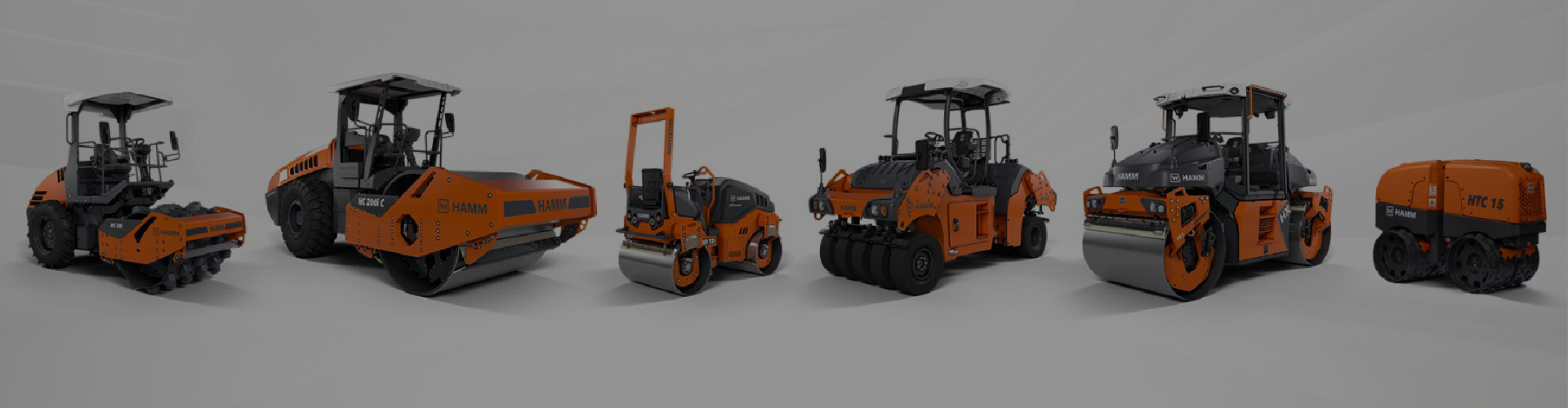
HAMM Tandem and Combination Rollers Available in the UAE
GENAVCO supplies the HAMM compaction equipment in the UAE range. Four machines cover tandem and combination duty from confined urban work to full highway paving.
1. HAMM HD 110 — full-size tandem roller for highway work
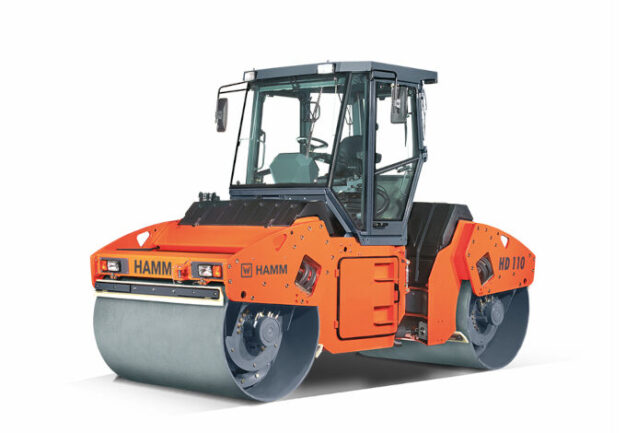
The largest tandem in the range, specified for wide mats and high paver output where the roller train has to keep pace across a full carriageway width.
- Vibration: Switchable front, rear or together
- Drive: Hydrostatic all-wheel drive for excellent hill climbing ability
- Operator station: Comfort seat that swivels and rotates, with steering wheel and instrument panel rotating with it
- Controls: 2 multifunction drive levers
- Visibility: Clear view of the drum surface, its outer edge and the working environment
- Sprinkler: Pressure sprinkler system with 2 water pumps, spray nozzles visible from the driver seat
- Monitoring: Speedometer, water level indicator, hydraulic oil temperature display, triple oil filtering
- Engine: Diesel engine with high power and low sound level
Two details matter more than they appear to. Nozzles visible from the seat let the operator confirm the sprinklers are working rather than discovering a blockage from pick-up marks in the mat; and a water level indicator tells them how much working time remains before a refill — which in UAE conditions is a real constraint on how far a machine can run from the bowser.
View the HAMM HD 110 tandem roller
2. HAMM HD 75 — tandem roller for general road and urban paving

The same operating platform and control philosophy in a smaller machine, for narrower mats, resurfacing work and sites where a full-size roller is more machine than the section needs.
- Vibration: Switchable front, rear or together
- Drive: Hydrostatic all-wheel drive for excellent hill climbing ability
- Operator station: Comfort seat that swivels and rotates, with steering wheel and instrument panel rotating with it
- Controls: 2 multifunction drive levers
- Visibility: Clear view of the drum surface, its outer edge and the working environment
- Sprinkler: Pressure sprinkler system with 2 water pumps, spray nozzles visible from the driver seat
- Monitoring: Speedometer, water level indicator, hydraulic oil temperature display, triple oil filtering
Operating a mixed fleet of HD 75 and HD 110 machines has a practical benefit beyond the machines themselves: the controls and operating method are the same, so operators move between them without retraining and the pass discipline stays consistent across the train.
View the HAMM HD 75 tandem roller
3. HAMM HD 14 VT — combination roller for mixed duty

A combination machine rather than a true tandem, pairing a steel drum with tyres so that compaction and surface sealing can be handled by one unit on smaller works.
- Steering: Crab steering up to 50 mm
- Visibility: Optimum front view due to concaving front end; good view of the drum’s outer edges
- Articulation: 3-point swivel joint for optimum driving comfort
- Machine height: Low, for working under restrictions and improving stability
- Operator: Ergonomic driver platform, spring-mounted driver seat, comfort seat with seat belt
- Instrumentation: Modern instrument panel, operating hours counter, indicator lights, emergency stop switch
- Servicing: Convenient maintenance and service access
Crab steering is the feature to plan work around. Offsetting the rear drum relative to the front lets the machine compact right up against a kerb, joint or edge without the body of the machine fouling it — which on urban resurfacing removes a great deal of hand work.
View the HAMM HD 14 VT combination roller
4. HAMM HD 8 VV — compact tandem roller for confined work

A small tandem with both drums vibrating, for work fronts where access is restricted and a full-size machine cannot manoeuvre.
- Drum suspension: Clear Side one-sided drum suspension, giving an unobstructed view to the drum edge
- Visibility: Optimum front view due to concaving front end
- Articulation: 3-point swivel joint with central suspension point
- Machine height: Low machine height
- Platform: Low working platform with high stability
- Operator: Comfort seat with seat belt, multifunction drive lever to the right of the seat
- Instrumentation: Modern instrument panel, operating hours counter, indicator lights, emergency stop switch
Clear Side suspension is the reason to choose this machine for edge work. With the drum supported from one side only, the operator sees exactly where the drum edge sits relative to a kerb or joint, which is the whole difficulty of compacting confined sections.
View the HAMM HD 8 VV compact tandem roller
Not sure how many rollers your paving train needs?
Send us your paver output, mat width and thickness, and the working window you expect on site — our team will size the roller train and return a costed proposal.
How to Plan Asphalt Compaction
Step 1 — Size the roller train to the paver. Machine count follows paver output and mat width. A train that cannot keep pace means the mat cools past the window before the breakdown pass arrives.
Step 2 — Establish the temperature window on site. Assess how quickly the actual mat is cooling under actual conditions, rather than working from ambient temperature or a previous job.
Step 3 — Run a test strip. Establish the pass count and vibration settings that reach target density on this mix, at this thickness, with these machines.
Step 4 — Plan the pass pattern and overlap. Consistent overlap and a repeatable pattern produce consistent density. Variation between operators shows directly in core results.
Step 5 — Keep the sprinklers working. Water on the drums prevents pick-up. Check nozzles at the start of each run and plan refills around the water capacity of the machine.
Step 6 — Finish with vibration off. The final pass in static mode removes marks left by earlier passes and delivers the surface regularity the specification is measured against.
Asphalt Compaction in UAE Conditions
- Water capacity is a working constraint: Sprinkler systems consume water continuously and evaporation is high. Tank capacity determines how long a machine works before refilling, and on a long paving run that logistics planning is as important as the compaction plan itself.
- Night paving is common: Infrastructure and resurfacing work frequently runs at night to avoid daytime traffic and heat. Under artificial light, visibility of the drum edge and clear operator sightlines matter considerably more, and machine lighting becomes a specification item.
- Surface cooling can outpace the body of the mat: Even where ambient temperature is high, wind and thin lifts stiffen the surface faster than the interior. Assess the mat rather than the air.
- Dust affects drums and sprinklers: Fine sand on the mat and in the water system causes both marking and nozzle blockage. Daily checks on the sprinkler system prevent most surface defects attributed to other causes.
Why Choose GENAVCO for Asphalt Compaction Equipment in the UAE
Buying the machine is the easy part. What determines whether the investment performs is everything that happens afterwards.
- Part of Juma Al Majid Holding Group: Decades of established presence in the UAE market and the financial stability that comes with a major regional group — this matters when you are signing multi-year service agreements.
- Authorised HAMM representation: Genuine equipment, factory-backed specification and full warranty integrity — not grey-market imports with uncertain parts availability.
- In-country spare parts inventory: A roller stopped mid-run halts the paving train and the mat behind it cools. Our genuine spare parts operation holds stock locally so a service item does not cost a night’s paving.
- Certified service and maintenance: Scheduled servicing, preventive maintenance and on-site breakdown response through our repairs and maintenance division across Dubai, Abu Dhabi, Sharjah and the wider UAE.
- Operator training: Pass pattern, overlap and vibration discipline decide density and finish as much as the machine does. Our operator training centre covers correct operation and daily checks.
- Roller train specification, not single machines: We size the train against paver output and mat width rather than quoting one roller in isolation, because that is what actually determines whether density is achieved.
- Depth across the paving train: Compaction alongside the wider road construction equipment range, so the whole sequence is supported from one supplier relationship.
Common Asphalt Compaction Problems
- Density failing on cores despite adequate passes: Usually the mat cooled past the window before the breakdown pass. The roller train was not keeping pace with the paver.
- Shoving or cracking under the drum: Rolling started while the mat was too hot and soft. The material is being pushed rather than densified.
- Marks left in the finished surface: Either the finish pass was made with vibration still on, or the sprinklers were not delivering water and asphalt is picking up on the drums.
- Aggregate crushing at the surface: Continued rolling after the mat cooled below the window. Additional passes at that point cause damage rather than density.
- Unrolled strips between passes: Overlap discipline. Consistent, planned overlap eliminates it; ad hoc pass patterns do not.
- Poor compaction at joints and kerbs: Access rather than machine capability. Crab steering or a compact machine with clear drum-edge visibility resolves most of it.
Frequently Asked Questions
What is the difference between a tandem roller and a double drum roller?
There is none — both terms describe the same machine, a roller with two steel drums, one at the front and one at the rear. The terminology varies by market and supplier. HAMM uses "tandem roller" in its own product literature for the HD Compact Line, HD and HD+ series.
Why is a tandem roller used for asphalt instead of a single drum roller?
Asphalt requires flat, uniform contact across the full machine length. A tandem roller has steel drums on both axles, so every pass leaves the same footprint. A single drum roller has rubber tyres at the rear, producing a different contact pattern from the front drum, which shows in a finished wearing course.
What is the difference between a tandem roller and a combination roller?
A tandem roller has steel drums on both axles. A combination roller has a steel drum on one axle and pneumatic tyres on the other, adding a kneading action that helps seal the surface. Combination machines suit mixed duty on smaller works where one machine has to do both jobs.
Why does asphalt temperature matter so much for compaction?
Compaction only works while the binder is soft enough for aggregate to rearrange into a denser packing. Rolling too hot displaces the mat and causes shoving; rolling too cool cannot achieve density and crushes aggregate instead. The temperature window governs the entire sequence.
How many rollers does an asphalt paving train need?
It depends on paver output and mat width, not preference. The train has to keep pace with the paver so the breakdown pass reaches the mat while it is still within the temperature window. A train that falls behind is the most common cause of density failure.
Does GENAVCO supply spare parts and servicing for HAMM rollers in the UAE?
Yes. GENAVCO holds genuine parts in-country and operates a certified service network covering Dubai, Abu Dhabi, Sharjah and the wider UAE, with preventive maintenance programmes, operator training and on-site breakdown support.
Ready to Specify Your Asphalt Compaction Fleet?
Asphalt density is decided by whether the roller train keeps pace with the paver and whether every pass falls inside the temperature window. Machine choice supports that; it does not substitute for it.
GENAVCO supplies HAMM tandem, compact tandem and combination rollers across the UAE, backed by genuine parts, certified service and operator training. For the full compaction sequence from formation upward, see our guide to choosing a road roller.
Tell us your paver output and mat width. We will size the roller train and price it properly.
ENQUIRE NOW — GET YOUR ASPHALT COMPACTION SPECIFICATION
Serving Dubai, Abu Dhabi, Sharjah and the wider UAE.