Everything built on a site sits on ground that was either compacted properly or was not. Foundations, pavements, hardstandings, pipelines — all of them transfer load into layers placed and compacted long before anything visible went up. When those layers fail, the failure appears at the surface years later and the cause is buried under the finished work.
The single drum roller is the machine that does that work. One large steel drum at the front delivers vibration deep into the layer; driven rubber tyres at the rear provide traction across loose, uneven and freshly placed material where a steel-drum machine would simply spin.
This guide covers how a single drum roller transmits compaction energy, why amplitude and moisture content decide the result more than machine weight does, how to plan lift thickness and passes, and which HAMM soil compactors GENAVCO supplies.
How a Single Drum Roller Compacts Soil
Compaction is the removal of air voids from a material so its particles pack more densely. A single drum roller does this with two mechanisms working together.
- Static weight: The mass of the machine bearing on the drum presses the material. On its own this compacts only the upper part of the layer, which is why weight alone is a poor proxy for compaction capability.
- Vibration: An eccentric weight rotating inside the drum drives it rapidly up and down. Each impact sends a pressure wave down through the layer, momentarily reducing friction between particles so they can rearrange into a denser packing. This is what reaches depth.
Two settings govern that vibration. Amplitude is how far the drum moves — high amplitude drives energy deeper and suits thick granular lifts, low amplitude works nearer the surface and suits thin lifts or material that would be damaged by heavy impact. Frequency is how often the drum strikes, which affects surface finish and the spacing of impacts along the direction of travel.
The rear tyres are not incidental. They provide the traction that lets the machine climb and manoeuvre on loose granular material, and they carry the drive so the drum can concentrate on compaction rather than propulsion.
Where Single Drum Rollers Are Used
- Road formation and subgrade: The base of every pavement structure, where inadequate compaction guarantees settlement regardless of what is built above.
- Subbase and base course: Thick granular layers where deep energy transfer is required and where high amplitude is normally specified.
- Bulk earthworks and embankments: Fill placed in successive lifts, each one compacted before the next is placed.
- Site platforms and hardstandings: Laydown areas, plant platforms and yard surfaces that will carry heavy repeated loading.
- Pipeline and trench backfill: Reinstatement compacted in layers to prevent the surface settling over the trench line.
- Quarry haul roads and access tracks: Working surfaces that must carry loaded plant continuously without rutting.
Amplitude, Moisture and Lift Thickness
Three variables determine whether a layer reaches specification. Machine size is not among them in any straightforward way.
- Moisture content is the first constraint: Granular material compacts best within a narrow moisture band. Too dry and the particles resist rearranging no matter how much energy is applied; too wet and water occupies the void space that compaction is trying to close. In UAE conditions, material dries quickly and moisture control is frequently the limiting factor rather than the machine. No number of passes fixes material at the wrong moisture content.
- Lift thickness must match the machine: Compaction energy reaches a finite depth. A lift placed thicker than the machine can reach will remain under-compacted at the bottom, and because the surface compacts first, the test result at the top can look acceptable while the base of the layer is not. Thinner lifts with the right amplitude beat thick lifts with a heavy machine.
- Amplitude follows the layer, not the machine: High amplitude for thick granular lifts, low amplitude for thin layers and material near a finished level. Running high amplitude on a thin lift can loosen rather than compact it and can damage what lies beneath.
- Pass count comes from a test strip: Establish the number of passes at the start of the work on the actual material, at the actual thickness, with the actual machine settings. Carrying a count over from a previous project is how layers get either under-compacted or over-rolled.
Advantages of a Single Drum Roller
These are the characteristics that make it the standard earthworks compaction machine.
- Deep compaction energy: Vibration transmits force well below the surface, which is what thick granular lifts require and what static weight alone cannot achieve.
- Traction on loose ground: Driven rear tyres let the machine work on freshly placed, uneven and unbound material where a steel-drum-only machine loses grip.
- Adjustable amplitude: The same machine handles thick base lifts and thinner finishing layers by changing settings rather than changing machines.
- High output over area: A wide drum covers large areas quickly, which suits bulk earthworks where the constraint is square metres per shift.
- Hill climbing capability: All-wheel drive and traction control allow work on embankments, ramps and graded surfaces.
- Handles varied material: Granular fill, crushed rock, mixed site-won material and stabilised layers all fall within its working range.
- Robust in harsh conditions: Built for the dust, heat and abrasive material that characterise earthworks in the region.
- One machine across project phases: The same unit works formation, subbase and base, so it stays utilised across a long programme rather than sitting idle between stages.
HAMM Single Drum Compactors Available in the UAE
GENAVCO supplies the HAMM compaction equipment in the UAE range. Two machines cover single drum soil compaction duty.
1. HAMM HC 119i — earthworks and asphalt-sector compaction

Built for sites that move between earthworks and asphalt-sector work, where the machine has to handle varied duty rather than a single repeated task.
- Articulation: Three-point articulation, a more sophisticated upgrade from conventional articulated joints, giving even weight distribution and excellent on-centre feel
- Engine: CEV Stage IV engine with best-in-class power and ECO mode
- Visibility: Excellent view of the machine and the construction site
- Operation: Intuitive and language-neutral controls
- Compaction: High compaction performance
- Servicing: Easy maintenance and servicing
Three-point articulation is the detail worth understanding. It keeps weight distributed evenly across the drum through turns and on uneven ground, which is precisely where conventional articulated machines lose contact and leave uneven density.
View the HAMM HC 119i soil compactor
2. HAMM Compactor 3411 — granular layers and graded surfaces
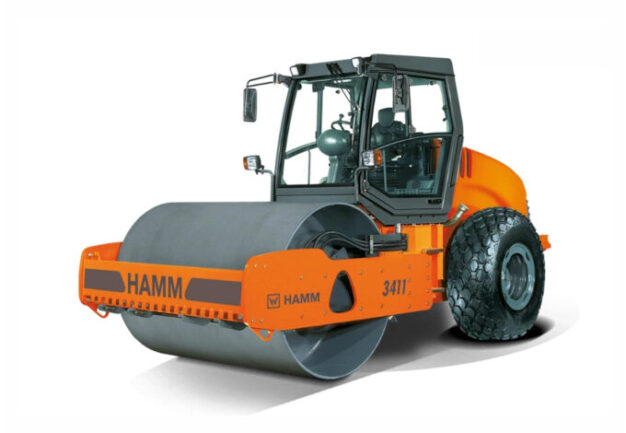
A soil compactor specified around traction and driveability, for work on embankments, graded surfaces and loose granular material.
- Drive: Continuously variable hydrostatic all-wheel drive
- Traction: Excellent engine power with traction control
- Gradients: Excellent hill climbing ability via self-locking differential
- Articulation: 3-point swivel joint for optimum driving comfort
- Steering: Hydrostatic steering, with swivelling steering and instrument console
- Operator: Spring-mounted driver seat, double-sided access, seat console that moves and swivels laterally
- Servicing: Tiltable GRP bonnet, optimum ease of maintenance, long service intervals
The self-locking differential is what distinguishes this machine on gradients. On an embankment with loose fill underfoot, a machine that loses drive to one wheel stops being a compactor and becomes an obstruction.
Not sure which machine your earthworks needs?
Send us your layer build-up, lift thicknesses, material type and daily output target — our team will specify the compactor and return a cost proposal.
How to Plan Soil Compaction on Site
- Step 1 — Identify the material and its moisture behaviour: Granular fill, crushed rock and site-won material all compact differently. Establish the target moisture band before planning anything else, because it constrains everything downstream.
- Step 2 — Set lift thickness against the machine: Decide the layer thickness the machine can genuinely compact through, then place to that. Do not set thickness from the programme and hope the machine reaches.
- Step 3 — Run a test strip: On the actual material, at the actual thickness, with the actual amplitude setting. Establish the pass count that reaches target density and record the settings used.
- Step 4 — Select amplitude for the layer: High amplitude for thick granular lifts, low amplitude for thinner layers or where the layer below must not be disturbed.
- Step 5 — Hold the pattern: Overlap between passes, consistent speed and a repeatable pattern produce consistent density. Variation in operator technique shows up directly in test results.
- Step 6 — Test and record before covering: Once the next lift is placed, a failure below it can only be corrected by removing everything above. Testing discipline is cheaper than remediation by a wide margin.
Soil Compaction in UAE Conditions
Regional conditions change how earthworks compaction is planned and operated.
- Material dries faster than it can be compacted: Moisture added at the mixing or placing stage evaporates quickly in summer conditions. The practical consequence is that the window between conditioning material and compacting it is short, and sequencing has to account for that rather than treating moisture as a fixed property.
- Dust load shortens service intervals: A soil compactor generates its own dust cloud and works in it all shift. Air filters and cooling packs load far faster than temperate-climate schedules assume, and intervals should be set against the environment rather than the manual.
- Heat affects the operator as much as the machine: Sustained summer working on an open platform reduces concentration, and pass discipline is exactly the thing that degrades when concentration does. Cab specification is a productivity decision, not a comfort one.
- Night working is common on infrastructure projects: Visibility of the drum edge and clear sightlines matter considerably more under artificial light, particularly where the machine works close to placed material or edges.
Why Choose GENAVCO for Compaction Equipment in the UAE
Buying the machine is the easy part. What determines whether the investment performs is everything that happens afterwards.
- Part of Juma Al Majid Holding Group: Decades of established presence in the UAE market and the financial stability that comes with a major regional group — this matters when you are signing multi-year service agreements.
- Authorised HAMM representation: Genuine equipment, factory-backed specification and full warranty integrity — not grey-market imports with uncertain parts availability.
- In-country spare parts inventory: A compactor stopped mid-lift holds up the whole earthworks sequence behind it. Our genuine spare parts operation holds stock locally so a service item does not stop the programme.
- Certified service and maintenance: Scheduled servicing, preventive maintenance and on-site breakdown response through our repairs and maintenance division across Dubai, Abu Dhabi, Sharjah and the wider UAE.
- Operator training: Amplitude selection, overlap and pass discipline decide density as much as the machine does. Our operator training centre covers correct operation and daily checks.
- Specification against the layer build-up: We size the machine against lift thickness, material and output target rather than quoting on operating weight alone.
- Depth across the site fleet: Compaction alongside our road construction equipment and earthmoving and light construction equipment ranges — one supplier relationship across the site.
Common Soil Compaction Problems
- Density passes at the top, fails at depth: The lift was placed thicker than the machine can compact through. The surface compacts first and masks it. Reduce lift thickness rather than adding passes.
- Material will not reach density at any pass count: Almost always moisture content outside the workable band. This is a material conditioning problem, not a machine problem.
- Surface loosening under the drum: High amplitude on a thin lift. The vibration is disturbing the layer rather than compacting it. Switch to low amplitude.
- Machine losing traction on the embankment: Loose fill and insufficient drive to one wheel. All-wheel drive with a self-locking differential is what handles this.
- Inconsistent test results across the same layer: Usually pass pattern and overlap varying between operators, or speed drifting upward through the shift.
- Rapid filter blockage: Normal for earthworks in this region. The fault is a service interval copied from a temperate-climate schedule.
Frequently Asked Questions
What is a single drum roller used for?
Single drum rollers compact soil and granular material — road formation, subgrade, subbase and base course, embankments, site platforms, trench reinstatement and haul roads. The steel drum delivers deep vibratory compaction while the driven rear tyres provide traction on loose material.
What is the difference between amplitude and frequency?
Amplitude is how far the drum moves during each vibration cycle and determines how deep the compaction energy reaches. Frequency is how often the drum strikes and affects surface finish and impact spacing. High amplitude suits thick granular lifts; low amplitude suits thinner layers.
Why will my material not reach target density?
Moisture content is the most common cause. Granular material compacts within a narrow moisture band — too dry and particles resist rearranging, too wet and water occupies the void space compaction is trying to close. No number of passes corrects material at the wrong moisture content.
How thick should each compacted lift be?
Lift thickness has to match what the machine can compact through, because compaction energy reaches a finite depth. A lift placed too thick compacts at the surface while remaining loose at the base, which can produce a passing surface test over a failing layer.
How many passes does soil compaction need?
Establish it with a test strip on the actual material, at the actual lift thickness, with the actual amplitude setting. Pass counts carried over from a previous project lead to either under-compaction or over-rolling, both of which cause problems.
Does GENAVCO supply spare parts and servicing for HAMM compactors in the UAE?
Yes. GENAVCO holds genuine parts in-country and operates a certified service network covering Dubai, Abu Dhabi, Sharjah and the wider UAE, with preventive maintenance programmes, operator training and on-site breakdown support.
Ready to Specify Your Soil Compaction Plant?
Earthworks compaction is decided by moisture, lift thickness and amplitude far more than by machine weight. Get those three right, hold the pass pattern, and the density results come back consistently across the layer instead of only at the surface.
GENAVCO supplies HAMM single drum compactors across the UAE, backed by genuine parts, certified service, operator training and specification support against your actual layer build-up.
Tell us your material and lift thicknesses. We will specify the compactor and price it properly.
ENQUIRE NOW — GET YOUR EARTHWORKS SPECIFICATION
Serving Dubai, Abu Dhabi, Sharjah and the wider UAE.