Compaction is the least visible part of road building and the one that decides how long the road lasts. Everything above it — the binder course, the wearing course, the surface finish — sits on layers that were either compacted properly or were not, and the difference does not show until the road starts failing.
In the UAE, where high ambient temperatures shorten the working window on asphalt and where subgrades are frequently granular and dry, getting the machine and the pass pattern right matters more than in temperate climates. The roller is not a finishing tool. It is the machine that determines structural life.
This guide covers the main road roller types and where each one belongs in the sequence, how layer thickness and pass count relate, what drives cost across the fleet, and the HAMM machines GENAVCO supplies.
The Compaction Sequence: Which Machine, Which Layer
Rollers are not interchangeable. Each type is built for a stage in the sequence, and using one out of place produces either poor density or damage to the layer.
- Single drum rollers — earthworks and subgrade: One large steel drum at the front, driven by rubber tyres at the rear. The tyres deliver traction across loose and uneven ground while the drum applies high amplitude vibration into deep granular layers. This is the earthworks machine, used on formation, subbase and thick granular lifts.
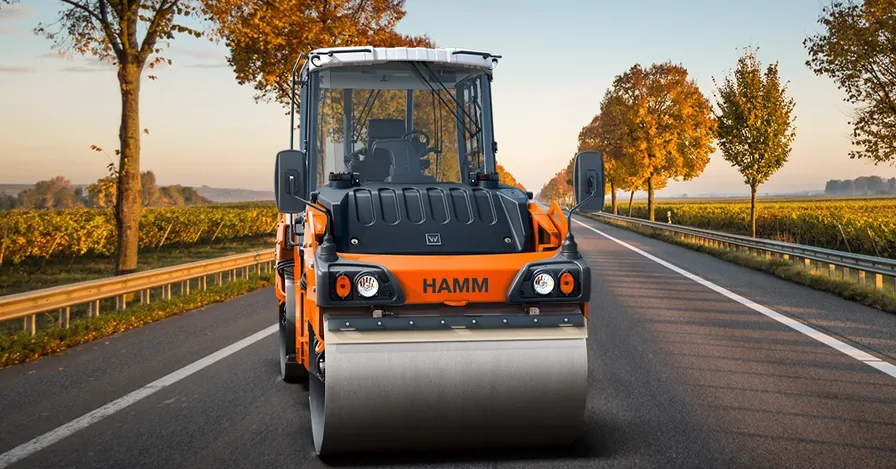
- Tandem rollers — asphalt breakdown and intermediate: Two steel drums, front and rear, both usually vibrating. Steel on both axles gives a flat, uniform contact over the full machine length, which is what asphalt needs. Also referred to as double drum rollers.
- Combination rollers — mixed duty: A steel drum on one axle and pneumatic tyres on the other, combining vibratory compaction with the kneading action of tyres. Useful where one machine has to cover both compaction and sealing on smaller works.
- Pneumatic tyred rollers — sealing and finishing: Multiple rubber tyres with overlapping tracks and adjustable ballast. The kneading action closes surface voids and seals the mat, which steel drums cannot do. This is a finishing machine, not a density machine.
The two type categories are covered in depth in our guides to single drum rollers for soil compaction and tandem and double drum rollers.
Matching the Roller to the Work
| Work stage | Roller type | Why |
|---|---|---|
| Formation and subgrade | Single drum | Deep vibration into granular layers; tyre traction on loose ground |
| Subbase and base course | Single drum | High amplitude for thick lifts and deep energy transfer |
| Asphalt breakdown pass | Tandem (double drum) | Flat steel contact front and rear over the full length |
| Asphalt intermediate pass | Tandem (double drum) | Controlled amplitude while the mat is still workable |
| Sealing and finishing | Pneumatic tyred | Kneading action closes surface voids and seals the mat |
| Confined and urban work | Compact tandem | Low machine height and small footprint in restricted access |
| Trench and footpath work | Compact tandem | Simple transport and loading between short work fronts |
| Mixed small works | Combination | Steel drum and tyres in one machine where fleet size is limited |
Layer Thickness, Passes and Temperature
Three variables decide whether a layer reaches specification, and all three are planning decisions rather than machine decisions.
- Layer thickness has to match the machine: A roller transmits compaction energy to a finite depth. Placing layers thicker than the machine can reach leaves the bottom of the lift under-compacted, and no number of additional passes fixes it — the energy simply does not reach. Thinner lifts with the right machine beat thick lifts with a heavy one.
- Pass count is determined on site, not from a table: The correct number of passes depends on material, moisture, layer thickness and machine settings. It should be established with a test strip at the start of the work and then held, rather than assumed from a previous job.
- Asphalt temperature sets the working window: Compaction has to be completed while the mat is within its workable temperature range. UAE conditions cut both ways — high ambient temperature slows cooling and extends the window, while surface heat and thin lifts can accelerate stiffening at the surface. Rolling outside the window either fails to achieve density or damages the mat.
- Over-rolling causes damage: Continuing to roll after target density is reached can crush aggregate and, on asphalt, push the mat and cause cracking. More passes is not a safe default.
Advantages of Specifying the Compaction Fleet Correctly
These benefits follow from matching machines to the sequence rather than from any particular brand.
- Structural life delivered as designed: Layers compacted to specification carry the loads the pavement was designed for, which is the entire point of the exercise.
- Fewer passes for the same density: A correctly matched machine reaches target density in fewer passes, which saves fuel, hours and programme time on every layer.
- Reduced rework and remediation: Density failures found at testing mean removing and replacing material, which costs far more than the machine hire it would have taken to avoid.
- Better surface finish: The right finishing machine seals the mat properly, which affects ride quality, water ingress and long-term durability.
- Lower fuel and hour consumption: Fewer passes across every layer of every lift compounds into a measurable reduction across a project.
- Less damage to placed material: Machines used within their intended stage do not crush aggregate or displace the mat.
- Predictable testing results: Consistent machine and pass discipline produces consistent density results, which shortens the approval cycle.
- Longer machine life: Rollers used for the work they were built for wear at the expected rate rather than being overworked outside their design envelope.
The HAMM Compaction Range Available in the UAE
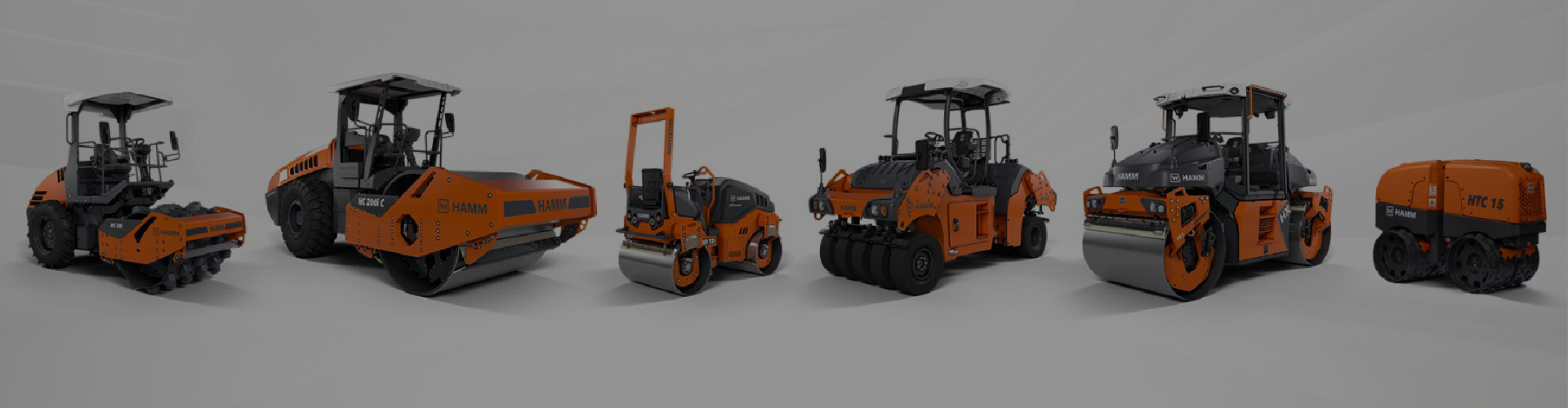
GENAVCO supplies the HAMM compaction equipment in the UAE range, covering earthworks through to asphalt finishing. The table below sets out the full lineup and where each machine sits in the sequence.
| Machine | Type | Primary stage |
|---|---|---|
| HAMM HC 119i | Single drum compactor | Earthworks, subgrade and base |
| Compactor 3411 | Single drum compactor | Earthworks and granular layers |
| HD 110 | Tandem roller | Asphalt breakdown and intermediate |
| HD 75 | Tandem roller | Asphalt breakdown and intermediate |
| HD 14 VT | Combination roller | Mixed compaction and sealing duty |
| HD 8 VV | Compact tandem roller | Confined and urban asphalt work |
| HD12 | Compact tandem roller | Restricted access and short work fronts |
| Pneumatic Tyre Rollers | Pneumatic tyred roller | Sealing and surface finishing |
Two machines are worth examining in detail here, because they sit outside the two type guides and between them cover the smallest and the final stages of the sequence.
HAMM HD12 — compact tandem roller for restricted access

The smallest machine in the range, built for work fronts where a full-size tandem cannot operate and where the roller moves frequently between short sections.
- Driver platform: Ergonomic driver platform
- Dimensions: Compact, for restricted access work
- Visibility: Excellent view of the drum edge, the machine and the site environment
- Transport: Simple transport and simple loading
- Controls: Simple, intuitive and language-neutral operation
- Best for: Footpaths, trenches, car parks, urban patching and confined sections
Language-neutral controls matter more on this class of machine than on any other, because compact rollers are typically operated by whoever is available on the day rather than by a dedicated roller operator.
View the HAMM HD12 compact tandem roller
HAMM Pneumatic Tyre Rollers — sealing and surface finishing
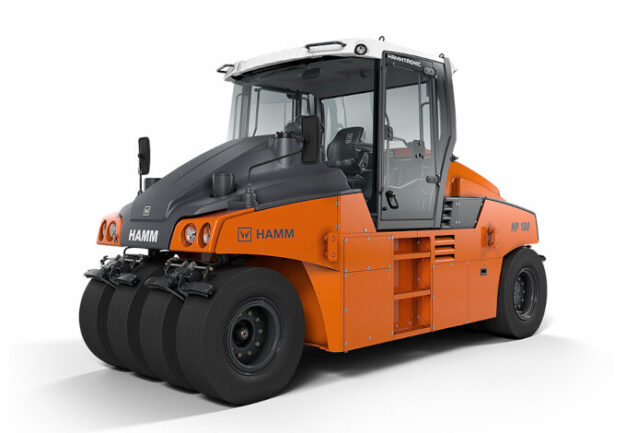
The finishing machine in the sequence. Rubber tyres knead the surface rather than pressing it flat, closing voids that steel drums leave open.
- Steering: Two-point steering, giving good stability
- Pressure distribution: 1:1 pressure distribution with uniform weight on each tyre
- Tyre overlap: 50 mm overlap on both sides
- Drive: Soft, continuously variable driving via hydrodynamic gearbox
- Transport speed: 20 km/h, for good construction site mobility
- Ballast: Range of ballast variations to adjust contact pressure
- Operator: Driver stand with access from both sides, cushioned adjustable seat, right-hand steering, 2 working mirrors, 2 additional spotlights
Ballast variation is the specification detail to plan around, because contact pressure is what the machine adjusts to suit the mix and the stage — the same roller behaves differently loaded and unloaded.
View HAMM pneumatic tyre rollers
Send us your layer build-up, lift thicknesses, daily output target and site access constraints — our team will specify the compaction fleet and return a costed proposal.
What Drives Road Roller Cost
The purchase price is one input. Over a machine’s life on a UAE project, fuel, hours and downtime dominate.
- Operating weight and drum width — the largest single factor, and the one that should follow the layer specification rather than a preference for size
- Machine type — single drum, tandem, combination and pneumatic are different machines at different price points
- Vibration system specification — amplitude and frequency options, and whether vibration is switchable front, rear or together
- Cab or ROPS configuration — open platform, canopy or fully enclosed and air-conditioned cab
- Compaction measurement systems — on-board density measurement adds cost and reduces testing and rework
- Sprinkler system capacity — water capacity determines how long an asphalt roller works between refills, which matters in UAE heat
- Transport and mobilisation — machine weight and dimensions affect what trailer and permits are needed between sites
- Service package — full maintenance contract versus parts-only support
The figure that matters is cost per compacted square metre, not the invoice. A machine that reaches density in fewer passes, holds a full water tank through a longer stretch and avoids a single density failure will outperform a cheaper unit across a project. Ask any supplier to model it that way.
Compaction in UAE Conditions
Regional conditions change how a compaction plant is specified and operated.
- Heat management on asphalt work: High ambient temperature slows mat cooling, which extends the working window but also means the roller is working in sustained heat. Water capacity for the sprinkler system and operator cab conditioning both become specification items rather than preferences.
- Dry granular subgrades: Compacting dry granular material is a moisture-control problem as much as a machine problem. Material at the wrong moisture content will not reach density regardless of how many passes are applied.
- Dust and filtration: Air filters and cooling packs load faster than temperate-climate schedules assume. Service intervals should be set against the environment, particularly on earthworks where the machine generates its own dust cloud.
- Night working: Road and infrastructure projects frequently work at night to avoid daytime disruption and heat. Lighting, visibility of the drum edge and clear operator sightlines matter considerably more under those conditions.
Why Choose GENAVCO for Compaction Equipment in the UAE
Buying the machine is the easy part. What determines whether the investment performs is everything that happens afterwards.
- Part of Juma Al Majid Holding Group: Decades of established presence in the UAE market and the financial stability that comes with a major regional group — this matters when you are signing multi-year service agreements.
- Authorised HAMM representation: Genuine equipment, factory-backed specification and full warranty integrity — not grey-market imports with uncertain parts availability.
- In-country spare parts inventory: A roller stopped mid-lift holds up the paving train behind it. Our genuine spare parts operation holds stock locally so a service item does not stop the sequence.
- Certified service and maintenance: Scheduled servicing, preventive maintenance and on-site breakdown response through our repairs and maintenance division across Dubai, Abu Dhabi, Sharjah and the wider UAE.
- Operator training: Pass discipline and machine settings decide density as much as the machine does. Our operator training centre covers correct operation and daily checks.
- Fleet-level specification: We specify the compaction sequence across the project rather than quoting a single machine, so the fleet matches the layer build-up and the daily output target.
- Depth across road construction: Compaction alongside the wider road construction equipment range, so the paving train is supported from one supplier relationship.
Common Compaction Mistakes
- Layers placed thicker than the machine can reach: The bottom of the lift stays under-compacted and additional passes do not fix it. The layer thickness has to follow the machine, not the programme.
- Pass count carried over from a previous job: Material, moisture and thickness differ between projects. A test strip at the start establishes the correct count for the work in hand.
- Rolling asphalt outside the temperature window: Too hot and the mat displaces; too cool and density cannot be achieved. The window governs the sequence, not the shift pattern.
- Using a pneumatic roller for density: It is a sealing and finishing machine. Expecting it to deliver structural density produces neither.
- Over-rolling after target density: Additional passes can crush aggregate and crack the mat. More is not safer.
- Ignoring moisture content on granular layers: Material at the wrong moisture will not reach density no matter which machine is used or how many passes are applied.
Frequently Asked Questions
What type of road roller do I need?
It depends on the stage. Single drum rollers handle earthworks, subgrade and granular base layers. Tandem or double drum rollers handle asphalt breakdown and intermediate passes. Pneumatic tyred rollers seal and finish the surface. Most projects need more than one type across the sequence.
What is the difference between a single drum and a tandem roller?
A single drum roller has one steel drum at the front and driven rubber tyres at the rear, giving traction on loose ground and deep vibration into granular layers. A tandem roller has steel drums on both axles, giving flat uniform contact over the full machine length, which is what asphalt requires.
How many passes does compaction need?
There is no universal figure. The correct number depends on material, moisture content, layer thickness and machine settings, and it should be established with a test strip at the start of the work rather than assumed. Over-rolling after target density can damage the layer.
How thick can a compacted layer be?
Layer thickness has to match what the machine can reach. A roller transmits energy to a finite depth, so a lift placed thicker than the machine can compact will remain under-compacted at the bottom regardless of how many passes are applied.
Does UAE heat affect asphalt compaction?
Yes. Compaction must be completed while the mat is within its workable temperature range. High ambient temperature slows cooling and extends that window, but surface heat and thin lifts can stiffen the surface faster, so the sequence has to be planned around the mat rather than the shift.
Does GENAVCO supply spare parts and servicing for HAMM rollers in the UAE?
Yes. GENAVCO holds genuine parts in-country and operates a certified service network covering Dubai, Abu Dhabi, Sharjah and the wider UAE, with preventive maintenance programmes, operator training and on-site breakdown support.
Ready to Specify Your Compaction Fleet?
Compaction is where pavement life is won or lost, and it is decided by matching machines to layers rather than by machine size. Get the sequence right and the density results come back consistently, the rework disappears and the road performs as designed.
GENAVCO supplies the full HAMM range across the UAE — single drum compactors, tandem rollers, combination rollers and pneumatic tyred rollers — backed by genuine parts, certified service and operator training.
Tell us your layer build-up and output target. We will specify the fleet and price it properly.
ENQUIRE NOW — GET YOUR COMPACTION SPECIFICATION
Serving Dubai, Abu Dhabi, Sharjah and the wider UAE.