Earthmoving is the first trade on site and frequently the last. Before anything is built, ground has to be cleared, cut, filled, levelled and compacted — and the fleet chosen to do that work determines the programme for everything that follows.
The mistake most operations make is buying machines individually. A site fleet is a system: the excavator loads what the trucks carry, the dozer pushes what the excavator cannot reach, the grader finishes what the dozer roughs out. Specify them in isolation and you end up with capacity sitting idle in one place and a bottleneck in another.
This guide covers what each class of earth moving equipment is built to do, how to match machines to the work, what drives cost across a fleet, and the Shantui range GENAVCO supplies in the UAE.
What Each Machine Class Is Actually For
Every earthmoving machine is a compromise between digging, carrying, pushing and finishing. Understanding which of those a machine is optimised for prevents most specification errors.
- Excavators dig: A boom, arm and bucket on a rotating superstructure, digging below the machine and loading to the side without repositioning. The most versatile machine on site and the natural centre of most fleets.
- Wheel loaders carry: A bucket on a front linkage with rubber tyres underneath. Built to scoop loose material and move it over distance at speed, which is a different job from digging into undisturbed ground.
- Bulldozers push: A blade on a tracked chassis with the traction to move large volumes of material short distances, and the ground pressure to work on soft or uneven terrain where wheels would sink.
- Motor graders finish: A long wheelbase and an adjustable blade between the axles, producing the accurate, flat surface that a dozer cannot. This is a precision machine, not a bulk earthmoving one.
Matching Machines to Site Tasks
| Task | Primary machine | Why |
|---|---|---|
| Bulk excavation | Excavator | Digs below grade and loads trucks without repositioning |
| Truck loading from stockpile | Wheel loader | Faster cycle on loose material than an excavator |
| Site clearance and stripping | Bulldozer | Blade width and traction move volume over short distance |
| Cut and fill over distance | Bulldozer | Pushes material where haulage would not be economical |
| Subgrade levelling | Motor grader | Blade between axles produces accurate finished level |
| Haul road maintenance | Motor grader | Restores surface and profile quickly across long runs |
| Material rehandling in yards | Wheel loader | Travel speed and manoeuvrability over repeated cycles |
Two of these decisions have enough depth to warrant their own guides. Loader selection and the load-and-carry question are covered in our guide to wheel loaders for load and carry, and the undercarriage question — whether an excavator should run on tracks or tyres — in our guide to choosing an excavator undercarriage.
Sizing the Fleet, Not the Machine
Fleet productivity is governed by how machines feed each other, and a fleet is limited by its slowest link in exactly the way a crushing circuit is.
- Match the loading tool to the haulage: An excavator should fill a truck in a sensible number of passes — too few and the bucket is oversized for the truck, too many and the truck waits. This ratio determines both machine sizes.
- Count the trucks the loading tool can serve: Cycle time and haul distance determine how many trucks one machine keeps busy. Too few and the loader stands idle; too many and trucks queue, which is the more expensive error.
- Decide push distance before choosing dozer over haulage: Bulldozers move material economically over short distances. Beyond that, load-and-haul becomes cheaper. Knowing where that crossover falls for your site prevents buying the wrong solution entirely.
- Plan for the finishing trade: Bulk earthmoving that leaves an inaccurate surface creates grader work, and grader time is more expensive per cubic metre than dozer time. Getting the bulk work closer to level reduces the finishing bill.
Advantages of Specifying a Fleet Correctly
These benefits come from fleet composition rather than from any individual machine.
- Machines stay loaded: A balanced fleet keeps every unit working rather than paying for capacity that stands waiting on another machine.
- Lower cost per cubic metre: Fuel, hours and operator time spread across more moved material when the fleet is matched.
- Shorter programme: Earthmoving is on the critical path for most projects, and a fleet that does not bottleneck delivers the platform sooner.
- Less rework on levels: Bulk work brought closer to finished level reduces expensive grader and hand-finishing time.
- Predictable fuel budgeting: Machines working within their design envelope consume fuel at forecastable rates rather than being pushed beyond efficient output.
- Longer machine life: Equipment used for the work it was built for wears at expected rates, rather than a loader being used to dig or a dozer to finish.
- Simpler parts holding: A fleet from one manufacturer shares filters, fluids and service intervals, which reduces stock and technician training.
- Better resale position: Machines with documented, appropriate use hold value considerably better than those worked outside their intended application.
The Shantui Range Available in the UAE
GENAVCO supplies Shantui construction machinery in the UAE. Shantui was founded in 1980, is one of the top 50 construction equipment manufacturers worldwide, and holds more than 140 individual model numbers in its catalogue. The table below sets out the range GENAVCO carries.
| Machine | Class | Published range |
|---|---|---|
| Bulldozers | Tracked dozer | 80 hp to 900 hp across mechanical, hydraulic, hydrostatic and electric types |
| Wheel Loaders | Wheeled loader | 1 m³ / 60 kW up to 3.5 m³ / 175 kW, with larger models available |
| Excavators | Excavator | 5.8 t / 0.2 m³ / 35.5 kW upward, built through the Komatsu joint venture |
| Motor Grader Series | Motor grader | 15.4 t / 118 kW / 3,660 mm blade to 16.2 t / 160 kW / 4,270 mm blade |
| Forklift Series | Material handling | Added to the Shantui line in 2007 |
Two machines are worth examining in detail here — the primary bulk earthmoving machine and the finishing machine, which between them define much of what an earthmoving fleet can do.
1. Shantui Bulldozers — 80 hp to 900 hp
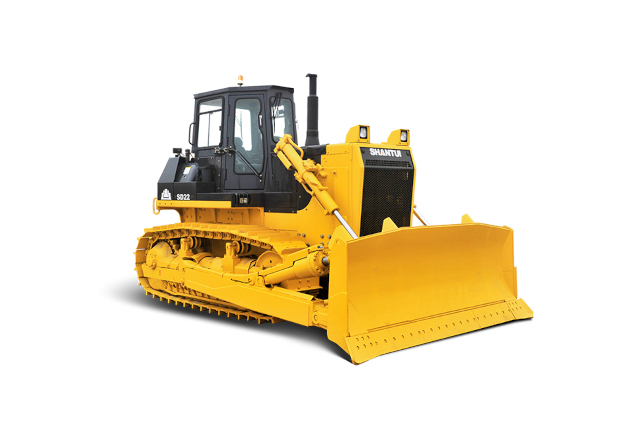
Shantui is the world’s largest bulldozer producer by production and sales, and the dozer line remains the strongest part of the range.
- Power range: 80 hp to 900 hp
- Types available: Mechanical, hydraulic, hydrostatic and electric
- Applications: Mines, forests, deserts, wetlands and coal fields
- SD16: 160 horsepower
- SD22: 220 horsepower
- SD90-C5 D11: 900 horsepower crawler bulldozer, the largest in the Shantui range
- Construction: Advanced structure providing reliable performance with convenient and flexible operation
Desert working is named explicitly in the application list, which matters regionally. Soft sand demands low ground pressure and sustained traction, and it defeats wheeled machines that would perform adequately on firmer ground.
2. Shantui Motor Grader Series — precision finishing

The finishing machine in the earthmoving sequence, producing the accurate, consistent surface that bulk earthmoving cannot deliver on its own.
- Operating weight: 15.4 tonnes to 16.2 tonnes
- Engine power: 118 kW to 160 kW
- Blade width: 3,660 mm to 4,270 mm
- Model series: SG16-3, SG18-3 and SG21-3 — similar characteristics with graduated engine size and power ratings, the "3" denoting the third generation
- SG19-B6: 151 kW, 16 tonnes, 3,965 mm blade
- SG21-3 features: External gears for high torque transference, linked swing frame for easy operation, capable of handling high workloads under harsh conditions
Motor graders sit across the boundary between earthmoving and road construction, and are equally at home maintaining haul roads on an earthworks site or preparing subgrade ahead of the paving train. The road side of that work is covered in our road construction equipment range.
View the Shantui motor grader series
Planning a site fleet rather than a single machine?
Send us your volumes, haul distances, ground conditions and programme — our team will size the fleet so the machines feed each other rather than bottleneck.
What Drives Earthmoving Fleet Cost
Purchase price is the visible number. Across a working life, fuel, operators, tyres or undercarriage, and downtime dominate.
- Machine size and power - the largest single factor, and the one most often specified above what the work requires
- Undercarriage or tyres - tracked machines consume undercarriage; wheeled machines consume tyres, and both are substantial recurring costs
- Attachment specification - bucket types, blade configurations and quick couplers
- Cab specification - air conditioning is not optional for sustained UAE summer operation
- Fuel consumption at working load - the figure that matters is consumption while producing, not idle or rated
- Operator availability - machines requiring specialist operators carry a hidden cost in a tight labour market
- Transport and mobilisation - weight and dimensions determine trailer class and permits between sites
- Service package - full maintenance contract versus parts-only support
The figure that matters is cost per cubic metre moved, not the invoice. A correctly matched fleet moves more material per litre of fuel and per operator hour than an assortment of individually good machines. Ask any supplier to model it at fleet level rather than machine by machine.
Earthmoving in UAE Conditions
- Sand behaves differently from soil: Loose desert sand offers poor traction and low bearing capacity. Tracked machines with low ground pressure work where wheeled equipment struggles, and this shapes fleet composition more here than in most markets.
- Heat is an operator issue before it is a machine issue: Sustained summer temperatures degrade concentration and productivity long before they affect the equipment. Cab air conditioning is a productivity specification, not a comfort one.
- Dust load shortens service intervals: Air filters and cooling packs load far faster than temperate-climate schedules assume. Intervals should follow the environment, particularly on machines working in their own dust cloud all shift.
- Night working is common on infrastructure: Lighting, visibility and machine sightlines matter more under artificial light, and fatigue management becomes part of the productivity calculation.
- Abrasive ground consumes ground engaging tools: Teeth, cutting edges and blade wear parts are consumed faster in abrasive material and should be budgeted realistically rather than from manufacturer baselines.
Why Choose GENAVCO for Earth Moving Equipment in the UAE
Buying the machine is the easy part. What determines whether the investment performs is everything that happens afterwards.
- Part of Juma Al Majid Holding Group: Decades of established presence in the UAE market and the financial stability that comes with a major regional group — this matters when you are signing multi-year service agreements.
- Authorised Shantui representation: Genuine equipment, factory-backed specification and full warranty integrity — not grey-market imports with uncertain parts availability.
- In-country spare parts inventory: A stopped machine holds up every trade behind it on an earthworks programme. Our genuine spare parts operation holds stock locally so filters and wear parts do not become programme delays.
- Certified service and maintenance: Scheduled servicing, preventive maintenance and on-site breakdown response through our repairs and maintenance division across Dubai, Abu Dhabi, Sharjah and the wider UAE.
- Operator training: Technique determines fuel consumption and cycle times as much as machine specification does. Our operator training centre covers correct operation and daily checks.
- Fleet-level specification: We size the fleet against volumes, haul distances and programme rather than quoting machines individually, because productivity is set by how the machines work together.
- Depth across site equipment: Earthmoving within our wider earthmoving and light construction equipment range, so the whole site fleet is supported from one relationship.
Common Fleet Specification Mistakes
- Buying machines individually: A fleet is limited by its slowest link. Capacity added anywhere else produces no additional output and costs money every hour it stands.
- Mismatching loading tool to haulage: A bucket that fills a truck in an awkward number of passes wastes either loader capacity or truck time on every single cycle.
- Using a loader to dig: Wheel loaders scoop loose material efficiently and dig undisturbed ground badly. Using one to excavate wears the machine and produces poor output.
- Pushing material too far with a dozer: Beyond a certain distance, load-and-haul is cheaper. Dozing past that point burns fuel and hours for no economic gain.
- Skipping the finishing machine: Bulk earthmoving that leaves an inaccurate surface generates expensive grader and hand-finishing work later.
- Specifying oversized machines: A machine working well below its capacity is inefficient in fuel and capital alike. Bigger is not a safe default.
Frequently Asked Questions
What counts as earth moving equipment?
The main classes are excavators for digging, wheel loaders for scooping and carrying, bulldozers for pushing material and clearing ground, and motor graders for producing accurate finished levels.
What is the difference between a wheel loader and an excavator?
A wheel loader has a bucket on a front linkage and rubber tyres, and is built to scoop loose material and carry it over distance at speed. An excavator has a boom, arm and bucket on a rotating superstructure, digging below its own level and loading to the side without repositioning. Loaders carry; excavators dig.
When should I use a bulldozer instead of an excavator and trucks?
Bulldozers move material economically over short distances, where the cost of loading and hauling would not be justified. Beyond a certain push distance, load-and-haul becomes cheaper. Establishing where that crossover falls for your site determines which approach is correct.
How do I size an earthmoving fleet?
Work from volumes, haul distances and the programme rather than machine by machine. Match the loading tool to the truck size so filling takes a sensible number of passes, then calculate how many trucks that machine can keep working. A fleet produces at the rate of its slowest link.
Do tracked or wheeled machines suit UAE ground conditions better?
It depends on the surface. Loose sand offers poor traction and low bearing capacity, which favours tracked machines with low ground pressure. On firm, prepared or sealed surfaces, wheeled machines offer better travel speed and lower running costs.
Does GENAVCO supply spare parts and servicing for Shantui equipment in the UAE?
Yes. GENAVCO holds genuine parts in-country and operates a certified service network covering Dubai, Abu Dhabi, Sharjah and the wider UAE, with preventive maintenance programmes, operator training and on-site breakdown support.
Ready to Specify Your Site Fleet?
Earthmoving productivity is decided by how the machines work together, not by the rating of any one of them. Match the loading tool to the haulage, put the right machine on each task, and the fleet delivers the platform on programme rather than becoming the reason it slips.
GENAVCO supplies the Shantui range across the UAE — bulldozers, wheel loaders, excavators and motor graders — backed by genuine parts, certified service and operator training.
Tell us your volumes, distances and programme. We will size the fleet and price it properly.
ENQUIRE NOW — GET YOUR FLEET SPECIFICATION
Serving Dubai, Abu Dhabi, Sharjah and the wider UAE.