Compressed air is often called the fourth utility, and on most industrial sites that is accurate — it is as fundamental as power and water, and it is usually the one nobody has audited. It is also the most expensive utility per unit of useful work delivered, because a large share of the energy that goes into a compressor leaves as heat rather than as air.
That makes the buying decision worth getting right. In the UAE, where facilities run long hours in high ambient temperatures and heavy dust loads, a compressor specified from a catalogue rather than from actual demand will cost more to run for its entire life.
This guide covers the main air compressor types and where each one fits, how to work out what size you need, what actually drives lifetime cost, and which Denair machines suit which application.
The Main Types of Air Compressor
Compression technology divides into a few families. Choosing the right one narrows the decision far more effectively than comparing individual models across categories.
Rotary screw. Two interlocking helical rotors compress air continuously. Built for 100% duty cycle, quiet, and efficient under sustained load. This is the default for continuous industrial demand and covers the widest capacity range.
Reciprocating (piston). Compresses air in strokes using pistons. Lower purchase price and effective for intermittent, low-demand use, but limited duty cycle and higher energy cost per cubic metre under continuous running.
Oil free. Any design where no lubricant contacts the air stream — scroll, dry screw or water-injected. Specified where lubricant carry-over is unacceptable rather than where it is merely undesirable.
Centrifugal. Dynamic compression using a high-speed impeller. Suits very large, steady demand at plant scale where flow requirements are far beyond what positive-displacement machines cover economically.
Portable. Not a separate technology so much as a packaging decision — usually a screw element in a diesel or electric mobile unit, for locations without fixed infrastructure.
Which Type Suits Which Application
| Application | Recommended type | Why |
|---|---|---|
| Continuous manufacturing | Rotary screw (fixed or VSD) | 100% duty cycle, lowest energy cost under sustained load |
| Intermittent workshop use | Reciprocating | Lower upfront cost; duty cycle limits are not a constraint |
| Food, pharma, electronics | Oil free | No lubricant carry-over into the air stream |
| Construction and drilling | Diesel portable | Self-contained; no mains supply required |
| Indoor site or plant mobility | Electric portable | Zero point-of-use emissions, lower running cost |
| Very large steady plant demand | Centrifugal | Efficient at high flow where screw machines multiply |
| Small site, no compressor room | Full feature screw | Dryer, receiver and filtration integrated in one unit |
For a deeper look at the two most commonly specified categories, see our guides to how rotary screw compressors work and choosing a portable air compressor.
Advantages of Getting the Specification Right
These are the benefits that follow from correct selection rather than from any particular brand.
- Lower energy cost for the life of the machine: Energy typically dominates the lifetime cost of a compressor. Correct sizing and pressure specification affect that figure every hour the machine runs.
- Fewer unplanned stoppages: A machine matched to its duty and its environment does not shut down on temperature or run its components to premature failure.
- Stable pressure at the point of use: Correctly sized storage and pipework mean tools and processes receive the pressure they were designed for, not what is left after system losses.
- Air quality matched to the process: Specifying treatment against the actual requirement avoids both product contamination and the cost of over-treating air that never needed it.
- Longer service intervals: Machines running within their design envelope in a properly ventilated space need less frequent intervention.
- Room to grow without replacement: Sensible headroom and a scalable technology mean expansion adds capacity rather than forcing a system redesign.
- Lower heat load on the building: An efficient, correctly sized machine rejects less waste heat into the facility, which in UAE conditions reduces cooling load as well.
- Predictable maintenance budgeting: Scheduled preventive maintenance on a correctly specified machine is forecastable; reactive repair on an overworked one is not.
Denair Air Compressors Available in the UAE
GENAVCO supplies the full range of Denair compressed air solutions in the UAE, spanning compact workshop machines through to large industrial installations and site-mobile units. Here are four that cover the majority of requirements.
1. Denair Electric Screw Air Compressors — the industrial default

The core fixed-installation range and the machine most UAE manufacturing and process plants will specify, available in fixed and variable speed.
- Installed motor power: 5.5 kW to 400 kW (7.5 hp to 550 hp)
- Free air delivery: 0.36 to 74.49 m³/min (12 cfm to 2,630 cfm)
- Configuration: Fixed speed or variable speed
- Components: Schneider electronics (France), Danfoss pressure sensors (Denmark), SKF bearings (Sweden)
- Certification: CE and ISO 9001
- Best for: Continuous manufacturing, process plants, general industrial air
View Denair electric screw air compressors
2. Denair Oil Free Air Compressors — where purity is the requirement
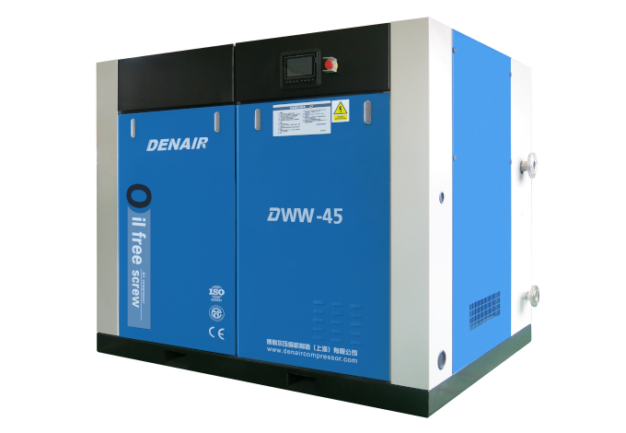
For food, beverage, pharmaceutical, electronics and any process with direct product contact, in scroll, dry screw and water-injected configurations.
- Installed motor power: 2.2 kW to 500 kW (3 hp to 670 hp)
- Free air delivery: 0.21 to 86.01 m³/min (7.5 cfm to 3,038 cfm)
- Types: Scroll (up to 37 kW), dry screw oil free, water injected oil free
- Screw element: GHH Rand, made in Germany
- Best for: Food and beverage, pharmaceutical, electronics, laboratory and product-contact processes
View Denair oil free air compressors
3. Denair Full Feature Air Compressors — a complete system in one unit
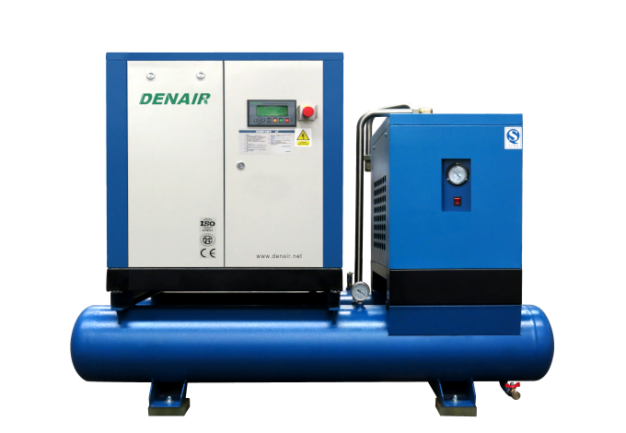
Factory-fitted with the entire downstream air treatment package, so there is nothing separate to specify, source or install.
- Installed motor power: 5.5 kW to 37 kW (7.5 hp to 50 hp)
- Free air delivery: 0.59 to 6.32 m³/min (21 cfm to 223 cfm)
- Integrated: Refrigerated dryer, receiver tank, water separator, 1 micron pre-filter, 0.01 micron post-filter, five automatic drains
- Installation benefit: Reduces installation space by up to 50%, with piping connections pre-made
- Best for: Sites without an existing compressed air room or engineering resource
View Denair full feature air compressors
4. Denair Diesel Portable Air Compressors — air without infrastructure

Self-contained site air for locations with no mains supply, covering general tool work through to high-pressure drilling duty.
- Capacity: 120 cfm to 1,638 cfm (3.4 to 46.38 m³/min)
- Pressure range: 102 to 508 psi(g) (7 to 35 bar)
- Air filtration: Two-stage dust removal, efficiency up to 99.9%
- Best for: Construction, mining, borehole drilling, quarrying, shipyards, sandblasting
View Denair diesel portable air compressors
Not sure which type or size fits your operation?
Send us your air demand, working pressure, air quality requirement and shift pattern — our team will specify the system and return a costed proposal.
What Drives Air Compressor Cost
The purchase price is the smallest part of what a compressor costs. Over a typical service life, energy consumption dominates — which is why specification decisions matter far more than negotiating the invoice.
The variables that move the purchase figure:
- Capacity and motor power — the largest single factor, and the one most often over-specified
- Fixed speed or variable speed — VSD carries a premium that pays back where demand fluctuates
- Oil free versus lubricated — a substantial step in cost, justified only where the process genuinely requires it
- Working pressure — higher-pressure machines cost more to buy and considerably more to run
- Air treatment specification — dryer type and filtration stages, driven by the required air quality class
- Integration level — a full-feature package versus separately specified components
- Service package — full maintenance contract versus parts-only support
The number that matters is total cost of ownership, not the quotation. Two machines with similar purchase prices can differ substantially in lifetime cost through efficiency, pressure specification and how well the size matches actual demand. Ask any supplier for a TCO comparison rather than a price list.
How to Specify an Air Compressor
Six steps, in order. Skipping the first two is where most poor specifications originate.
Step 1 — Measure actual demand, do not estimate it. Total the air consumption of every tool and process, apply a realistic utilisation factor, and log the profile across a full week rather than a single shift. Demand patterns, not peak figures, determine whether fixed or variable speed is correct.
Step 2 — Establish the true required pressure. Specify for the highest-pressure item on the system, not a round number. Every additional bar adds roughly 6–7% to energy consumption, permanently.
Step 3 — Define the air quality requirement. What the process tolerates determines dryer type and filtration stages. Over-treating air is a recurring cost; under-treating it damages equipment and product.
Step 4 — Account for UAE ambient conditions. Output ratings assume standard inlet conditions. High ambient temperature and dust load both reduce real-world performance, so specification and compressor room ventilation must reflect actual conditions.
Step 5 — Size the whole system, not just the machine. Receiver volume, pipework bore and treatment capacity all have to match the flow. A correctly sized compressor on undersized pipework will still starve the process.
Step 6 — Agree the service arrangement up front. Response times, preventive schedules and parts availability are worth settling before purchase, not after the first stoppage.
Air Treatment: What Happens After Compression
A compressor delivers hot, wet, dirty air. What reaches the point of use depends on what sits between — and this is the part most specifications underweight.
Drying comes first. Compression concentrates water vapour, and UAE humidity makes the volume of condensate significant. Compressed air refrigeration dryers cover general industrial requirements, while desiccant dryers achieve the much lower dew points that instrument air and sensitive processes specify.
Filtration follows. Compressed air filters staged from coarse to fine remove particulates and aerosols. The specification should follow the air quality class the process actually requires.
Storage stabilises everything. Air receiver tanks buffer short-duration peaks so the compressor is not cycling constantly, which reduces both energy consumption and mechanical wear.
Why Choose GENAVCO as Your Compressed Air Partner in the UAE
Buying the machine is the easy part. What determines whether the investment performs is everything that happens afterwards.
- Part of Juma Al Majid Holding Group: Decades of established presence in the UAE market and the financial stability that comes with a major regional group — this matters when you are signing multi-year service agreements.
- Authorised Denair representation: Genuine equipment, factory-backed specification and full warranty integrity — not grey-market imports with uncertain parts availability.
- In-country spare parts inventory: A stopped compressor stops the plant. Our genuine spare parts operation holds stock locally so a failed component does not become a production shutdown.
- Certified service and maintenance: Scheduled servicing, preventive maintenance and breakdown response through our repairs and maintenance division across Dubai, Abu Dhabi, Sharjah and the wider UAE.
- Complete system supply: Compressor, dryer, filtration and receiver specified together as one system, rather than a machine sold in isolation and left for someone else to integrate.
- Application-led specification: We survey the demand profile rather than quoting against a headline kW figure. Correct sizing is where the savings actually come from.
- Full range across every type: Screw, oil free, portable, skid mounted and centrifugal from a single supplier, so the recommendation follows the application rather than the inventory.
Common Compressed Air Mistakes
- Specifying pressure higher than needed: The most expensive habit in compressed air. Each unnecessary bar adds roughly 6–7% to energy consumption for the life of the system.
- Ignoring leaks: Leakage on an established system is frequently the single largest waste, and it grows quietly. A leak survey usually costs less than the air it saves in a few months.
- Sizing for a theoretical maximum: Adding every tool at full consumption produces a machine that spends its life running unloaded, which wastes energy continuously.
- Treating air treatment as optional: Skipping the dryer to save capital cost transfers the problem to valves, cylinders and product surfaces downstream.
- Under-ventilating the compressor room: In UAE conditions this is the most common cause of nuisance shutdowns, and it is almost always an installation issue rather than a machine fault.
- Undersizing pipework: A correctly specified compressor on small-bore pipework will still deliver poor pressure at the point of use.
Frequently Asked Questions
What type of air compressor do I need?
It depends on duty and air quality. Rotary screw suits continuous industrial demand; reciprocating suits intermittent low-demand use; oil free is required where lubricant carry-over is unacceptable; portable units serve sites without fixed infrastructure; and centrifugal covers very large steady plant demand.
How do I know what size air compressor to buy?
Total the air consumption of everything on the system, apply a realistic utilisation factor, specify at the highest pressure genuinely required, and add allowance for leakage and planned growth. Ratings assume standard inlet conditions, so UAE ambient temperature must be accounted for.
How much does an air compressor cost in the UAE?
There is no single figure, as capacity, fixed or variable speed, oil free versus lubricated, working pressure and air treatment all move the price. More importantly, purchase price is a small share of lifetime cost — energy consumption dominates, so total cost of ownership is the figure to compare.
What is the difference between oil free and lubricated air compressors?
A lubricated compressor uses oil in the compression chamber, which requires filtration to remove carry-over from the air stream. An oil free compressor has no lubricant contact with the air at all, which is necessary for food, pharmaceutical, electronics and direct product-contact applications.
Do I need an air dryer with my compressor?
In almost all cases, yes. Compression concentrates water vapour, and UAE humidity produces substantial condensate. Untreated moisture reaches pneumatic components and product surfaces. The dryer type depends on the dew point your process requires.
Does GENAVCO supply spare parts and servicing for Denair compressors in the UAE?
Yes. GENAVCO holds genuine Denair parts in-country and operates a certified service network covering Dubai, Abu Dhabi, Sharjah and the wider UAE, with preventive maintenance programmes and breakdown support.
Ready to Specify Your Compressed Air System?
The right compressor is the one matched to your demand profile, your required pressure, your air quality class and the conditions it will actually run in. Get those four right and the machine costs less to run every hour of its working life.
GENAVCO supplies the complete Denair range across the UAE — screw, oil free, portable, skid mounted and centrifugal, together with dryers, filtration and receivers — backed by genuine parts, certified service and local application expertise.
Tell us your air demand and your process. We will specify the system and price it properly.
ENQUIRE NOW — GET YOUR AIR COMPRESSOR QUOTE
Serving Dubai, Abu Dhabi, Sharjah and the wider UAE.