Compressed air is the fourth utility on most industrial sites — as fundamental as power and water, and usually the least well specified. In the UAE, where facilities run long hours in high ambient temperatures, the compressor choice determines both energy cost and how often production stops.
For continuous industrial duty, the rotary screw compressor has become the default. It is not the cheapest technology to buy, but it is the one built to run all day, every day, without the duty cycle limits that constrain piston machines.
This guide covers how a screw compressor actually works, where it outperforms other compression technologies, how to size one correctly for your air demand, and which Denair models suit which application.
How a Rotary Screw Compressor Works
A rotary screw compressor uses two interlocking helical rotors — a male and a female profile — turning inside a sealed housing. Air is drawn into the space between the rotor lobes at the inlet end. As the rotors turn, that space progressively reduces in volume along the length of the rotors, compressing the air continuously until it is discharged at the outlet.
The important word is continuously. A piston compressor compresses air in discrete strokes, producing pulsating output and heat that limits how long it can run. A screw element delivers a smooth, uninterrupted flow and is designed for 100% duty cycle — it can run continuously without a cool-down period.
Rotor profile design is where manufacturers differentiate. Denair screw elements use an advanced SAP profile, which governs how tightly the rotors mesh and therefore how much air slips back past the lobes instead of being delivered. Less internal leakage means more free air delivered per kilowatt consumed — which is the number that shows up on the electricity bill.
Screw Compressor vs Other Compression Technologies
| Factor | Rotary Screw | Reciprocating (Piston) |
|---|---|---|
| Duty cycle | 100% — continuous running | Intermittent; needs cool-down periods |
| Air delivery | Smooth, pulse-free | Pulsating; needs larger receiver |
| Noise | Low — suits in-plant installation | High |
| Typical capacity | Small workshop through to large plant | Lower flow ranges |
| Maintenance interval | Long, scheduled | Shorter, more frequent |
| Upfront cost | Higher | Lower |
| Energy cost per m³ | Lower under continuous load | Higher under continuous load |
| Footprint | Compact for output | Larger for equivalent output |
Fixed Speed or Variable Speed?
This is the single decision with the largest effect on running cost, and it depends entirely on how stable your air demand is.
Fixed speed runs the motor at constant rpm and manages output by loading and unloading. When demand is steady and close to the machine’s rated output, this is efficient and mechanically simple. When demand fluctuates, the compressor spends time unloaded — still consuming power, producing no air.
Variable speed (VSD) adjusts motor speed to match actual demand. Because power consumption falls roughly with the cube of speed, modest reductions in output produce disproportionate energy savings. Where demand swings across shifts or seasons, VSD typically pays back the price premium well inside the machine’s life.
The practical test is to log air consumption over a full week rather than a single shift. A flat profile points toward fixed speed; a profile that varies substantially between peak and trough points toward variable speed. Denair electric screw compressors are available in both configurations across the range, and the demand data determines which one fits.
Advantages of a Screw Compressor
These are the operational benefits that justify the higher purchase price.
- Continuous duty capability: Designed to run 100% of the time without thermal cut-outs or mandated rest periods, which is what continuous-process plants require.
- Lower energy cost per cubic metre: Energy is the dominant lifetime cost of any compressor. An efficient screw element delivers more air per kilowatt, and that gap compounds across years of running.
- Smooth, pulse-free air delivery: Steady pressure protects downstream instrumentation, pneumatic controls and finishing processes that pulsation would disrupt.
- Low noise and vibration: Quiet enough to install within the plant rather than in a separate compressor house, which reduces pipework runs and pressure drop.
- Compact footprint: High output relative to floor area, and full-feature models integrate dryer, receiver and filtration into a single skid.
- Long service intervals: Fewer wearing parts in contact than a piston machine, with scheduled rather than reactive maintenance.
- Scalable across the range: The same technology covers small workshop demand through to large plant loads, so a growing site can expand without changing compression technology.
- Oil-free options available: Where product contact risk rules out any lubricant carry-over, dry screw and water-injected designs deliver Class 0 air without changing the underlying architecture.
Denair Screw Compressors Available in the UAE
GENAVCO supplies the full range of Denair compressed air solutions in the UAE, covering everything from compact workshop units to large industrial installations. Here are four models that cover the majority of applications.
1. Denair Electric Screw Type Air Compressors — the industrial workhorse

The core fixed-installation range, available in both fixed speed and variable speed configurations. This is the machine most UAE manufacturing and process plants will specify.
- Installed motor power: 5.5 kW to 400 kW (7.5 hp to 550 hp)
- Free air delivery: 0.36 to 74.49 m³/min (12 cfm to 2,630 cfm)
- Configuration: Fixed speed or variable speed
- Components: Schneider electronics (France), Danfoss pressure sensors (Denmark), SKF bearings (Sweden)
- Control: Intelligent controller with multi-language LCD screen
- Certification: CE and ISO 9001
The breadth of this range is the point — one technology and one service relationship covers a small production line and a large plant.
View Denair electric screw type air compressors
2. Denair Full Feature Screw Compressors (DNA Series 3) — complete air system in one unit
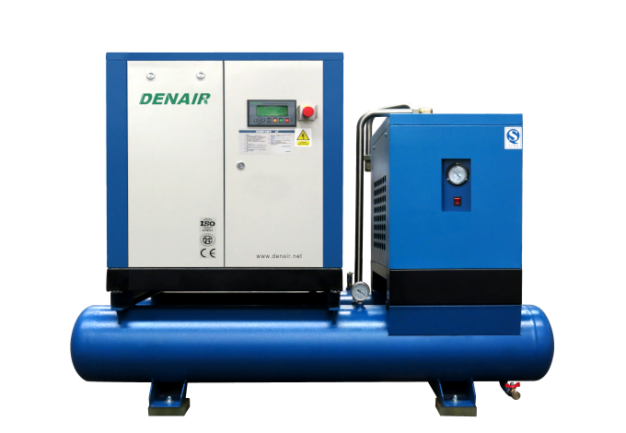
A fixed speed machine supplied factory-fitted with the entire downstream air treatment package, so there is nothing to specify, source or pipe up separately.
- Installed motor power: 5.5 kW to 37 kW (7.5 hp to 50 hp)
- Free air delivery: 0.59 to 6.32 m³/min (21 cfm to 223 cfm)
- Integrated: Refrigerated air dryer, air receiver tank, water separator filter, 1 micron pre-filter, 0.01 micron post-filter
- Drainage: Five automatic drains removing moisture from filters and tank
- Installation benefit: Reduces installation space by up to 50% with all piping connections pre-made
For a site without an existing compressed air room, this removes most of the installation cost and all of the specification risk.
View Denair full feature screw compressors
3. Denair Oil Free Screw Compressors — where air purity is non-negotiable
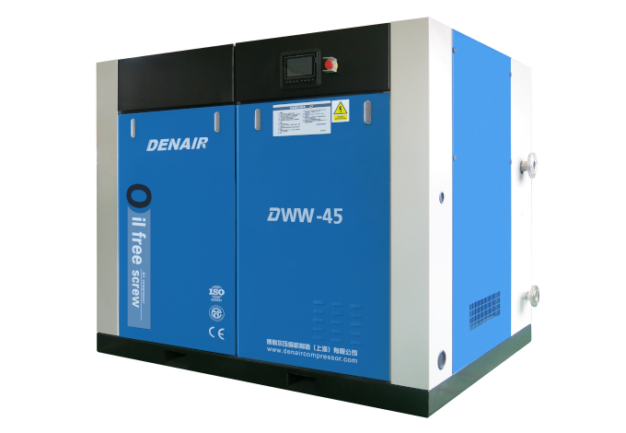
For food, beverage, pharmaceutical, electronics and any process where lubricant carry-over into the air stream is unacceptable. Available in scroll, dry screw and water-injected designs.
- Installed motor power: 2.2 kW to 500 kW (3 hp to 670 hp)
- Free air delivery: 0.21 to 86.01 m³/min (7.5 cfm to 3,038 cfm)
- Types: Scroll type (up to 37 kW), dry screw oil free, water injected oil free
- Screw element: GHH Rand, made in Germany, advanced SAP profile
- Configuration: Fixed speed or variable speed
The widest capacity span in the Denair range, which matters because oil-free requirements rarely scale neatly with plant size.
View Denair oil free screw compressors
4. Denair Diesel Portable Screw Compressors — screw technology off-grid

The same screw element architecture in a diesel-driven, site-mobile package for locations with no mains supply.
- Capacity: 120 cfm to 1,638 cfm (3.4 to 46.38 m³/min)
- Pressure range: 102 to 508 psi(g) (7 to 35 bar)
- Filtration: Two-stage dust removal with efficiency up to 99.9%
- Applications: Mining, hydropower, oil and gas, borehole drilling, shipyards, construction, quarrying, sandblasting
Covered in more depth in our guide to choosing a portable air compressor.
View diesel portable screw compressors
Not sure which capacity you need?
Send us your air demand in cfm or m³/min, working pressure, and shift pattern — our team will size the machine and return a costed proposal.
How to Size a Screw Compressor Correctly
Oversizing wastes energy every hour the machine runs. Undersizing starves the process. Both are common, and both are avoidable.
Step 1 - Total your actual air demand. Add the consumption of every tool and process on the system, in cfm or m³/min. Use manufacturer figures, not estimates.
Step 2 - Apply a realistic utilisation factor. Not everything runs at once. Applying a duty factor to each item gives a working figure rather than a theoretical maximum you will never reach.
Step 3 - Establish the true required pressure. Specify for the highest-pressure item on the system, not an arbitrary round number. Every additional bar of pressure adds roughly 6–7% to energy consumption, so over-specifying pressure is a permanent tax on the electricity bill.
Step 4 - Add allowance for leaks and growth. Leakage on an established system is often significant. Add a realistic allowance, plus headroom for planned expansion — but headroom, not a doubling.
Step 5 - Account for UAE ambient conditions. Compressor output ratings assume standard inlet conditions. High ambient temperatures reduce delivered air, so the compressor room needs adequate ventilation and the specification needs to reflect real conditions.
Step 6 - Size the receiver and treatment to match. The compressor is one component. Receiver volume, dryer capacity and filtration all need to match the flow, or the system will underperform regardless of the machine.
Air Treatment: The Part Most Specifications Miss
A compressor delivers hot, wet, dirty air. What arrives at the point of use depends entirely on what sits between.
- Moisture is the primary problem: Compressing air concentrates the water vapour in it, and UAE humidity makes this worse than in drier climates. Untreated, that water reaches pneumatic cylinders, valves and product surfaces: Compressed air refrigeration dryers handle general industrial requirements; desiccant dryers go further where very low dew points are specified.
- Particulates and aerosols come next: Compressed air filters staged from coarse to fine protect both the process and the downstream equipment. Filtration is specified by what the application tolerates, not by habit.
- Storage stabilises the system: Air receiver tanks buffer short-duration peak demand so the compressor is not cycling constantly — which reduces both energy use and wear.
Why Choose GENAVCO as Your Compressed Air Partner in the UAE
Buying the machine is the easy part. What determines whether the investment performs is everything that happens afterwards.
- Part of Juma Al Majid Holding Group: Decades of established presence in the UAE market and the financial stability that comes with a major regional group — this matters when you are signing multi-year service agreements.
- Authorised Denair representation: Genuine equipment, factory-backed specification and full warranty integrity — not grey-market imports with uncertain parts availability.
- In-country spare parts inventory: A stopped compressor stops the plant. Our genuine spare parts operation holds stock locally so a failed element does not become a production shutdown.
- Certified service and maintenance: Scheduled servicing, preventive maintenance programmes and breakdown response through our repairs and maintenance division across Dubai, Abu Dhabi, Sharjah and the wider UAE.
- Complete system supply: Compressor, dryer, filtration, receiver and piping specified together as one system — not a machine sold in isolation and left for someone else to integrate.
- Application-led sizing: We survey the demand profile rather than quoting against a headline kW figure. Correct sizing is where the energy savings actually come from.
- Local operating knowledge: Ambient temperature, dust load and humidity all affect compressor performance in the UAE. Specifications that ignore this underperform in service.
Common Screw Compressor Problems — and What Causes Them
- Pressure dropping at the point of use: Usually pipework rather than the compressor — undersized bore, excessive fittings, or leaks. Check system pressure at the machine before assuming it is under-capacity.
- High discharge temperature: Most often restricted ventilation in the compressor room or a fouled cooler. In UAE summer conditions this is the most common cause of nuisance shutdowns.
- Water in the air lines: The dryer is undersized, has failed, or the automatic drains are blocked. Compressing humid air produces a lot of condensate and it has to go somewhere.
- Excessive loading and unloading: Receiver volume too small for the demand pattern, or a fixed speed machine on a variable load. Both waste energy continuously.
- Rising energy consumption over time: Usually system leakage rather than machine degradation. A leak survey is cheaper than a new compressor and almost always finds something.
Frequently Asked Questions
What is a screw compressor and how does it differ from a piston compressor?
A screw compressor uses two interlocking helical rotors to compress air continuously as it passes along their length, whereas a piston compressor compresses air in discrete strokes. The screw design delivers smooth, pulse-free air and is built for 100% duty cycle, making it the standard choice for continuous industrial demand.
Should I choose a fixed speed or variable speed screw compressor?
It depends on demand stability. Fixed speed suits steady loads close to the machine’s rated output. Variable speed matches motor speed to actual demand and delivers substantial energy savings where consumption fluctuates across shifts or seasons.
What size screw compressor do I need?
Size against total air demand in cfm or m³/min with a realistic utilisation factor applied, at the highest pressure any item on the system genuinely requires, plus an allowance for leakage and planned growth. Over-specifying pressure is particularly costly, as each additional bar adds roughly 6–7% to energy consumption.
Do I need an oil free screw compressor?
Only where lubricant carry-over into the air stream is unacceptable — food and beverage, pharmaceutical, electronics, and processes with direct product contact. For general industrial use, a lubricated screw compressor with correct filtration is both sufficient and more economical.
How often does a screw compressor need servicing?
Service intervals depend on operating hours, ambient conditions and duty. UAE dust and heat generally shorten filter and cooler service intervals compared with temperate climates. GENAVCO provides scheduled preventive maintenance programmes based on your actual running hours.
Does GENAVCO supply spare parts and servicing for Denair compressors in the UAE?
Yes. GENAVCO holds genuine Denair parts in-country and operates a certified service network covering Dubai, Abu Dhabi, Sharjah and the wider UAE, with preventive maintenance and breakdown support.
Ready to Specify Your Screw Compressor?
A screw compressor sized against real demand, at the right pressure, with matched air treatment, will cost less to run every hour of its life than one specified from a catalogue. The difference compounds over a decade of operation.
GENAVCO supplies the complete Denair range across the UAE — screw compressors, dryers, filtration and receivers — backed by genuine parts, certified service and local application expertise.
Tell us your air demand and duty cycle. We will size the system and price it properly.
ENQUIRE NOW — GET YOUR SCREW COMPRESSOR QUOTE
Serving Dubai, Abu Dhabi, Sharjah and the wider UAE.