On a construction site, a borehole rig or a shutdown maintenance job, compressed air has to arrive where the work is — not where the plant room happens to be. That is the entire case for a portable air compressor, and it is why site air is specified completely differently from fixed industrial air.
The decisions that matter are different too. Instead of annual energy cost and demand profiles, the questions become how much air the tools actually consume, whether mains power exists at the location, how the unit gets moved between work fronts, and whether it will still deliver rated output in July.
This guide covers how to size a portable air compressor for real site demand, when diesel beats electric and when it does not, what UAE conditions do to output, and which Denair units suit which kind of work.
Where Portable Air Compressors Are Used in the UAE
Site air demand across the region falls into a few recognisable patterns, and each drives a different specification.
- Construction and civils: Breakers, jackhammers, compaction tools and general pneumatic work. Demand is intermittent but the peaks are high, and the unit moves between work fronts through the project.
- Borehole and water well drilling: High pressure is the constraint rather than flow. Down-the-hole hammer drilling needs sustained pressure well above standard industrial levels, and the requirement climbs with depth.
- Quarrying and mining: Continuous, heavy duty in the dustiest conditions any compressor will encounter. Filtration and cooling determine service life here more than anything else.
- Oil, gas and shutdown maintenance: Temporary air for turnaround work where the permanent system is offline or does not reach. Reliability across a fixed shutdown window is the priority.
- Sandblasting and surface preparation: Sustained high flow for extended periods — one of the most demanding continuous applications, and the one most often under-specified.
- Shipyards and marine: Mixed tool work across large structures where running fixed pipework is impractical.
Diesel or Electric Portable: Which One
Both are portable. They solve different problems, and the deciding factor is usually power availability rather than preference.
| Factor | Diesel Portable | Electric Portable |
|---|---|---|
| Power source | Self-contained — no mains needed | Requires mains or generator supply |
| Typical location | Open sites, remote work, early-stage projects | Established sites, indoor work, plant areas |
| Emissions | Exhaust output — outdoor use | Zero at point of use |
| Noise | Higher | Lower |
| Running cost | Fuel and engine servicing | Lower per hour where power exists |
| Pressure range | Wide, including high-pressure drilling duty | Standard to medium-high industrial pressure |
| Mobility | Towable, fully independent | Compact and light, easily repositioned |
| Best for | Construction, drilling, quarrying, remote work | Indoor, enclosed and power-served locations |
Advantages of a Portable Air Compressor
These are the practical benefits that matter once the unit is on site.
- Air arrives at the work front: No long hose runs from a fixed plant, which means no accumulated pressure drop between the compressor and the tool.
- Independent of site infrastructure: A diesel unit works from day one on a site with nothing but a fuel supply — before power, before permanent services.
- Repositionable as work moves: Follows the job across the site rather than dictating where work can happen.
- Deployable across multiple projects: A single unit can serve several sites over its life rather than being tied to one facility, which changes the return calculation.
- High pressure capability: Portable screw units cover pressures well above standard industrial levels, which is what drilling and specialist applications require.
- Screw technology in a mobile package: Continuous duty capability and pulse-free delivery, not the intermittent-duty limits of a small piston machine.
- Fast to bring into service: No installation, no pipework, no commissioning — connect the hose and work.
- Suits temporary and standby needs: Covers shutdowns, peak demand and breakdown cover without permanently oversizing the fixed system.
Denair Portable Air Compressors Available in the UAE
GENAVCO supplies the full range of Denair compressed air solutions in the UAE, including portable units for site and mobile applications. Here are three models covering the majority of site requirements, plus the storage that makes them work properly.
1. Denair Diesel Portable Screw Compressors — the site standard

The core site machine: screw element technology in a self-contained diesel package, covering everything from general tool work to high-pressure drilling duty.
- Capacity: 120 cfm to 1,638 cfm (3.4 to 46.38 m³/min)
- Pressure range: 102 to 508 psi(g) (7 to 35 bar)
- Screw element: Advanced SAP profile design
- Engine: Heavy duty diesel with lower fuel consumption and extended service life
- Air filtration: Two-stage dust removal, efficiency up to 99.9%
- Applications: Mining, hydropower, oil and gas, borehole, shipyard, construction, chemical, quarry, sandblasting
The pressure range is what distinguishes this from general-purpose site compressors — 35 bar covers down-the-hole hammer drilling that standard 7-bar units cannot support. The two-stage filtration matters specifically in UAE dust conditions, where intake contamination is the main driver of premature wear.
View Denair diesel portable screw compressors
2. Denair Electric Portable Air Compressor — mains-powered mobility
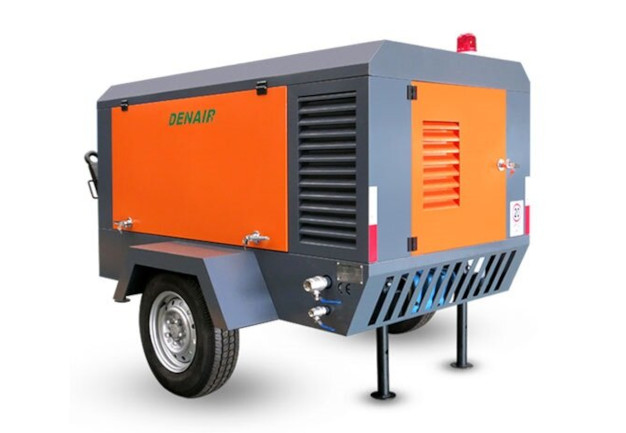
A compact, mains-powered unit for locations that have electrical supply and cannot accommodate engine exhaust or noise.
- Working pressure: 7 to 18 bar (102 to 261 psig)
- Free air delivery: 219 to 795 cfm (6.2 to 22.5 m³/min)
- Working power: 37 to 185 kW (50 to 252 hp)
- Access design: Full-opened design simplifies maintenance and repair compared with gull-wing type enclosures
- Transport: Small, lightweight and space-saving, reducing transportation cost
- Handling: Operating crank design for quick connection to power equipment
- Cooling: Cold box design maintains low internal unit temperature
The cold box design is worth noting for regional use — internal temperature control is what keeps a compact enclosure delivering rated output through a UAE summer.
View Denair electric portable air compressor
3. Denair Skid Mounted Air Compressors — heavy duty semi-permanent air
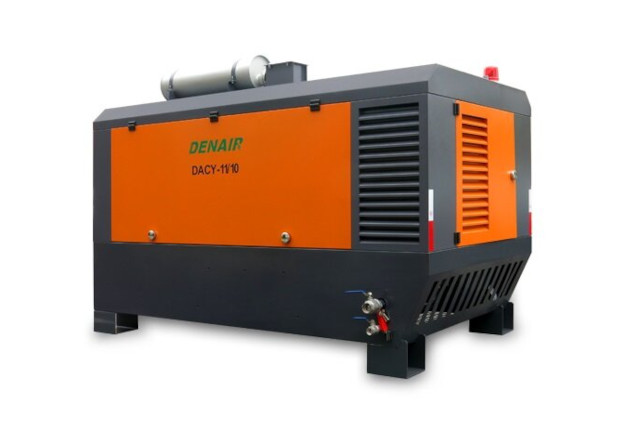
For long-duration projects that need large volumes of air at one location — relocatable between phases, but not moved daily.
- Power: Up to 700 horsepower, diesel powered
- Type: Rotary screw compressor
- Compression element: Processed on German KAPP machinery with precision-aligned roller bearings
- Engine: Heavy-duty Cummins diesel for extended operation
- Components: German MANN oil filter, Siemens electronics
- Operation: Automatic operation system with unattended running and remote control available
- Certification: CE, ISO 9001 and energy saving certification
Unattended operation and remote control are the features that matter on extended projects — they remove the need for a dedicated operator across long running periods.
View skid mounted air compressors
4. Denair Air Receiver Tanks — the component most site setups skip

A receiver buffers short peak demand so the compressor is not cycling against every tool trigger. On sites running breakers and intermittent tools, this reduces both fuel consumption and wear.
- Capacity: 300 litres to 10,000 litres (0.3 to 10 m³)
- Function: Stabilises delivery pressure during fluctuating demand
- Benefit: Reduces compressor cycling, lowering fuel use and mechanical wear
- Best for: Any site with intermittent high-peak tool demand
Not sure what capacity your site needs?
Send us your tool list, the number of operators working simultaneously, and the required pressure — our team will size the unit and return a cost proposal.
How to Size a Portable Air Compressor for Site Work
Undersizing is the most common site error, and it shows up as tools running slowly rather than as an obvious fault — which is why it often goes uncorrected for months.
Step 1 — List every tool and its air consumption. Use manufacturer cfm figures at the working pressure, not nominal figures. Breakers, in particular, consume far more air than operators expect.
Step 2 — Count simultaneous users, not total tools. Size for how many tools genuinely run at the same moment. Four breakers on site with two operators is a two-tool demand.
Step 3 — Establish the highest pressure any tool requires. General pneumatic tools work at standard pressure; drilling applications need substantially more. The highest single requirement sets the machine specification.
Step 4 — Add allowance for hose losses. Long hose runs and small-bore hose cause real pressure drop at the tool. Add margin, or specify shorter runs with larger bore.
Step 5 — Derate for UAE ambient conditions. Rated output assumes standard inlet conditions. High ambient temperature reduces delivered air, so a unit sized exactly to demand on paper will fall short in summer.
Step 6 — Add a receiver where demand is intermittent. Peak-heavy, intermittent duty is exactly the pattern a receiver smooths. It is cheaper than moving up a machine size.
Operating a Portable Compressor in UAE Conditions
Heat and dust are the two variables that determine whether a site compressor reaches its expected service life.
- Heat reduces output and stresses the machine: Position the unit where it can draw cool air rather than recirculating its own exhaust heat, keep coolers clear, and allow clearance around the enclosure. A compressor boxed into a corner in July will shut down on temperature.
- Dust is the main cause of premature wear: Two-stage intake filtration handles a great deal, but only if the elements are serviced on a schedule appropriate to the environment. A quarry or unpaved site needs far shorter intervals than the standard recommendation — build that into the maintenance plan rather than waiting for a performance drop.
- Fuel quality and refuelling practice matter: Contaminated fuel on remote sites causes injector and filter problems that present as compressor faults. Clean storage and disciplined refuelling prevent most of it.
- Condensate still forms: High humidity produces significant condensate even on portable units. Where the air feeds sensitive tools or blasting, inline filtration protects both the equipment and the finish.
Why Choose GENAVCO for Site Compressed Air in the UAE
A compressor that stops on site stops the work front. Support availability matters more here than in any fixed installation.
- Part of Juma Al Majid Holding Group: Decades of established presence in the UAE market and the financial stability that comes with a major regional group — this matters when you are signing multi-year service agreements.
- Authorised Denair representation: Genuine equipment, factory-backed specification and full warranty integrity — not grey-market imports with uncertain parts availability.
- In-country spare parts inventory: Site downtime is measured in idle crews, not just lost air. Our genuine spare parts operation holds stock locally so a filter or element does not stop the job for a fortnight.
- On-site service across the Emirates: Scheduled servicing, preventive maintenance and breakdown response through our repairs and maintenance division, covering Dubai, Abu Dhabi, Sharjah and the wider UAE.
- Operator training: Correct operation and daily checks extend service life considerably. Our operator training centre covers safe use and routine maintenance.
- Complete site equipment supply: Compressed air alongside our wider earthmoving and light construction equipment range — one supplier relationship across the site fleet.
- Application-led specification: We size against your tool list and working pattern, not a headline cfm figure. Undersized site air is expensive in a way that never appears on the invoice.
Common Site Compressor Problems — and What Causes Them
- Tools running slowly or weakly: Almost always insufficient air rather than a tool fault. Check delivered pressure at the tool, not at the compressor — hose losses are usually the culprit.
- Shutting down on high temperature: Restricted airflow around the enclosure, recirculated hot air, or a dust-blocked cooler. The most frequent UAE summer complaint and usually the easiest to fix.
- Rapid filter blockage: Normal in dusty environments. The fault is the service interval, not the machine — shorten it to match the site.
- Excessive fuel consumption: Often a unit oversized for the actual duty, running unloaded much of the time, or a system leak. Both are worth measuring before assuming engine wear.
- Water in the air line: High humidity plus no inline treatment. Fit filtration where the air feeds blasting, painting or sensitive tools.
Frequently Asked Questions
What size portable air compressor do I need for a construction site?
Size against the combined air consumption of tools running simultaneously, not the total number of tools on site, at the highest pressure any tool requires. Add margin for hose losses and derate for UAE ambient temperature, since rated output assumes standard inlet conditions.
Should I choose a diesel or electric portable air compressor?
Diesel where there is no reliable mains supply — open sites, remote work and early-stage projects. Electric where power exists and the work is indoors or noise-sensitive, since running costs are lower and there are no exhaust emissions at the point of use.
What pressure do I need for borehole drilling?
Down-the-hole hammer drilling requires substantially higher pressure than general pneumatic tools, and the requirement increases with depth. Denair diesel portable units cover up to 35 bar, which supports drilling duty that standard site compressors cannot.
Do portable air compressors work in UAE summer heat?
Yes, provided they are positioned and maintained correctly. Rated output falls as ambient temperature rises, so specify with margin, allow clearance for cooling airflow, keep coolers clear of dust, and avoid positions where the unit recirculates its own exhaust heat.
Do I need an air receiver with a portable compressor?
It depends on the demand pattern. Where tool use is intermittent with high peaks, a receiver stabilises pressure and reduces compressor cycling, lowering both fuel consumption and wear. For steady continuous demand it is less critical.
Does GENAVCO service portable compressors on site in the UAE?
Yes. GENAVCO holds genuine Denair parts in-country and operates a certified service network covering Dubai, Abu Dhabi, Sharjah and the wider UAE, with preventive maintenance programmes and on-site breakdown support.
Ready to Specify Your Site Air?
Site compressed air is sized against tools and conditions, not against a catalogue figure. Get the cfm, the pressure and the heat derating right, and the crews work at full rate for the length of the project.
GENAVCO supplies the complete Denair portable range across the UAE — diesel, electric and skid mounted — backed by genuine parts, on-site service and local application expertise. For fixed plant installations, see our guide to how rotary screw compressors work.
Tell us your tools and your site conditions. We will size the unit and price it properly.
ENQUIRE NOW — GET YOUR PORTABLE COMPRESSOR QUOTE
Serving Dubai, Abu Dhabi, Sharjah and the wider UAE.