Power continuity is a design requirement in the UAE, not a contingency. Data centres, hospitals, cold chain, manufacturing lines, marine operations and construction sites all carry a cost of interruption measured in hours of lost output, spoiled stock or contractual penalty.
A generator is the equipment that removes that exposure. Specifying it well is a technical exercise — the wrong rating, the wrong enclosure or the wrong control system will each produce a machine that technically works and practically disappoints.
This guide covers the main power generator categories and where each fits, the difference between prime and standby ratings, how to size in kVA, what drives lifetime cost, and which GPS machines suit which application.
How a Generator Set Actually Works
A generating set has two halves. An engine converts fuel into rotating mechanical energy. An alternator, coupled to it, converts that rotation into electrical output. A control system governs engine speed so the output holds the correct frequency and voltage under changing load.
Everything else — canopy, fuel tank, cooling, exhaust, transfer switching — exists to keep those two halves running safely and to deliver their output where it is needed. Understanding the split matters because most specification errors sit on one side or the other: an engine sized for the wrong duty, or an alternator and control system that cannot handle the load characteristics.
The two halves are covered in depth in our companion guides to how a diesel generator works and understanding electrical output and kVA.
Prime, Standby and Continuous Ratings
This is the single most misunderstood item on a generator specification, and getting it wrong shortens machine life considerably.
- Standby rating: The maximum output available for the duration of a mains outage, with a variable load and a limited number of running hours per year. A standby-rated machine is not built to run as a primary source, and using it that way will not deliver its expected service life.
- Prime rating: Output available for an unlimited number of hours per year with a variable load. This is the correct rating where the generator is the main power source — remote sites, construction, off-grid operations.
- Continuous rating: Output available for unlimited hours at a constant load. Specified for base-load applications where the machine runs at a steady output indefinitely.
The same physical machine carries different figures under each rating. A set quoted at one kVA figure on standby will carry a lower figure on prime. Comparing two quotations without confirming which rating each uses is the most common way to compare unlike with unlike.
Generator Categories and Where Each One Fits
| Application | Typical category | Why |
|---|---|---|
| Building and facility backup | Canopied industrial set with ATS | Automatic changeover on mains failure, sound attenuated |
| Continuous site power | Prime-rated industrial set | Built for unlimited running hours on variable load |
| Noise-sensitive locations | Silenced canopy or shelter | Attenuation to controlled sound levels |
| Temporary and relocatable power | Containerised set | Transportable, weather-protected, quick to deploy |
| Marine and offshore | Marine-rated set with class approval | Sea-water cooling and marine type approval |
| Night works and site lighting | Mobile lighting tower | Integrated generation and lighting in one unit |
| Distribution-level supply | Medium voltage set | Output at distribution voltage rather than low voltage |
Advantages of Specifying a Generator Correctly
These benefits follow from correct selection rather than from any particular brand.
- The machine reaches its design life: A set matched to its duty and rating runs within its envelope instead of being worked continuously at a rating it was never sold under.
- Stable output under real load: Correct alternator and control specification means voltage and frequency hold steady when large loads start, rather than dipping and disrupting sensitive equipment.
- Predictable fuel consumption: A correctly loaded engine runs efficiently. Chronic light loading wastes fuel and causes long-term engine problems.
- Compliance with site noise limits: Canopy and silencer grade specified against the location avoids retrofitting attenuation after installation.
- Automatic, unattended changeover: Properly integrated transfer switching restores power without anyone on site, which is the entire point of a standby installation.
- Room to expand without replacement: Sensible headroom and synchronisation capability allow capacity to be added later rather than forcing a full replacement.
- Lower total cost of ownership: Fuel and maintenance dominate lifetime cost. Both are set by decisions made at specification, not at purchase.
- Faster commissioning: A set specified with the right control, tank and connection arrangement installs cleanly instead of needing site modification.
Generators Available from GENAVCO in the UAE
GENAVCO supplies GPS power generation solutions in the UAE, covering small trade sets through to large industrial and marine installations.
The full generator range at a glance, with the capacity band each covers:
| Range | Output band | Suited to |
|---|---|---|
| Industrial Range | 10 – 2500 kVA | Buildings, facilities, industrial standby and prime |
| Marine Range | 40 – 500 kVA | Vessels and marine installations, class approved |
| Medium Voltage | 1000 – 3500 kVA | Distribution-voltage supply, large infrastructure |
| Containerised | Per set installed | Relocatable, weather-protected, rapid deployment |
| Lighting Towers | Up to 22 kVA | Night works, site lighting, temporary supply |
Two ranges are worth looking at in detail here, because they sit at opposite ends of the ladder and between them cover most first-time buying decisions.
GPS Industrial Range — 10 kVA to 2,500 kVA

The broad middle of the range, covering small, mid-sized and large installations where continuous-duty construction matters, from a single trade set up to large industrial standby and prime power.
- Output range: 10 kVA to 2,500 kVA
- Applications: Building sector, industry, agriculture and civil protection
- Frame: Solid electro-welded steel frames with built-in varying-capacity tank
- Engines and alternators: Specified to the application
- Canopy: Steel construction suitable for tropical environments, built for maintenance access
- Customisation: Configured to load, duty rating and site requirement at order stage
Running at 1500 rpm rather than 3000 gives this range the component life associated with continuous-duty machines, independent of which engine is fitted.
Marine Range — John Deere Diesel, 40 kVA to 500 kVA
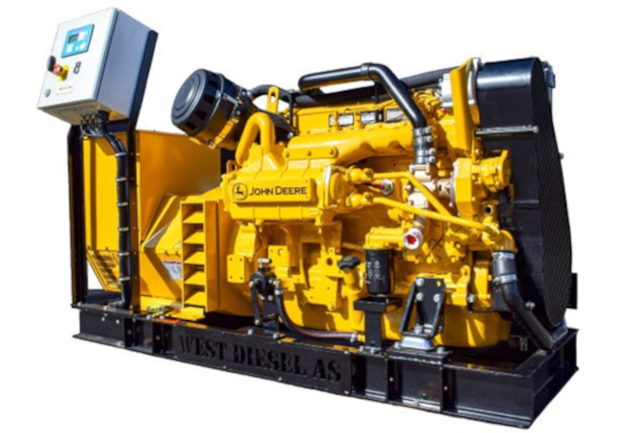
The specialised end of the range, built around a single named engine platform to meet the certification requirements that marine installation imposes.
- Output range: 40 kVA to 500 kVA
- Cooling: Sea-water cooled
- Approval: Marine type and class approval
- Engine: John Deere diesel
- Control: Programmable control panel with synchronisation
Engine choice is constrained here in a way it is not elsewhere in the range, because class approval applies to the installed package rather than to the set in isolation.
View the marine generator range
Not sure what rating or size you need?
Send us your connected load, the largest single motor starting on the system, your duty pattern and any site noise limits — our team will size the set and return a cost proposal.
How to Specify a Power Generator
Six steps in order. Skipping the first two produces the majority of poorly specified installations.
- Step 1 - Establish the duty first, then the rating. Decide whether the machine is standby, prime or continuous before discussing kVA. The rating determines which figure on the datasheet applies, and every downstream decision follows from it.
- Step 2 - Total the connected load and the starting load. Running load is only half the calculation. Large motors draw several times their running current at start, and the set has to absorb that without the voltage collapsing.
- Step 3 - Account for load characteristics, not just size. Non-linear loads such as variable speed drives, UPS systems and LED lighting place demands on the alternator that a simple kVA total does not capture.
- Step 4 - Derate for UAE ambient conditions. Output ratings assume reference conditions. High ambient temperature reduces available output, so both the set and its ventilation must be specified against real site conditions rather than datasheet reference figures.
- Step 5 - Specify enclosure, silencing and fuel together. Canopy grade, silencer grade and tank arrangement are governed by the location — noise limits, run-time between refuelling, and whether an external bulk tank is needed.
- Step 6 - Define the control and changeover requirement. ATS, BMS integration and synchronisation are specification items, not accessories. They determine whether the installation actually operates unattended.
What Drives Generator Cost
Purchase price is a fraction of what a generator costs across its life. Fuel and maintenance dominate, and both are largely fixed by the specification.
- Output rating in kVA - the largest single factor, and the one most often over-specified
- Duty rating - a prime-rated machine at a given output is a larger set than a standby-rated one
- Enclosure and silencer grade - hospital and residential attenuation carry a premium over industrial grade
- Fuel tank arrangement - built-in capacity versus external bulk tanks and transfer systems
- Control and integration - basic control panel versus ATS, BMS integration and synchronisation
- Frequency and voltage - 50 Hz or 60 Hz, low voltage or medium voltage output
- Installation type - open set, canopied, containerised or shelter-mounted
- Certification requirements - marine class approval and similar approvals add cost and lead time
The figure that matters is total cost of ownership. Fuel consumption at the actual operating load, service intervals, parts availability and residual value will each outweigh the difference between two comparable quotations. Ask any supplier for a TCO model rather than a price alone.
Why Choose GENAVCO as Your Power Generation Partner in the UAE
Buying the machine is the easy part. What determines whether the investment performs is everything that happens afterwards.
- Part of Juma Al Majid Holding Group: Decades of established presence in the UAE market and the financial stability that comes with a major regional group — this matters when you are signing multi-year service agreements.
- Authorised GPS representation: Genuine equipment, factory-backed specification and full warranty integrity — not grey-market imports with uncertain parts availability.
- In-country spare parts inventory: A standby set that fails on the day it is needed has cost more than it ever saved. Our genuine spare parts operation holds stock locally so maintenance is not delayed waiting on shipment.
- Certified service and maintenance: Scheduled servicing, preventive maintenance programmes and breakdown response through our repairs and maintenance division across Dubai, Abu Dhabi, Sharjah and the wider UAE.
- Installation and commissioning: Site preparation through to commissioning handled as one scope, rather than a machine delivered and left for someone else to integrate.
- Application-led sizing: We specify against connected load, starting load and duty pattern rather than a headline kVA figure. Correct sizing is where both reliability and fuel savings come from.
- Depth across the power category: Industrial, marine, containerised, medium voltage and lighting towers within our wider power generation and industrial equipment range — so the recommendation follows the application rather than the inventory.
Common Generator Specification Mistakes
- Comparing standby and prime figures side by side: The same machine carries different ratings under each. Two quotations are only comparable once both state the rating they are quoted under.
- Sizing on running load alone: Motor starting current is where an undersized set reveals itself — the voltage dips, and connected equipment trips or resets.
- Chronic light loading: A generator running far below its rated output for long periods develops engine problems over time. Oversizing is not a safe default.
- Ignoring ambient derating: Output figures assume reference conditions. In UAE summer temperatures the available output is lower, and enclosure ventilation matters as much as the rating.
- Treating the ATS as an accessory: If changeover is not specified and integrated properly, the installation needs someone on site to start it — which defeats the purpose.
- Leaving noise until installation: Silencer grade is a specification decision. Discovering a site noise limit after delivery is an expensive retrofit.
Frequently Asked Questions
What size power generator do I need?
Size against total connected load plus the starting requirement of the largest motor on the system, then apply the correct duty rating and derate for UAE ambient conditions. Load characteristics matter too — variable speed drives and UPS systems place demands on the alternator that a simple kVA total does not capture.
What is the difference between prime and standby rating?
Standby rating is the maximum output available during a mains outage, for a limited number of hours per year. Prime rating is output available for unlimited hours on a variable load, and is the correct rating where the generator is the main power source. The same machine carries a lower figure on prime than on standby.
How much does a power generator cost in the UAE?
There is no single figure. Output rating, duty rating, enclosure and silencer grade, fuel tank arrangement, control and integration requirements and any certification all move the price. Purchase price is also a small share of lifetime cost, since fuel and maintenance dominate over the machine’s service life.
Do generators lose output in UAE summer heat?
Yes. Published ratings assume reference ambient conditions, and available output falls as temperature rises. Both the rating and the enclosure ventilation should be specified against actual site conditions rather than datasheet reference figures.
What is an ATS and do I need one?
An automatic transfer switch detects a mains failure, starts the generator and transfers the load without human intervention, then returns the load to mains when supply is restored. Any installation intended to operate unattended needs one, and it should be specified with the set rather than added afterwards.
Does GENAVCO supply spare parts and servicing for generators in the UAE?
Yes. GENAVCO holds genuine parts in-country and operates a certified service network covering Dubai, Abu Dhabi, Sharjah and the wider UAE, with installation, commissioning, preventive maintenance programmes and breakdown support.
Ready to Specify Your Power Generator?
The right generator is the one matched to your duty rating, your connected and starting load, your site conditions and your control requirement. Those four decisions determine reliability and running cost for the life of the installation.
GENAVCO supplies the full GPS range across the UAE — industrial, marine, containerised, medium voltage and lighting towers — engineered and supported for UAE conditions.
Tell us your load and your duty pattern. We will size the set and price it properly.
ENQUIRE NOW — GET YOUR POWER GENERATOR QUOTE
Serving Dubai, Abu Dhabi, Sharjah and the wider UAE.