Every generating set has two halves. An engine produces rotation, and an alternator turns that rotation into electricity. Most buying conversations focus almost entirely on the first half — the engine, the fuel, the running hours — and then the installation underperforms for reasons that sit entirely on the second.
Voltage that dips when a large motor starts. A set that trips on a load well below its nameplate figure. Two quotations that look identical until you notice one is quoted in kVA and the other in kW. These are electrical-side problems, and they are decided at specification.
This guide covers how an electric generator actually produces power, what kVA means and how it differs from kW, when single phase and three phase apply, why load type matters as much as load size, and how transfer switching turns a machine into an installation.
How an Electric Generator Produces Power
The principle is electromagnetic induction. When a conductor moves through a magnetic field, a voltage is induced across it. An alternator applies this at scale: a rotating magnetic field, driven by the engine, passes continuously across windings arranged around the stator, inducing an alternating voltage in them.
Two things follow from that, and both matter commercially.
- Frequency is set by rotational speed: The output frequency depends on how fast the field rotates and how many magnetic poles the alternator has. A four-pole alternator turning at 1500 rpm produces 50 Hz. To produce 60 Hz from the same machine, the engine has to run at 1800 rpm. This is why sets are specified as 50 Hz or 60 Hz and why the choice is made at order rather than adjusted on site.
- Voltage is regulated, not fixed by speed alone: An automatic voltage regulator adjusts the excitation of the rotating field to hold output voltage steady as load changes. The quality of that regulation determines how the set behaves when a large load switches on — and it is the difference between connected equipment riding through a load step or resetting.
The engine half of the machine is covered in our companion guide to how a diesel generator works.
kVA and kW: Why Generators Are Rated in kVA
This is the most common source of confusion in generator procurement, and the most expensive to get wrong.
- kW is real power - the power that does useful work. It is what the connected equipment actually converts into motion, heat or light.
- kVA is apparent power - the total the generator must supply. In AC systems with inductive loads such as motors and transformers, current and voltage fall out of step with each other. Some of the current supplied does no useful work but still has to flow through the alternator and cabling.
- The power factor is the ratio between them. Multiply kVA by power factor to get kW. Generating sets are conventionally rated at 0.8 power factor, so a set rated at a given kVA figure delivers 80% of that number in kW.
The practical consequence: a quotation in kVA and a quotation in kW are not directly comparable, and a load list totalled in kW cannot be matched against a generator nameplate in kVA without converting first. Always confirm which unit a figure is stated in, and at what power factor.
Single Phase and Three Phase
| Factor | Single phase | Three phase |
|---|---|---|
| Typical use | Light commercial, small tools, lighting | Industrial motors, HVAC, larger installations |
| Output at same frame size | Lower | Higher |
| Load balance | Not applicable | Requires balancing across phases |
| Motor starting | Limited | Better suited to large motor loads |
| Cabling | Simpler | More conductors, higher installed cost |
| Typical UAE application | Small sites, temporary supply, lighting | Buildings, plant, industrial and marine |
Where a three phase set supplies single phase loads, those loads should be distributed across the phases as evenly as practical. Significant imbalance causes voltage differences between phases, alternator heating and, in extreme cases, protection trips — a common finding on installations that grew piecemeal rather than being designed.
Load Type Matters as Much as Load Size
A kVA total tells you how much. It does not tell you what kind, and the alternator responds very differently to each.
Motor starting loads. Direct-on-line motors draw several times their running current at start. The set has to absorb that surge without the voltage collapsing, which is a function of alternator sizing and regulation rather than engine power. This is the single most common reason an apparently correctly sized set underperforms.
Non-linear loads. Variable speed drives, UPS systems, LED drivers and switch-mode power supplies draw current in pulses rather than smoothly. This distorts the waveform and heats the alternator beyond what the kVA figure alone would suggest. Installations with a high proportion of these loads need the alternator specified accordingly.
Leading power factor. Lightly loaded UPS systems and long cable runs can present a leading power factor, which some alternators handle poorly. It should be flagged at specification rather than discovered during commissioning.
Step loading. How much load can be applied in one block matters for data centres and any installation where the whole load transfers at once on mains failure. Applying it in stages is often the answer, and that is a control system decision.
Advantages of Getting the Electrical Specification Right
These benefits follow from the alternator and control side rather than from engine selection.
- Stable voltage under load steps: Connected equipment rides through motor starts and load transfers instead of resetting or tripping.
- Correct capacity for the actual load: Converting between kVA and kW properly means the set is sized against real demand rather than a figure in the wrong unit.
- Alternator reaches its service life: Specifying for non-linear load and phase balance prevents the winding heating that shortens it.
- Unattended changeover on mains failure: Properly integrated transfer switching restores supply automatically, which is the entire purpose of a standby installation.
- Capacity expandable by synchronisation: Sets that can run in parallel allow load to grow by adding a machine rather than replacing the installation.
- Correct frequency for the connected equipment: 50 Hz or 60 Hz confirmed at order avoids equipment compatibility problems that cannot be fixed on site.
- Meaningful diagnostics: Programmable control panels reporting multiple parameters turn maintenance from reactive to scheduled.
- Integration with building systems: BMS connectivity puts generator status into the same monitoring environment as the rest of the facility.
Generating Sets Available from GENAVCO in the UAE
GENAVCO supplies GPS power generation solutions in the UAE alongside the Green Power generator range. Here are three configurations, described by their electrical and control characteristics.
1. Industrial Range — 10 kVA to 2500 kVA with full control integration

The range built for managed installations, where the control and changeover capability matters as much as the output figure.
- Output range: 10 kVA to 2500 kVA
- Frequency: Can be supplied as 50 Hz or 60 Hz
- Integration: Compatible with BMS, ATS and synchronisation
- Control: Programmable control panels with multiple diagnostic parameters
- Enclosure: Closed canopy for sound attenuation
- Silencer options: Hospital, residential and industrial grade
Synchronisation capability is the specification item worth settling at the outset. A set that can run in parallel allows capacity to be added later by installing a second machine, rather than replacing the first when demand grows.
View the industrial generator range with ATS and BMS integration
2. Medium Voltage — 1000 kVA to 3500 kVA
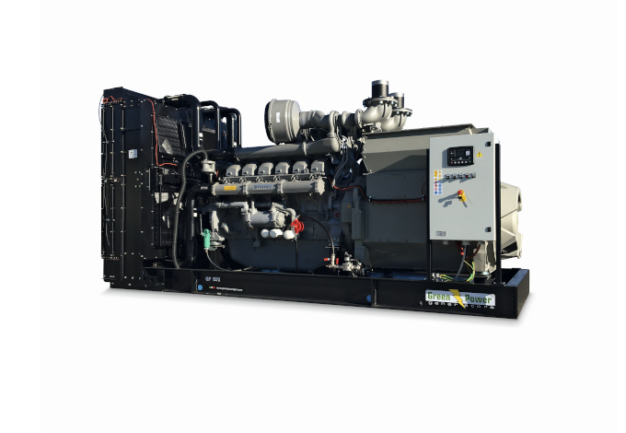
Where the load is large or the distribution run is long, generating at medium voltage rather than low voltage reduces cable losses and simplifies the distribution design. This is the range built for that.
- Output range: 1,000 kVA to 3,500 kVA
- Output voltage: 3,000 V to 12,000 V
- Engine brands: Perkins, Cummins, MTU, Mitsubishi
- Alternator brands: Mecc Alte, Stamford, Leroy Somer, Marelli
- Control: Automatic panel, or COMAP/DEEPSEA parallel panels
- Also supplied: Circuit breakers and power cables at medium and high voltage
The alternator brand list matters more here than on a low voltage set, because at distribution voltage the alternator and its excitation system are doing considerably more of the engineering work. Parallel panel capability is standard, which is what allows multiple sets to share a large load.
View medium voltage generating sets
3. Lighting Towers — single or three phase up to 22 kVA
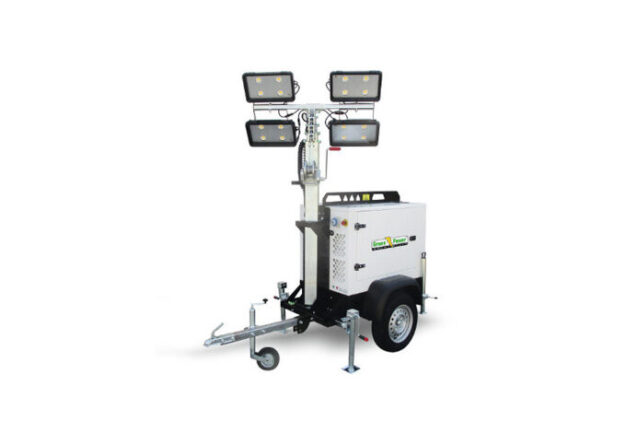
A compact unit where the phase configuration is a specification choice, useful where a site needs both illumination and a modest power take-off.
- Power: Up to 22 kVA
- Supply: One-phase or three-phase
- Type: Fixed or mobile
- Fuel: Petrol or diesel
- Best for: Night works, road works, event and security lighting, temporary site supply
View single and three phase lighting towers
Not sure how your load converts to a generator rating?
Send us your load schedule with kW figures and power factors, the largest motor on the system and its starting method, and any non-linear loads — our team will convert it to a rating and return a costed proposal.
Transfer Switching: What Turns a Machine Into an Installation
A generator sitting beside a building is not a backup system. What makes it one is the switchgear that detects a failure and moves the load.
- Automatic transfer switch (ATS): Monitors the incoming mains supply, signals the generator to start on failure, waits for output to stabilise, then transfers the load. When mains returns and proves stable, it transfers back and signals the set to cool down and stop. Without it, someone has to be on site to start the machine — which defeats the purpose of a standby installation.
- Synchronisation: Allows two or more sets to run in parallel, sharing load. It supports capacity expansion, redundancy, and running only the machines needed at a given load rather than one large set at inefficient light load.
- BMS integration: Puts generator status, alarms and running data into the building management system, so the set is monitored alongside everything else rather than being checked manually.
- Programmable control and diagnostics: Multi-parameter monitoring turns maintenance from reactive to scheduled, and gives useful information when a fault does occur rather than a single warning lamp.
How to Size a Generator from Your Electrical Load
- Step 1 - Build a load schedule, not a total. List each load with its rating, its power factor and whether it is continuous or intermittent. A single summed figure hides everything that determines the specification.
- Step 2 - Convert consistently into one unit. Decide whether you are working in kW or kVA and convert everything, applying the correct power factor. Mixing units is where sizing errors originate.
- Step 3 - Identify the largest motor and its starting method. Direct-on-line starting imposes the heaviest demand. Star-delta and soft starters reduce it substantially, and the starting method changes the required set size.
- Step 4 - Flag non-linear and leading power factor loads. Variable speed drives, UPS systems and LED lighting need to be identified by proportion of total load so the alternator can be specified for them.
- Step 5 - Confirm frequency, voltage and phase. 50 Hz or 60 Hz, the required output voltage, and single or three phase. These are order-stage decisions that cannot be changed on site.
- Step 6 - Define the changeover and control requirement. ATS, synchronisation and BMS integration are specification items. Deciding them after the set is ordered leads to compromise or retrofit.
Why Choose GENAVCO as Your Power Generation Partner in the UAE
Buying the machine is the easy part. What determines whether the installation performs is everything around it.
- Part of Juma Al Majid Holding Group: Decades of established presence in the UAE market and the financial stability that comes with a major regional group — this matters when you are signing multi-year service agreements.
- Authorised GPS and Green Power representation: Genuine equipment, factory-backed specification and full warranty integrity — not grey-market imports with uncertain parts availability.
- Electrical specification support: We work from a load schedule rather than a headline figure, converting kW to kVA correctly and accounting for starting and non-linear loads before recommending a rating.
- In-country spare parts inventory: A standby set that fails on the day it is needed has cost more than it ever saved. Our genuine spare parts operation holds stock locally so servicing is not delayed waiting on shipment.
- Certified service and maintenance: Scheduled servicing, preventive maintenance and breakdown response through our repairs and maintenance division across Dubai, Abu Dhabi, Sharjah and the wider UAE.
- Installation and commissioning: Changeover, control integration and commissioning handled as one scope, rather than a machine delivered and left for others to connect.
- Range depth across output types: Low voltage and medium voltage, single and three phase, synchronisable and containerised — so the recommendation follows the electrical requirement rather than the inventory.
Common Electrical-Side Problems — and What Causes Them
- Voltage dips when a large motor starts: The starting load exceeded what the alternator was specified to absorb. A sizing decision, not a fault, and usually traceable to a load list that recorded running current only.
- Set trips below its nameplate rating: Frequently a kVA and kW confusion — the load was totalled in one unit and matched against a nameplate in the other.
- Alternator running hot on a moderate load: Often a high proportion of non-linear load, or significant imbalance between phases on a three phase set.
- Generator starts but load does not transfer: A changeover or control issue rather than a generator fault. Common where the ATS was added after the set was specified.
- Equipment resetting during transfer: Step loading applied in one block rather than in stages. Usually resolvable through control configuration.
- Frequency instability under varying load: Governor or control tuning, which should be confirmed at commissioning rather than left to be discovered in service.
Frequently Asked Questions
What is the difference between kVA and kW on a generator?
kW is real power — what the connected equipment converts into useful work. kVA is apparent power — the total the generator must supply, including current that flows without doing useful work. Power factor is the ratio between them, and generating sets are conventionally rated at 0.8, so a set delivers 80% of its kVA figure in kW.
Should I choose a single phase or three phase generator?
Three phase suits industrial motors, HVAC and larger installations, and delivers more output from the same frame size. Single phase suits light commercial use, small tools and lighting. Where a three phase set supplies single phase loads, those loads should be distributed as evenly as practical across the phases.
Why does my generator struggle when a large motor starts?
Direct-on-line motors draw several times their running current at start, and the alternator has to absorb that surge without the voltage collapsing. This is an alternator sizing and regulation question rather than engine power, and reduced-voltage starting methods lower the demand considerably.
What is the difference between a 50 Hz and 60 Hz generator?
Output frequency depends on the rotational speed of the alternator and its number of poles. A four-pole alternator produces 50 Hz at 1500 rpm and 60 Hz at 1800 rpm. The frequency must match the connected equipment and is specified at order, not adjusted on site.
Do variable speed drives and UPS systems affect generator sizing?
Yes. These are non-linear loads that draw current in pulses rather than smoothly, distorting the waveform and heating the alternator beyond what a kVA total alone suggests. Their proportion of total load should be identified so the alternator can be specified for them.
Does GENAVCO supply spare parts and servicing for generators in the UAE?
Yes. GENAVCO holds genuine parts in-country and operates a certified service network covering Dubai, Abu Dhabi, Sharjah and the wider UAE, with installation, commissioning, preventive maintenance programmes and breakdown support.
Ready to Convert Your Load Into a Generator Rating?
Most generator disappointments are electrical-side decisions made without a proper load schedule. Get the units consistent, the starting load accounted for, the load types identified and the changeover specified, and the installation does what it was bought to do.
GENAVCO supplies the full GPS and Green Power range across the UAE — low and medium voltage, single and three phase, synchronisable and containerised — backed by installation, commissioning, genuine parts and certified service. For the wider selection decision, see our guide to choosing a power generator.
Send us your load schedule. We will convert it to a rating and specify the set properly.
ENQUIRE NOW — GET YOUR ELECTRICAL SIZING REVIEW
Serving Dubai, Abu Dhabi, Sharjah and the wider UAE.