Where power has to be produced rather than drawn from a grid connection, the diesel generating set remains the standard answer. It is the technology behind hospital backup, data centre resilience, construction site power, marine auxiliary supply and every remote operation in the region that runs without a utility feed.
Diesel holds that position for a specific reason: energy density. A diesel engine converts a compact, easily stored, easily transported fuel into sustained mechanical power for as long as the tank is topped up. Nothing else currently matches that combination at industrial scale.
This guide covers how a diesel generator produces power, what UAE heat and dust do to it, how enclosure and silencing are specified, what fuel management actually involves, and which GPS diesel sets suit which application.
How a Diesel Generating Set Produces Power
A diesel engine draws air into the cylinder and compresses it hard enough that the air temperature rises above the ignition point of the fuel. Diesel is then injected directly into that hot compressed air and ignites without a spark. The resulting expansion drives the piston, and the crankshaft converts that into rotation.
That rotation turns the alternator, which is where electricity is actually produced. A governor holds engine speed constant so the output frequency stays stable as load changes — in a 50 Hz system, the engine holds 1500 rpm on a four-pole set.
This is why engine speed appears in product names. A 1500 rpm set runs slower, with larger components and longer service life, which suits continuous and prime duty. A 3000 rpm set is smaller, lighter and cheaper for the same output, which suits lighter and more intermittent demand.
The alternator half of the machine — kVA, phases, voltage and frequency — is covered in our companion guide to understanding electrical output and kVA.
1500 rpm and 3000 rpm Sets: The Practical Differences
| Factor | 1500 rpm | 3000 rpm |
|---|---|---|
| Typical duty | Continuous, prime and standby | Intermittent and light commercial |
| Output band | Small through to very large | Compact output range |
| Engine loading | Lower stress per component | Higher speed, more cycles per hour run |
| Service life | Longer between overhauls | Shorter for equivalent hours |
| Noise | Lower at equivalent output | Higher at equivalent output |
| Size and weight | Larger for equivalent output | Compact and lighter |
| Purchase cost | Higher for equivalent output | Lower |
| Typical use | Buildings, industry, marine, prime site power | Trade, small sites, occasional use |
Advantages of a Diesel Generator
These are the operational characteristics that keep diesel as the industrial standard.
- High energy density fuel: Diesel stores a large amount of usable energy in a compact, stable form that can be delivered to any site by road, which is what makes extended off-grid running practical.
- Sustained output for long periods: Prime-rated diesel sets are built to run for unlimited hours on variable load, refuelled rather than recharged.
- Strong response to load steps: Diesel engines absorb sudden load increases well, which matters when large motors start on an isolated supply.
- Scales across the full output range: The same technology covers a small trade set and a multi-megawatt installation, so a site can expand without changing generation type.
- Suited to UAE ambient conditions: Engine cooling and filtration systems on industrial sets are designed for continuous duty in high temperature and dust.
- Well-understood servicing: Diesel engines are familiar to technicians across the region, and fault diagnosis does not depend on specialist proprietary support.
- Long component life at 1500 rpm: Lower running speed reduces cyclic stress, which is why continuous-duty sets are built around it.
- Established fuel infrastructure: Supply, storage and transport are routine, with no site electrical upgrade required before the machine can operate.
Diesel Generators Available from GENAVCO in the UAE
GENAVCO supplies GPS power generation solutions in the UAE. Here are three diesel configurations — marine, industrial and containerised — chosen for what they show about engine specification.
1. Marine Range — 40 kVA to 500 kVA
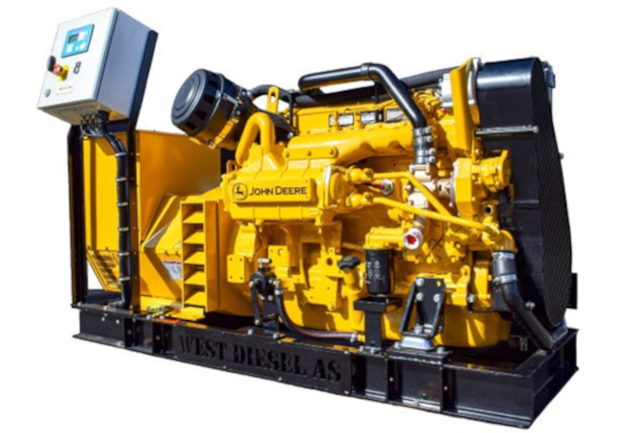
Purpose-built marine auxiliary sets with sea-water cooling and class approval, for vessels and marine installations where a land-based set cannot be used.
- Product range: 40 kVA to 500 kVA
- Engine: Powered by John Deere diesel
- Cooling: Sea-water cooled
- Approval: Marine type and class approval
- Enclosure: Closed canopy available for sound attenuation
- Control: Programmable control panel with synchronisation
Class approval is not a paperwork formality — it governs whether the set can be installed on a classed vessel at all, and it needs to be confirmed at enquiry stage rather than discovered at survey.
View the marine diesel generator range
2. GPS Industrial Range — 10 kVA to 2,500 kVA

A broad range spanning building, industrial, agricultural and civil protection applications, specified against the site's engine and duty requirement.
- Product range: 10 kVA to 2,500 kVA
- Frame: Solid electro-welded steel frames with built-in varying-capacity tank
- Engines and alternators: Specified to the application
- Canopy: Steel construction, suitable for tropical environments
- Access: Canopies designed for maximum accessibility for maintenance and cleaning
- Customisation: Configured to load, duty rating and site requirement at order stage
Canopy access is worth weighting more heavily than most buyers do. In a dusty environment, radiator and filter servicing happens often, and an enclosure that makes it awkward results in maintenance being deferred.
Not sure which configuration fits your site?
Send us your load, duty pattern, run-time requirement between refuelling and any site noise limits — our team will specify the set and return a cost proposal.
Running a Diesel Generator in UAE Conditions
Heat, dust and fuel quality are the three variables that determine whether a diesel set reaches its expected service life in this region.
- Heat reduces available output and stresses cooling: Ratings assume reference ambient conditions, and summer temperatures take the machine well outside them. Enclosure ventilation, radiator sizing and clearance around the set all become part of the specification rather than installation details. A canopied set boxed into a plant room with inadequate air movement will run hot and derate itself.
- Dust attacks filtration and cooling surfaces: Air filters load faster than temperate-climate service schedules assume, and radiator fins block with fine sand. Both should be inspected on a schedule matched to the actual environment, particularly on construction and quarry sites where the load is far higher than on a sealed facility.
- Fuel quality and storage matter more than most operators expect: Diesel degrades in storage, and standby installations are especially exposed because fuel can sit for months. Water ingress, microbial growth and particulate contamination all present as engine faults. Regular fuel testing and polishing on long-standing bulk tanks prevents the failure that only reveals itself the day the set is genuinely needed.
- Light loading causes long-term damage: A diesel engine running far below its rated output for extended periods does not reach proper operating temperature, which leads to incomplete combustion and deposit build-up. On standby installations this is why periodic load testing at a meaningful percentage of rating is part of maintenance, not an optional extra.
Enclosure, Silencing and Installation
The set is one component. How it is housed determines noise compliance, cooling performance and how easily it can be maintained.
- Canopy grade: A closed canopy provides sound attenuation and weather protection while allowing the airflow the machine needs. Steel canopies rated for tropical environments are the appropriate specification for UAE installation.
- Silencer grade: Industrial, residential and hospital grades are genuinely different products with different attenuation levels. The requirement is set by the location and by local noise limits, and it should be confirmed before order rather than retrofitted.
- Fuel arrangement: Built-in tanks give a defined run time. Where that is insufficient, external bulk tanks with a transfer and level monitoring system extend it. Bunding and fire separation requirements apply and should be designed in.
- Exhaust and ventilation: Exhaust routing, silencer placement and the ventilation path through the enclosure all affect both noise and cooling. These are design decisions, not site improvisations.
Why Choose GENAVCO as Your Diesel Generator Supplier in the UAE
Buying the machine is the easy part. What determines whether the investment performs is everything that happens afterwards.
- Part of Juma Al Majid Holding Group: Decades of established presence in the UAE market and the financial stability that comes with a major regional group — this matters when you are signing multi-year service agreements.
- Authorised GPS representation: Genuine equipment, factory-backed specification and full warranty integrity — not grey-market imports with uncertain parts availability.
- In-country spare parts inventory: Filters, belts and service items are consumed faster in dusty conditions. Our genuine spare parts operation holds stock locally so scheduled servicing is not delayed waiting on shipment.
- Certified service and maintenance: Scheduled servicing, preventive maintenance programmes and breakdown response through our repairs and maintenance division across Dubai, Abu Dhabi, Sharjah and the wider UAE.
- Operator training: Correct starting procedure, daily checks and load testing discipline extend engine life considerably. Our operator training centre covers safe operation and routine maintenance.
- Installation and commissioning: Site preparation, enclosure positioning, fuel system and changeover handled as one scope rather than a machine delivered and left to be integrated by others.
- Range depth across duty types: Industrial, marine, containerised and compact sets from one supplier, so the recommendation follows the application rather than the inventory.
Common Diesel Generator Problems — and What Causes Them
- Failure to start on demand: Most often battery condition or fuel degradation rather than the engine itself. Both are prevented by scheduled testing, and both are the classic standby installation failure.
- Running hot or derating in summer: Enclosure ventilation, blocked radiator fins or insufficient clearance around the set. Usually an installation issue rather than a machine fault.
- Wet stacking and deposit build-up: Extended light loading preventing the engine reaching operating temperature. Corrected by periodic load testing at a meaningful percentage of rating.
- Rapid air filter blockage: Normal in dusty environments. The fault is a service interval copied from a temperate-climate schedule rather than matched to the site.
- Fuel system faults on standby sets: Water, microbial growth or particulates in fuel that has been stored for months. Fuel testing and polishing prevent it.
- Voltage dip when large motors start: A sizing issue rather than a fault — the starting load exceeded what the set was specified to absorb.
Frequently Asked Questions
How does a diesel generator work?
A diesel engine compresses air until it is hot enough to ignite injected fuel without a spark, and the resulting expansion drives the crankshaft. That rotation turns an alternator, which produces the electrical output. A governor holds engine speed constant so output frequency remains stable as load changes.
What is the difference between a 1500 rpm and a 3000 rpm generator?
A 1500 rpm set runs slower with larger components, giving longer service life and lower noise, which suits continuous, prime and standby duty. A 3000 rpm set is smaller, lighter and lower cost for the same output, which suits intermittent and light commercial demand.
How often should a standby diesel generator be tested?
Standby sets should be run and load tested on a regular schedule so that battery condition, fuel quality and starting reliability are confirmed before they are needed. Testing at a meaningful percentage of rating also brings the engine to proper operating temperature, which prevents deposit build-up from extended light running.
Do diesel generators lose output in UAE summer heat?
Yes. Published ratings assume reference ambient conditions, and available output falls as temperature rises. Enclosure ventilation, radiator condition and clearance around the set all become more important, and the specification should reflect actual site conditions.
How long can a diesel generator run continuously?
A prime-rated set is designed for unlimited running hours on a variable load, so run time is governed by refueling and scheduled servicing rather than by the machine. A standby-rated set is not intended for continuous duty and should not be specified for it.
Does GENAVCO supply spare parts and servicing for diesel generators in the UAE?
Yes. GENAVCO holds genuine parts in-country and operates a certified service network covering Dubai, Abu Dhabi, Sharjah and the wider UAE, with installation, commissioning, preventive maintenance programmes and breakdown support.
Ready to Specify Your Diesel Generator?
A diesel set specified against the correct duty rating, housed with adequate cooling and silencing, and maintained on a schedule matched to UAE conditions will still be starting reliably years after a cheaper mis-specified installation has become a liability.
GENAVCO supplies the full GPS range across the UAE — industrial, marine and containerised — backed by installation, commissioning, genuine parts and certified service. For a broader view of the options, see our guide to choosing a power generator.
Tell us your load, your duty and your site conditions. We will specify the set and price it properly.
ENQUIRE NOW — GET YOUR DIESEL GENERATOR QUOTE
Serving Dubai, Abu Dhabi, Sharjah and the wider UAE.