Ask most buyers what generator they are looking at and the answer will be an engine brand. Perkins, Cummins, Volvo, John Deere — the engine name has become shorthand for the whole machine, even though a generating set is an assembly in which the engine is one component among several.
That shorthand is not unreasonable. The engine determines fuel consumption, service intervals, parts availability and a large share of the purchase price. But it does not determine everything, and buying on engine badge alone is how installations end up correctly engineered and wrongly specified.
This guide covers what the engine actually decides in a generating set, why Perkins is so widely specified, what the other components contribute, and how engine selection works across the GENAVCO range.
What the Engine Determines — and What It Does Not
A generating set is four things bolted together: an engine, an alternator, a control system and a base frame with cooling, canopy and tank. Each governs different outcomes.
| Outcome | Determined mainly by | Notes |
|---|---|---|
| Fuel consumption | Engine | The single largest running cost over the machine’s life |
| Service intervals and parts cost | Engine | Availability of genuine parts locally matters more than list price |
| Response to sudden load | Engine and governor | How quickly the set recovers when a large motor starts |
| Voltage stability | Alternator and AVR | An engine cannot compensate for an undersized alternator |
| Output frequency | Engine speed and alternator poles | 1500 rpm on a four-pole alternator gives 50 Hz |
| Behaviour on non-linear load | Alternator | Variable speed drives and UPS loads heat the alternator |
| Changeover and integration | Control system | ATS, BMS and synchronisation are control decisions |
| Noise level | Canopy and silencer | Engine choice affects it, enclosure decides it |
The practical takeaway is that engine brand answers roughly half the question. The alternator and control side is covered in our guide to how a diesel generator works, and the selection framework across categories in our guide to choosing a power generator.
Why Perkins Is So Widely Specified
Perkins is one of the most commonly encountered engine brands in generating sets worldwide, and the reasons are practical rather than promotional.
- Very large installed base: Perkins engines have been fitted into generating sets for decades and across most capacity bands. That scale means technicians in almost every market have worked on them.
- Parts availability: A widely used engine is a widely stocked engine. In practical terms, parts availability affects downtime far more than any published reliability figure.
- Breadth of range: The engine family spans small single-set applications through to large industrial output, so a supplier can build a consistent product line without switching engine platforms as capacity increases.
- Familiar service procedures: Maintenance schedules, filter specifications and diagnostic routines are well documented and well understood, which reduces dependence on specialist proprietary support.
None of this makes any one engine brand automatically correct for a given installation. It explains why Perkins appears so often on shortlists, and why buyers frequently start their search with the engine name rather than the set.
Engine Options Across the GENAVCO Generator Range
GENAVCO supplies GPS power generation solutions across the UAE. Engine selection differs by range, and the table below sets out what each one uses.
| Range | Output band | Engine arrangement |
|---|---|---|
| Medium Voltage | 1000 – 3500 kVA | Perkins, Cummins, MTU or Mitsubishi |
| Marine Range | 40 – 500 kVA | John Deere diesel |
| GPS Industrial Range | 10 – 2500 kVA | Specified to application |
The medium voltage generating sets are where the engine choice is stated most explicitly, with four engine brands available and matched to alternators from Mecc Alte, Stamford, Leroy Somer or Marelli at output voltages from 3,000 V to 12,000 V. For the GPS Industrial Range, engine selection is specified against the application rather than fixed to a single brand.
Three ranges are worth looking at in detail, described here purely by what powers them.
1. Medium Voltage — Perkins, Cummins, MTU or Mitsubishi
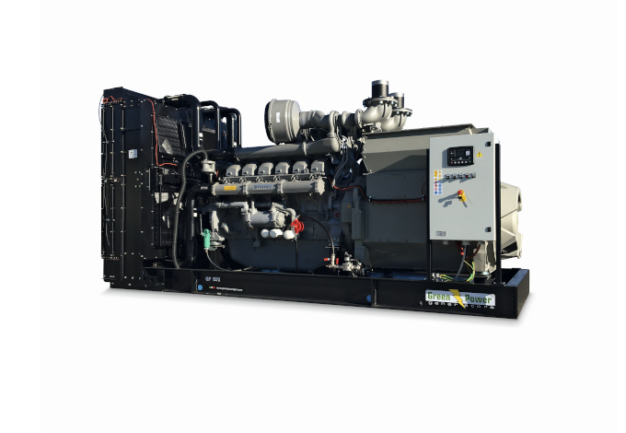
The only range in the GENAVCO lineup where the engine brand is stated explicitly, and the only one on which Perkins is named. At distribution voltage the engine and alternator are matched as a pair rather than selected independently.
- Engine brands: Perkins, Cummins, MTU or Mitsubishi
- Alternator brands: Mecc Alte, Stamford, Leroy Somer or Marelli
- Output range: 1,000 kVA to 3,500 kVA
- Output voltage: 3,000 V to 12,000 V
- Control: Automatic panel, or COMAP/DEEPSEA parallel panels
- Also supplied: Circuit breakers and power cables at medium and high voltage
If engine platform is a hard requirement on your project, this is the range where the choice is offered as a specification option rather than fixed at build.
View medium voltage generating sets
2. GPS Industrial Range — engine specified to application

The broadest range in the lineup, and one where the engine is matched to the application rather than being fixed to a single platform across the whole series.
- Engine sourcing: Engines supplied by leading world manufacturers in the sector
- Alternator sourcing: Alternators from leading world manufacturers in the sector
- Output range: 10 kVA to 2,500 kVA
- Running speed: 1500 rpm — lower cyclic stress per component than a 3000 rpm machine
- Control: State-of-the-art control units
- Build: Closed canopy for sound attenuation, configured to the specified load
Running at 1500 rpm rather than 3000 halves the number of combustion cycles per hour for the same output, which is the single largest factor in engine service life on a continuously running set — and it is independent of which brand is fitted.
View GPS Industrial Range generators
3. Marine Range — John Deere diesel
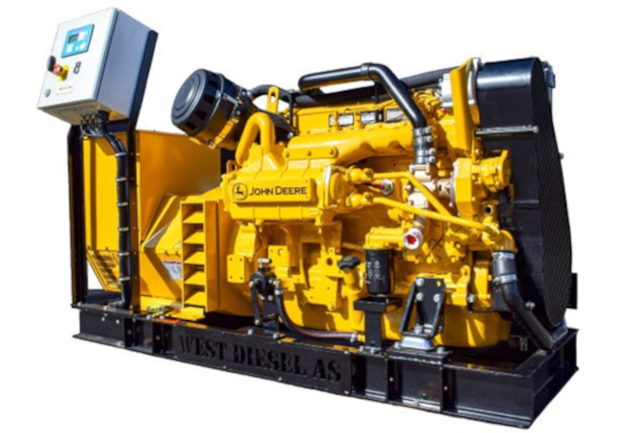
The one range built around a single named engine platform, reflecting the certification requirements that marine installation imposes.
- Engine: John Deere diesel
- Output range: 40 kVA to 500 kVA
- Cooling: Sea-water cooled
- Approval: Marine type and class approval
- Control: Programmable control panel with synchronisation
Engine choice is constrained here in a way it is not elsewhere in the range, because class approval applies to the installed package rather than to the set in isolation.
View the marine generator range
Need a set built around a specific engine platform?
Tell us your load, duty rating and any engine standardisation requirement across your existing fleet — our team will specify the set and return a cost proposal.
Advantages of Standardising on One Engine Platform
Where a site or fleet runs several generating sets, engine standardisation delivers benefits that have nothing to do with which brand is chosen.
- Smaller parts inventory: One filter specification, one belt set, one oil grade across the fleet rather than a store room holding variants for each machine.
- Faster fault resolution: Technicians build genuine familiarity with one platform, so diagnosis is quicker and errors less frequent.
- Simpler maintenance scheduling: Common service intervals across the fleet allow planned maintenance to be batched rather than tracked machine by machine.
- Better parts pricing: Consolidated demand for the same components gives more leverage on stocking arrangements.
- Reduced training burden: New technicians reach competence on the whole fleet rather than on individual machines.
- Predictable consumption data: Fuel and parts consumption across identical platforms is directly comparable, which makes budgeting and fault-spotting easier.
- Easier fleet expansion: Adding a machine of the same platform slots into existing service arrangements without renegotiating anything.
- Lower risk of obsolete stock: Parts held for one platform get used across the fleet instead of sitting against a single machine.
The Components Buyers Underweight
If the engine is the half of the machine everyone asks about, these are the parts that decide whether the installation performs.
- The alternator: Voltage stability under load steps, tolerance of non-linear loads and behaviour at leading power factor are all alternator characteristics. An excellent engine paired with an undersized alternator produces an installation that dips every time a large motor starts.
- The control system: Automatic transfer, synchronisation and building management integration determine whether the set runs unattended. These are specification items, not accessories, and retrofitting them is considerably more expensive than ordering them.
- The enclosure: Canopy construction and silencer grade set the noise level and, in UAE conditions, the cooling performance. A tropical-rated steel canopy with proper maintenance access is worth more in service than a marginal difference in engine specification.
- The fuel arrangement: Built-in tank capacity determines run time between refuelling. Where that is insufficient, external bulk tanks with transfer and level monitoring extend it, and that has to be designed rather than added.
Engine Selection in UAE Conditions
Ambient conditions affect every engine platform, and the specification has to account for them regardless of brand.
- Derating for temperature: Published output assumes reference ambient conditions. Summer temperatures reduce available output, so the specification and the enclosure ventilation both need to reflect real site conditions rather than datasheet figures.
- Filtration against dust: Air filters load faster here than temperate-climate service schedules assume, and radiator fins block with fine sand. Service intervals should be matched to the environment, particularly on construction and quarry sites.
- Fuel storage discipline: Diesel degrades in storage, and standby sets are especially exposed because fuel can sit for months. Water ingress, microbial growth and particulates present as engine faults regardless of engine brand.
- Load discipline: An engine running far below its rated output for extended periods does not reach proper operating temperature, leading to deposit build-up. Periodic load testing at a meaningful percentage of rating is part of maintenance on any platform.
Why Choose GENAVCO as Your Power Generation Partner in the UAE
Buying the machine is the easy part. What determines whether the investment performs is everything that happens afterwards.
- Part of Juma Al Majid Holding Group: Decades of established presence in the UAE market and the financial stability that comes with a major regional group — this matters when you are signing multi-year service agreements.
- Authorised GPS representation: Genuine equipment, factory-backed specification and full warranty integrity — not grey-market imports with uncertain parts availability.
- Engine-agnostic specification advice: We specify against your load, duty rating and site conditions, and will build around an engine standardisation requirement where your fleet has one. The recommendation follows the application rather than a single platform.
- In-country spare parts inventory: A standby set that fails on the day it is needed has cost more than it ever saved. Our genuine spare parts operation holds stock locally so servicing is not delayed waiting on shipment.
- Certified service and maintenance: Scheduled servicing, preventive maintenance programmes and breakdown response through our repairs and maintenance division across Dubai, Abu Dhabi, Sharjah and the wider UAE.
- Installation and commissioning: Site preparation, fuel system, changeover and commissioning handled as one scope rather than a machine delivered and left for others to integrate.
- Depth across the power category: Industrial, marine, containerised, medium voltage and lighting towers within our wider power generation and industrial equipment range.
Common Engine-Related Questions on Site
- Why is fuel consumption higher than the datasheet? Datasheet figures assume a specific load point and reference conditions. Real consumption depends on actual load percentage, ambient temperature and set condition. A set running at low load percentage is disproportionately inefficient.
- Why does the engine start but the set trip on load? Usually an alternator or control issue rather than an engine one. The engine running proves combustion; it says nothing about whether the alternator can carry the connected load.
- Why are filters needing replacement so often? Dust load. Service intervals published for temperate conditions do not transfer to UAE construction and quarry environments, and the interval should be shortened rather than the machine questioned.
- Does the engine brand affect resale value? Widely used platforms with strong regional parts support generally hold value better, because the next buyer is inheriting a machine they can service. Documented maintenance history matters at least as much.
Frequently Asked Questions
What does the engine brand actually determine in a generator?
The engine largely determines fuel consumption, service intervals, parts cost and how the set responds to sudden load. It does not determine voltage stability, behaviour on non-linear loads, transfer switching or noise level — those are set by the alternator, the control system and the enclosure.
Why is Perkins so commonly specified in generating sets?
Perkins engines have a very large installed base across most capacity bands, which means widespread technician familiarity and strong parts availability. In practice, parts availability affects downtime more than any published reliability figure, which is why widely used platforms are frequently shortlisted.
Should I standardise my fleet on one engine platform?
Where a site runs several sets, standardising reduces parts inventory, simplifies maintenance scheduling, shortens fault diagnosis and lowers the training burden. It is a legitimate constraint to build a specification around, independent of which platform is chosen.
What engines are used across the GENAVCO generator range?
Medium voltage sets from 1,000 to 3,500 kVA are available with Perkins, Cummins, MTU or Mitsubishi engines. The marine range uses John Deere diesel. The GPS Industrial Range, from 10 kVA to 2,500 kVA, uses engines specified to the application.
Does engine choice change how a generator performs in UAE heat?
Every platform derates as ambient temperature rises, so the specification and enclosure ventilation matter more than brand. Filtration service intervals also need shortening for regional dust levels regardless of which engine is fitted.
Does GENAVCO supply spare parts and servicing for generators in the UAE?
Yes. GENAVCO holds genuine parts in-country and operates a certified service network covering Dubai, Abu Dhabi, Sharjah and the wider UAE, with installation, commissioning, preventive maintenance programmes and breakdown support.
Ready to Specify Your Generating Set?
Engine brand is a reasonable place to start a conversation and a poor place to end one. Load, duty rating, alternator specification, control requirement and site conditions decide whether an installation performs — and a good engine cannot compensate for getting those wrong.
GENAVCO supplies the full GPS range across the UAE, with engine selection matched to the application and to any fleet standardisation requirement you already have.
Tell us your load, your duty and your engine preference. We will specify the set and price it properly.
ENQUIRE NOW — GET YOUR GENERATOR SPECIFICATION
Serving Dubai, Abu Dhabi, Sharjah and the wider UAE.