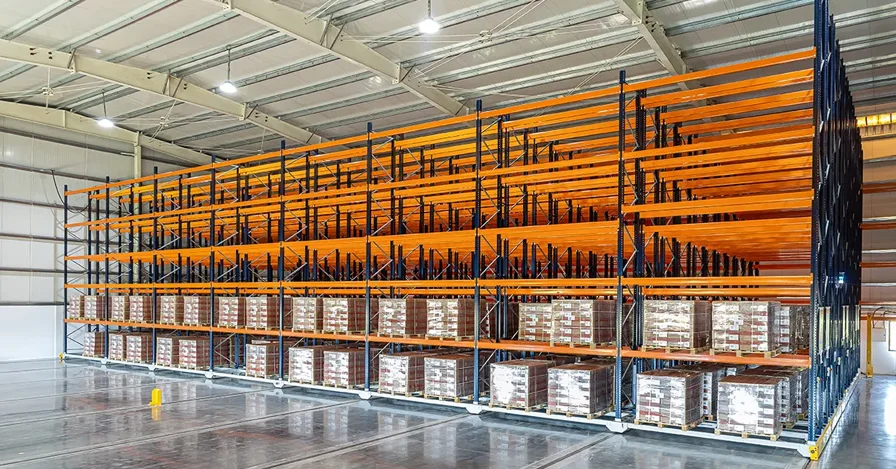
There are five ways to store a pallet, and the difference between them is not really about steel. It is about how many of your pallets you can reach without moving another one first.
That figure — selectivity — runs from one hundred percent down to a single face per lane, and every step down buys storage density in exchange. Get it right and the warehouse holds what it needs and works quickly. Get it wrong and either the building is half empty or the forklifts spend their day shuffling pallets to reach the one they want.
This guide compares all five pallet racking system types on the terms that actually decide the choice — SKU count, rotation and handling equipment — and sets out the Godrej range GENAVCO supplies in the UAE.
The Five Systems at a Glance
| System | Selectivity | Best suited to |
|---|---|---|
| Selective | 100% — every pallet accessible | Large SKU variety, any quantity |
| Double Deep | 50% — two pallets deep | Medium or lower SKU variety, paired pallets |
| Drive-in | One face per lane | Few SKUs produced or dispatched in batches |
| Shuttle | One face per lane, automated retrieval | Limited SKU variety, high throughput |
| Very Narrow Aisle | 100% — same as selective | Constrained floor area, high clear height |
Very narrow aisle is the one that surprises people. It is selective racking — full accessibility — but with the aisles narrowed to under two metres, so it recovers floor area without giving up any selectivity at all. The trade is equipment and floor tolerance rather than access.
SKU Profile Decides the System
One measure narrows the choice faster than anything else: how many different products you hold, relative to how much of each.
- Many SKUs, low quantity each: Any order might call for any product, so every pallet needs to be reachable. Selective racking, or very narrow aisle where the floor area is tight. Density systems would produce constant shuffling.
- Medium SKU variety, pallets in pairs: Where two pallets of the same product can reasonably sit one behind the other, double deep halves the number of aisles required while retaining workable access.
- Few SKUs, large quantities: Batch production or seasonal buffer stock. Drive-in or shuttle systems, where an entire lane holds one product and selectivity within the lane is irrelevant.
- Few SKUs but high throughput: Where density is needed but forklifts entering lanes would be too slow, shuttle systems provide the density with automated retrieval instead.
Count the product lines before measuring the building. A warehouse holding four hundred SKUs and one holding twelve need entirely different systems even at identical tonnage and identical footprint.
Rotation: The Constraint That Rules Systems Out
Stock rotation requirements can eliminate otherwise suitable systems, and this is best established early rather than discovered at commissioning.
- FIFO — first in, first out: Required for dated goods, batch-controlled material and anything with shelf life. Loading and retrieval must happen from opposite ends, or from a fully selective face.
- LIFO — last in, first out: Acceptable where product does not age or where batch integrity is not tracked. Loading and retrieval from the same face, which allows simpler and denser configurations.
- Selective and VNA suit either: Full accessibility means rotation is managed by the warehouse management system rather than by the physical layout.
- Drive-in and shuttle are configurable: Both can be set up for LIFO or FIFO dispatch, but the configuration is a design decision made before installation rather than a setting changed afterwards.
Advantages of Getting the Pallet System Right
These returns follow from matching the system to the stock profile rather than from the racking itself.
- Fewer handling movements per pallet retrieved: A system matched to SKU profile means loads are not moved aside to reach other loads, which is pure lost time on every occurrence.
- More pallet positions in the same building: Correct density and aisle choice can substantially increase capacity without extending the facility.
- Faster put-away and retrieval cycles: Accessible positions for fast-moving lines shorten travel across thousands of movements a week.
- Rotation enforced by layout: A system configured for the required rotation makes FIFO a property of the racking rather than of operator discipline.
- Lower equipment count: Efficient layouts require fewer machines to achieve the same throughput, which reduces both capital and operator cost.
- Reduced product damage: Fewer movements per pallet means fewer opportunities for impact damage to stock and structure.
- Scalable as volumes grow: Modular systems expand vertically and horizontally rather than requiring replacement.
- Predictable throughput: A layout matched to demand produces consistent cycle times that can be planned and resourced around.
Godrej Pallet Racking Systems Available in the UAE
GENAVCO supplies Godrej storage solutions in the UAE. All five pallet racking systems are available and specified against the stock profile rather than sold as standard configurations.
1. Selective Pallet Racking — 100% accessibility

The simplest and most economical racking system, and the default where product variety is high. Every pallet is directly accessible from the aisle.
- Selectivity: 100% accessibility to each pallet
- Suits: Large variety of SKUs irrespective of quantity
- Adaptability: Adaptable to varying pallet and load heights
- Configuration: Wide range of beams and uprights offering the optimal solution for any pallet size or load
- Applications: Raw material stores, finished goods stores, distribution centres
- Equipment: Compatible with most material handling equipment — forklift, stacker, reach truck
- Safety: Variety of racking accessories available to enhance safety during pallet handling
Compatibility with standard handling equipment is the practical advantage. Selective racking works with whatever forklifts an operation already runs, which makes it the lowest-risk starting point for a facility whose stock profile may change.
View Godrej selective pallet racking
2. Double Deep Pallet Racking — 50% selectivity, half the aisles
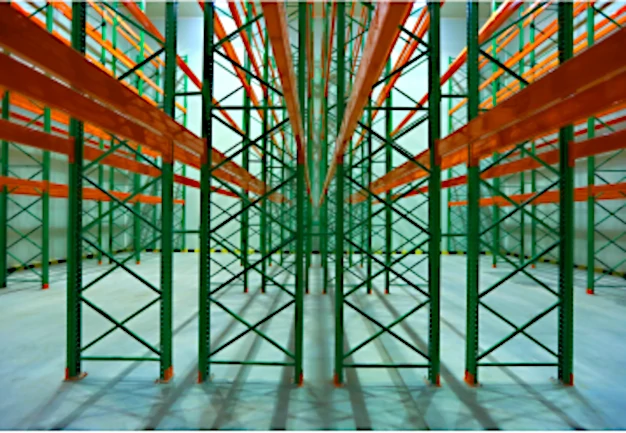
Two pallets stored one behind the other, which halves the number of aisles needed and converts that floor area into storage.
- Selectivity: 50% — two pallets deep
- Suits: Medium or lower SKU variety, irrespective of quantity
- Ideal configuration: Two pallets of the same SKU kept one behind the other
- Equipment requirement: Needs special material handling equipment with extended reach — telescopic or pantograph
- Scalability: Scalable vertically and horizontally
- Adaptability: Adaptable to varying pallet and load heights, with a wide range of beams and uprights
The equipment requirement is the item to settle first. Reaching the rear pallet needs a telescopic or pantograph reach truck, and that machine has to be specified alongside the racking. Ordering double deep racking without confirming the handling equipment leaves half the positions unreachable.
View Godrej double deep pallet racking
3. Drive-in Pallet Racking — maximum density for few SKUs
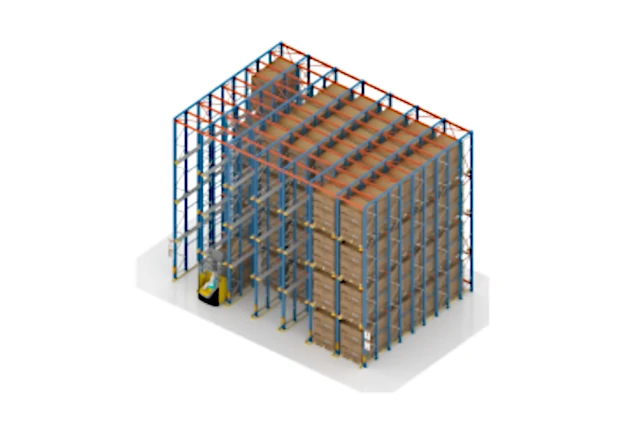
A dense storage system where handling equipment drives inside the racking structure to place and retrieve pallets, with each storage bay one pallet wide.
- Concept: Dense storage for few varieties of SKUs produced or dispatched in batches
- Operation: Material handling equipment such as reach trucks drive inside the racks to access pallets
- Bay configuration: Each storage bay is one pallet wide
- Rotation: Can be configured for LIFO or FIFO dispatch
- Suits: Industries involved in batch production
- Safety: Safety and stability elements to support operation, with a wide range of accessories
- Adaptability: Adaptable to varying pallet and load heights
Because the truck enters the structure, operator care matters more here than in any other system. Impact damage to internal rails is harder to spot than damage to an external upright, which makes scheduled inspection particularly important on drive-in installations.
View Godrej drive-in pallet racking
4. Shuttle Pallet Racking — density with automated retrieval
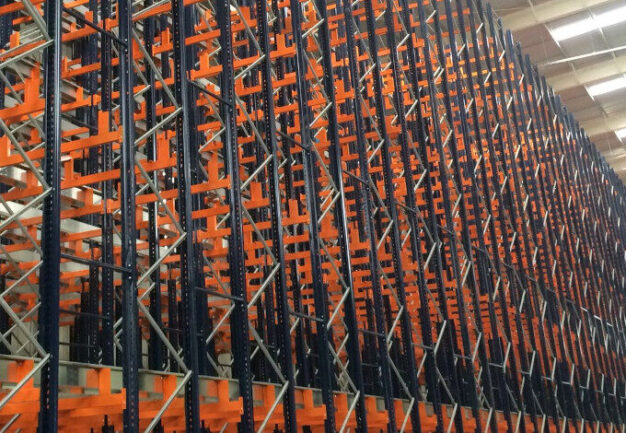
A shuttle travels within the racking to carry pallets to the forklift, so the truck never enters the structure. Density comparable to drive-in, with considerably faster throughput.
- Operation: Shuttle on racks carries pallets to the forklifts, moved within the racks by remote control
- Rotation: Configurable in LIFO or FIFO
- Performance: Fast throughput while improving storage density
- Suits: Industries with limited variety of SKUs; ideal for buffer storage managing seasonal demand
- Safety: Highly safe, as forklifts stay away from the racks
- Temperature: Operates in subzero temperatures down to –30°C
- Upgrade path: Upgradeable from current static racks
Two details make this system distinctive. Operating to –30°C makes it viable for cold storage, where dense storage matters most because refrigerated volume is expensive. And being upgradeable from existing static racks means an operation can move to shuttle without replacing the whole installation.
View Godrej shuttle pallet racking
5. Very Narrow Aisle Racking — full selectivity, recovered floor space
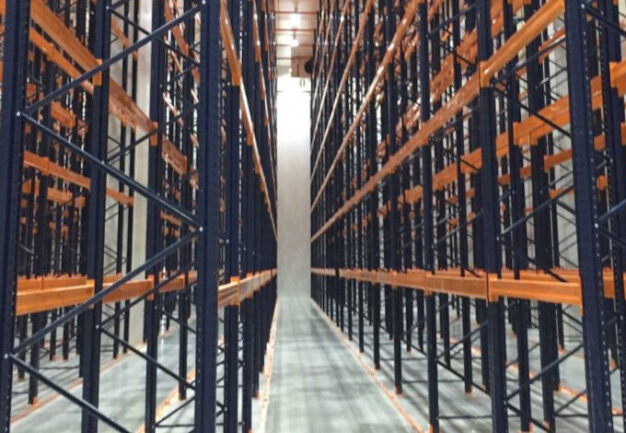
Selective pallet racking configured for VNA equipment, with aisles under two metres. Full accessibility is retained while a substantial share of the floor previously given to aisles becomes storage.
- Aisle width: Under 2 metres
- Height capability: VNA equipment can reach up to 18 metres
- Capacity effect: More pallet positions possible compared with other material handling equipment
- System basis: Selective pallet racking made compatible with VNA equipment
- Guidance required: Special guides — mechanical rails or electrical wires; mechanical rails widely used for ease and economy
- Floor requirement: VNA equipment demands a high level of floor accuracy
- Throughput: Offers fast throughput; scalable vertically and horizontally
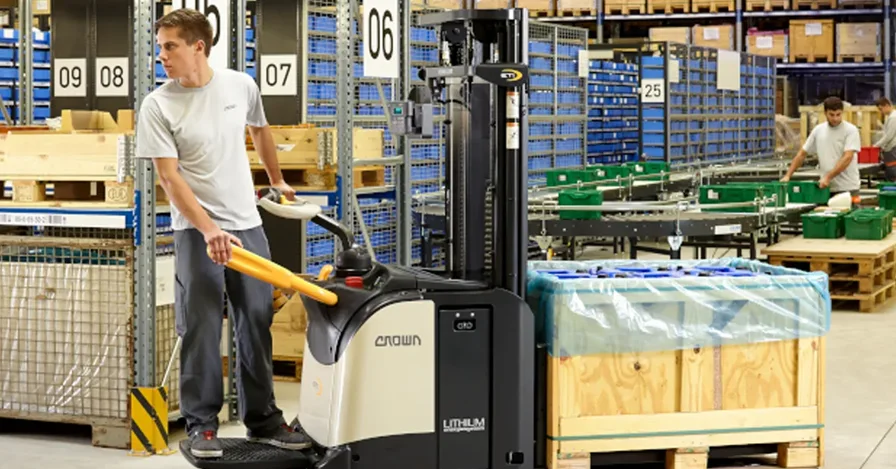
The floor accuracy requirement is the item that catches operations out. VNA equipment working at 18 metres needs a slab built to tight flatness tolerance, and that has to be established before the racking is designed rather than discovered during commissioning. The equipment side is covered by Crown reach trucks and VNA equipment, which GENAVCO specifies alongside the racking.
View Godrej very narrow aisle racking
Not sure which pallet system suits your stock?
Send us your SKU count, quantity held per line, pallet dimensions and weights, rotation requirement and clear height — our team will design the system and return a cost proposal.
How to Choose Between the Five
Step 1 - Count your SKUs and quantity per line. This single measure eliminates most of the options immediately. High variety points to selective or VNA; low variety with high volume points to drive-in or shuttle.
Step 2 - Establish the rotation requirement. Strict FIFO constrains the configuration of dense systems and must be designed in rather than added later.
Step 3 - Confirm the handling equipment. Double deep needs extended reach; VNA needs guided equipment and an accurate floor; drive-in needs trucks that enter the structure. Racking and equipment are one decision.
Step 4 - Measure the true clear height. Height to the lowest obstruction, not the roof. Sprinklers, services and lighting all reduce usable height and determine how many levels are achievable.
Step 5 - Check the floor before committing to VNA. Flatness tolerance for high-level narrow-aisle operation is a construction specification. Establish it before design.
Step 6 - Design for throughput as well as capacity. The configuration holding the most pallets is not always the one that moves them fastest. Fast lines need accessible positions.
Pallet Racking in UAE Warehouses
- Land cost pushes operations toward density and height: Where floor area is expensive, VNA and dense systems deliver better returns than extending the building. This is why narrow-aisle configurations are more common here than in markets with cheaper land.
- Cold storage makes density particularly valuable: Refrigerated volume is expensive to build and to run, so getting more pallets into the same cold envelope has a direct operating benefit. Systems rated to subzero temperatures matter for this reason.
- Re-export operations tend toward high SKU variety: The region’s distribution role means many facilities hold wide product ranges for onward shipment, which favours selectivity over density.
- High utilisation accelerates impact damage: Racking worked hard across long shifts accumulates damage from handling equipment. Scheduled structural inspection is what keeps a busy installation safe.
- Racking is an engineered structure: Load ratings, bracing and design sign-off are not optional on a system carrying tonnes of material above people working beneath it.
Why Choose GENAVCO for Pallet Racking in the UAE
Buying the steel is the easy part. What determines whether the installation performs is the design work before it and the support after it.
- Part of Juma Al Majid Holding Group: Decades of established presence in the UAE market and the financial stability that comes with a major regional group — this matters when you are signing multi-year service agreements.
- Authorised Godrej representation: Genuine engineered components with factory-backed load ratings — not generic steel of uncertain provenance and unverified capacity.
- Design against your stock profile: We specify from SKU count, load profiles, rotation requirements and future expansion rather than quoting a bay count. The system choice is worth more than the price per bay.
- Racking and handling equipment together: Double deep, drive-in and VNA each demand particular equipment. Our material handling and racking solutions cover both sides, so the aisle and the truck are specified as one decision.
- Installation and team training: We manage installation and train warehouse teams so the system is used as designed from the first shift.
- Scheduled inspection and structural audits: Racking accumulates impact damage in service. Our repairs and maintenance division provides inspections, structural audits and rapid component replacement.
Common Pallet Racking Mistakes
- Specifying density for a high-variety operation: Dense racking holding many product lines produces constant load shuffling. The handling cost exceeds the space saved, often within the first year.
- Ordering double deep without extended-reach equipment: The rear pallet cannot be reached with standard forklifts, leaving half the positions unusable.
- Committing to VNA before checking the floor: Flatness tolerance for high-level narrow-aisle work is a construction specification. Remediating a slab after installation is expensive and disruptive.
- Setting rotation configuration too late: Drive-in and shuttle systems are configured for LIFO or FIFO at design stage. Changing afterwards means reconfiguring the installation.
- Measuring to the roof rather than the obstruction: Sprinklers, lighting and services reduce usable height. Designing to the wrong figure loses a level or fails inspection.
- Skipping inspection on drive-in systems: Trucks entering the structure cause internal damage that is harder to see than damage to an external upright.
Frequently Asked Questions
Which pallet racking system should I choose?
Start with SKU count and quantity held per line. Many product lines in small quantities point to selective racking, or very narrow aisle where floor area is constrained. Few product lines in large quantities point to drive-in or shuttle systems. Rotation requirements and available handling equipment then narrow it further.
What does selectivity mean in pallet racking?
Selectivity is the proportion of pallets you can reach without moving another one first. Selective racking offers 100% accessibility. Double deep offers 50%, since one pallet sits behind another. Drive-in and shuttle systems present one face per lane, so selectivity within the lane is limited.
What is the difference between drive-in and shuttle racking?
Both provide high-density storage for limited SKU varieties. With drive-in, handling equipment drives inside the racking to place and retrieve pallets. With shuttle racking a remote-controlled shuttle carries pallets within the racks and the forklift stays outside, which gives faster throughput and reduces impact risk to the structure.
Can pallet racking be used in cold storage?
Yes. Shuttle pallet racking operates in subzero temperatures down to minus 30 degrees Celsius, which suits cold storage where dense storage is particularly valuable because refrigerated volume is expensive to build and run.
What handling equipment does each system need?
Selective racking works with most standard equipment including forklifts, stackers and reach trucks. Double deep requires extended reach equipment with telescopic or pantograph forks. Drive-in requires trucks that enter the structure. A very narrow aisle requires guided VNA equipment and an accurate floor.
Does GENAVCO install and maintain pallet racking in the UAE?
Yes. GENAVCO manages installation, trains warehouse teams, and provides scheduled inspections, structural audits and component replacement across Dubai, Abu Dhabi, Sharjah and the wider UAE.
Ready to Design Your Pallet Storage?
The five systems are not better or worse than one another — they answer different questions. Count the SKUs, establish the rotation requirement, confirm the equipment, and the right system becomes obvious rather than a matter of preference.
GENAVCO supplies all five Godrej pallet racking systems across the UAE, with layout design, installation, team training and scheduled structural inspection. For the wider selection framework, see our guide to choosing a warehouse racking system.
Tell us your SKU profile and rotation requirement. We will design the system and price it properly.
ENQUIRE NOW — GET YOUR PALLET RACKING DESIGN
Serving Dubai, Abu Dhabi, Sharjah and the wider UAE.