Forklifts are involved in a disproportionate share of serious warehouse injuries every year, and the majority of those incidents trace back to preventable factors — pedestrian interaction, load instability, or equipment that wasn't properly inspected before the shift began. Safety in a warehouse isn't primarily a training problem or a signage problem; it's substantially an equipment and process problem, and it starts with the machines doing the heaviest lifting. This guide looks at the most common warehouse safety risks, how modern forklift technology addresses them directly, and the operational practices that keep a warehouse genuinely safe day to day.
Common Warehouse Safety Risks
Most warehouse incidents aren't caused by a single dramatic failure — they're the result of routine risks that become serious only when they intersect with a moment of inattention or an equipment limitation.
Pedestrian Safety
Pedestrian and forklift interaction is one of the most consistent sources of serious warehouse injury, and the risk is structural rather than incidental — forklifts have significant blind spots, particularly when reversing or carrying a load that obstructs forward visibility, and pedestrians moving through mixed-traffic aisles don't always anticipate a machine's turning radius or stopping distance. Physical segregation of pedestrian and vehicle routes reduces this risk far more reliably than signage or awareness campaigns alone, since it removes the opportunity for the interaction rather than relying on both parties noticing each other in time.
Load Stability
An unstable or improperly positioned load is one of the leading causes of forklift tip-overs, and the physics involved leave very little margin for error — exceeding rated capacity, carrying a load too high, or cornering too fast with an elevated load can shift a forklift's centre of gravity past the point of recovery in a fraction of a second. Understanding a machine's load chart and stability triangle isn't optional operator knowledge; it's the difference between routine handling and a tip-over incident that puts both the operator and anyone nearby at serious risk.
How Modern Forklifts Improve Workplace Safety
Equipment design has advanced significantly on exactly these risk categories, building safety features directly into the machine rather than relying solely on operator vigilance. Our electric forklift guide covers the broader technology shift behind these improvements in more depth.
Ergonomic Operator Controls
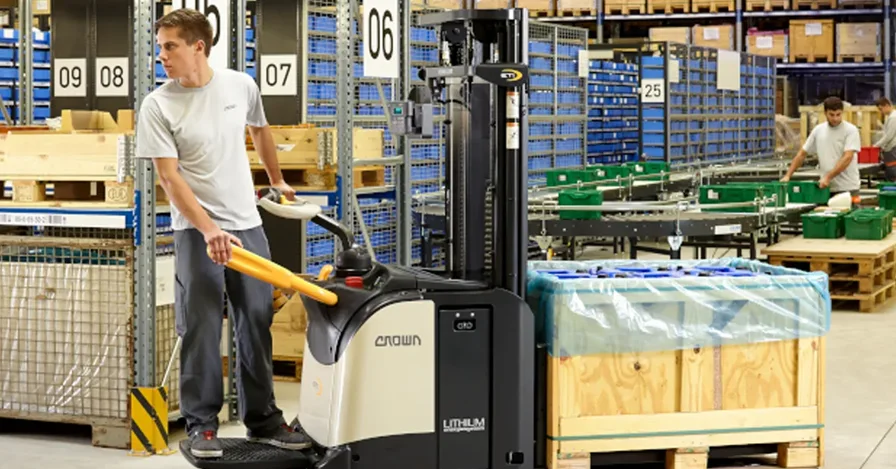
Fatigue and awkward control positioning both increase the likelihood of operator error over a long shift, which is why modern forklift cabin design has moved toward intuitive, low-effort control layouts, improved sightlines, and reduced vibration transmission. An operator who isn't fighting an uncomfortable seating position or straining to see around a mast after six hours on shift makes fewer of the small judgement errors that compound into serious incidents.
Advanced Braking Systems
Regenerative braking on modern electric forklift platforms provides more consistent, predictable deceleration than older mechanical systems, particularly in high-frequency stop-start operations where braking performance directly affects both safety and control precision. Some systems also include automatic speed reduction when cornering or when a load sensor detects an unstable condition, intervening before the operator's own reaction time becomes the limiting factor in preventing an incident.
Creating a Safer Warehouse Environment
Equipment safety features only deliver their full value inside an operational environment that supports them with consistent process and genuinely qualified operators.
Preventive Equipment Inspections
A pre-shift inspection checklist — brakes, tyres, forks, hydraulic function, warning devices — catches developing faults before they become the mechanical failure behind an incident, and it takes only a few minutes when it's built into standard shift procedure. Our warehouse safety and material handling equipment range is specified with inspection accessibility in mind, since equipment that's difficult to inspect quickly tends to get inspected less thoroughly under time pressure, regardless of how well-intentioned the checklist is.
Operator Certification
Certified, refreshed training consistently correlates with lower incident rates, not because certification itself prevents accidents, but because the training process builds genuine understanding of load charts, stability limits, and site-specific hazards that a one-time induction rarely covers in sufficient depth. Recertification on a regular cycle, rather than a single certification at hire that's never revisited, keeps that knowledge current as equipment, layouts, and site conditions change over an operator's tenure.
Frequently Asked Questions
What is the most common cause of forklift accidents in warehouses?
Pedestrian and vehicle interaction, along with load instability from exceeding capacity or improper load positioning, account for a large share of serious forklift incidents. Both risks are addressed more effectively through physical traffic segregation and operator training on load limits than through signage alone.
How often should forklifts be inspected for safety?
A documented pre-shift inspection is standard practice before every shift, covering brakes, tyres, forks, hydraulic function, and warning devices. This catches developing mechanical issues before they become the cause of an incident, in addition to periodic more thorough scheduled maintenance checks.
Does electric forklift technology actually improve safety compared to older equipment?
Yes — regenerative braking, improved sightlines, and in some models automatic speed reduction on cornering or unstable load detection all reduce the margin for operator error compared to older mechanical systems, particularly in high-frequency stop-start warehouse environments.
Conclusion
Warehouse safety isn't something that gets solved with a policy document or a safety poster — it's built into the equipment operators use every shift and the processes that surround it. Physically separating pedestrian and vehicle traffic, understanding load stability limits, and choosing forklifts with modern ergonomic and braking technology all reduce risk at the source rather than relying on operators to compensate for equipment or process gaps. Pairing that equipment with consistent pre-shift inspections and genuinely current operator certification is what turns a warehouse from one that's technically compliant into one that's actually safe to work in. If you're reviewing your warehouse safety practices and want help specifying equipment that supports safer operations, Genavco's material handling team can help match the right forklifts to your facility.