No generator is silent. The term describes a set built to run quietly enough for the location it serves — a hospital courtyard, a hotel basement, a residential-adjacent site, a facility working through the night. What counts as quiet enough is set by the location, not by the marketing.
This matters commercially because acoustic performance is one of the few generator specifications that is difficult and expensive to fix after installation. Output can be supplemented with a second set. Noise has to be designed in.
This guide covers how a silent generator actually achieves low noise, what canopy and silencer grades mean in practice, how to read a dB(A) figure properly, and the acoustic options available across the GENAVCO range.
Where Generator Noise Comes From
A generating set produces noise from four distinct sources, and each is treated differently. Understanding which one dominates is what makes an acoustic specification effective rather than expensive.
- Exhaust noise: The loudest single source on most sets, and the one that responds best to treatment. Exhaust silencers are graded by attenuation level, which is why the same machine can be supplied at very different noise ratings.
- Engine and mechanical noise: Combustion, valve train and injection noise radiating from the engine block. This is addressed by the canopy — its construction, its lining and how well it seals.
- Cooling fan and airflow noise: Often underestimated. A canopy has to admit and exhaust large volumes of cooling air, and those openings are also the path noise takes out. Attenuated air paths are what allow an enclosure to be both quiet and adequately cooled.
- Structure-borne vibration: Transmitted through the base into the slab and building structure. Anti-vibration mounting matters particularly on rooftop and basement installations, where the structure itself can radiate noise into occupied space.
A specification that treats only the exhaust will disappoint, because the fan and casing noise then dominate. This is the most common reason an installation fails to meet a limit it was supposedly specified for.
Reading a dB(A) Figure Correctly
Acoustic figures are only comparable when quoted the same way, and they frequently are not.
- Distance changes everything: A noise level is meaningless without the distance it was measured at. Sound pressure falls with distance from the source, so a figure quoted at 7 metres and one quoted at 1 metre describe very different machines. Always confirm the measurement distance before comparing two quotations.
- The decibel scale is logarithmic: A 10 dB reduction is perceived as roughly halving the loudness, and small numerical differences represent large changes in acoustic energy. A few decibels is not a rounding difference.
- Load condition matters: A set measured at no load is quieter than the same set under full load. Figures should state the condition they were measured under.
- Site conditions modify the result: Reflective surfaces, enclosures, courtyards and adjacent buildings all change what actually arrives at the boundary. A free-field figure is a starting point, not a prediction of site compliance.
The practical rule: when a noise limit applies, get the requirement stated as a level at a defined position, and specify against that rather than against a headline figure.
Canopy and Silencer Grades
Two separate specification decisions control the outcome, and they are frequently confused with each other.
- The canopy: A closed canopy provides sound attenuation together with weather and dust protection, while allowing the airflow the machine needs. Steel construction rated for tropical environments is the appropriate specification for UAE installation, and maintenance access should be weighted heavily — in a dusty environment, radiator and filter servicing happens often, and an enclosure that makes it awkward results in maintenance being deferred.
- The silencer: Exhaust silencers are supplied in grades — industrial, residential and hospital — which are genuinely different products with different attenuation levels, not marketing tiers. The grade required is set by the location and by the applicable noise limit.
These are ordered together. Specifying a high-grade silencer on a basic canopy, or the reverse, produces an unbalanced installation where one path dominates and the money spent on the other is wasted.
Acoustic Options Across the GENAVCO Range
GENAVCO supplies GPS power generation solutions in the UAE. The table below sets out the acoustic provision available on each range.
| Range | Acoustic provision | Output band |
|---|---|---|
| Industrial Range | Closed canopy; silencer in hospital, residential or industrial grade | 10 – 2500 kVA |
| Containerised sets | Non-silenced, or silenced up to 50 dB(A) at 7 m | Per set installed |
| Marine Range | Closed canopy available for sound attenuation | 40 – 500 kVA |
Three ranges are worth looking at in detail, described here purely by their acoustic provision.
1. Industrial Range — three graded silencer options

The only range in the lineup where exhaust attenuation is offered as a graded specification, which makes it the range to specify against a defined noise limit.
- Silencer grades: Hospital, residential or industrial
- Enclosure: Closed canopy for sound attenuation
- Output range: 10 kVA to 2500 kVA
- Frequency: Can be supplied as 50 Hz or 60 Hz
- Integration: Compatible with BMS, ATS and synchronisation
The grade is an order-stage decision and the most consequential one on this page. Hospital grade is a physically different silencer from industrial grade, and fitting the higher grade later means working in the space already built around the installed set.
View the industrial generator range
2. Marine Range — closed canopy in a confined space
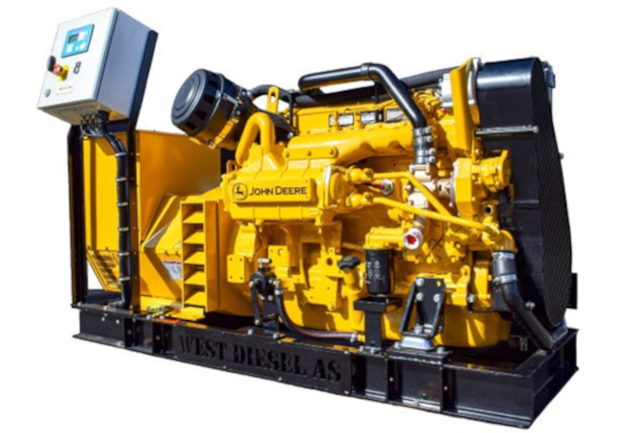
Acoustic treatment matters differently at sea. The set sits inside a hull with accommodation nearby and no boundary distance to fall back on, so attenuation is measured against occupied space a few metres away.
- Enclosure: Closed canopy available for sound attenuation
- Output range: 40 kVA to 500 kVA
- Cooling: Sea-water cooled — no radiator fan noise path to the space
- Approval: Marine type and class approval
- Control: Programmable control panel with synchronisation
Sea-water cooling removes one of the four noise sources entirely. With no radiator fan drawing and exhausting air through the enclosure, the airflow path that usually dominates a canopied set does not exist.
View the marine generator range
Working to a specific noise limit?
Send us the limit, the position it applies at, and the distance from the proposed generator location — our team will specify the canopy and silencer grade to meet it and return a cost proposal.
Advantages of Specifying Acoustics Properly
These benefits follow from getting the enclosure and silencing right at order rather than after installation.
- Compliance without retrofit: Meeting the site noise limit on commissioning avoids remedial acoustic work, which is expensive and often constrained by the space already built around the set.
- Night running becomes viable: A set that meets residential-adjacent limits can run outside working hours, which matters for testing schedules and for prime-power operations.
- Fewer complaints and fewer restrictions: Noise complaints tend to result in operating restrictions, and restrictions on a standby set are a resilience problem, not just an administrative one.
- Better working conditions nearby: Lower noise around the plant area reduces the need for hearing protection zones and makes adjacent work more practical.
- Weather and dust protection included: A properly built canopy protects the set from the same conditions that shorten component life in the region.
- Maintenance stays on schedule: An enclosure designed for access means servicing gets done rather than deferred, which matters more in dusty conditions than in temperate ones.
- Wider siting options: A quieter set can be positioned closer to occupied buildings, which shortens cable runs and simplifies the installation.
- Protected asset value: Acoustic and weather protection is difficult to add later, so a well-enclosed set holds its position in the market better.
Acoustics and Cooling: The Tension to Manage
Every acoustic decision has a cooling consequence, and in UAE conditions that tension is the central design problem.
- An enclosure has to breathe: A generating set rejects a large quantity of heat, and the canopy must admit cool air and exhaust hot air continuously. Those openings are also the primary escape path for noise, which is why attenuated air paths — rather than simply smaller openings — are what make an enclosure work.
- Ambient temperature narrows the margin: Published output assumes reference conditions, and available output falls as temperature rises. An acoustic enclosure that restricts airflow compounds that, so the two have to be specified together rather than sequentially.
- Positioning matters as much as the canopy: A well-enclosed set placed where it recirculates its own hot air will still run hot. Clearance and orientation are part of the acoustic and thermal design, not site details.
- Dust closes the gap over time: Attenuated air paths and radiator fins both load with fine sand. Acoustic performance and cooling performance degrade together as they block, which is why service intervals should be set against the actual environment.
Where Acoustic Specification Matters Most
- Hospitals and healthcare facilities: Standby generation is mandatory and the surrounding environment is noise-sensitive, which is why hospital-grade silencing exists as a distinct specification.
- Hotels and hospitality: Guest-facing operations where plant noise carries a direct commercial cost, and where testing schedules have to work around occupancy.
- Residential-adjacent developments: Mixed-use buildings and sites bordering residential areas, where local limits apply at the boundary rather than at the machine.
- Offices and educational buildings: Occupied environments where standby sets sit close to working space and are tested during hours.
- Night-working construction sites: Road and infrastructure projects that work outside daytime hours specifically to reduce disruption, where plant noise would undo the benefit.
- Data centres and control facilities: Continuous operation close to occupied technical space, often with regular load testing built into the maintenance regime.
Why Choose GENAVCO as Your Power Generation Partner in the UAE
Buying the machine is the easy part. What determines whether the installation performs is everything that happens afterwards.
- Part of Juma Al Majid Holding Group: Decades of established presence in the UAE market and the financial stability that comes with a major regional group — this matters when you are signing multi-year service agreements.
- Authorised GPS representation: Genuine equipment, factory-backed specification and full warranty integrity — not grey-market imports with uncertain parts availability.
- Acoustic specification against a stated limit: We specify canopy and silencer grade against the noise limit at the position it applies, rather than quoting a headline figure and leaving compliance to be discovered at commissioning.
- In-country spare parts inventory: Attenuated air paths and filters load faster in regional dust. Our genuine spare parts operation holds stock locally so servicing is not delayed waiting on shipment.
- Certified service and maintenance: Scheduled servicing, preventive maintenance and breakdown response through our repairs and maintenance division across Dubai, Abu Dhabi, Sharjah and the wider UAE.
- Installation and commissioning: Enclosure positioning, ventilation path and exhaust routing handled as one scope, rather than a machine delivered and left for others to site.
- Range across every acoustic requirement: Graded silencing, tropical-rated canopies and containerised sets to a stated dB(A) figure, within our wider power generation and industrial equipment range.
Common Acoustic Problems — and What Causes Them
- Set louder in service than expected: Usually a comparison error — a figure quoted at one distance measured against a limit defined at another, or a no-load figure compared with in-service running.
- Noise complaints despite a silenced set: Frequently reflected sound from surrounding structures, or an exhaust discharging toward a boundary. Free-field figures do not predict site behaviour.
- Enclosure meets the limit but the set runs hot: Airflow restricted in pursuit of attenuation. Attenuated air paths, not smaller openings, are the correct solution.
- Acoustic performance degrading over time: Air paths and radiator fins loading with dust. Both acoustic and thermal performance fall together, and both recover with servicing.
- Vibration transmitted into the building: Structure-borne rather than airborne noise. Anti-vibration mounting is a separate specification item from the canopy and silencer.
- Retrofit quoted at several times the original cost: Acoustic treatment added after installation is constrained by the space already built around the set. This is why the grade is an order-stage decision.
Frequently Asked Questions
Are silent generators actually silent?
No. The term describes a set built with acoustic enclosure and silencing so it runs quietly enough for a noise-sensitive location. What counts as acceptable is set by the applicable limit at the position it applies, not by a product description.
What does dB(A) at 7 metres mean?
It is the sound level measured at a distance of 7 metres from the set. Distance is essential to the figure, because sound pressure falls as you move away from the source. A level quoted at 7 metres and one quoted at 1 metre describe very different machines, so always confirm the measurement distance before comparing quotations.
What is the difference between hospital, residential and industrial grade silencers?
They are different products with different levels of exhaust attenuation, not marketing tiers. Hospital grade provides the greatest attenuation, industrial grade the least. The grade required is determined by the location and the applicable noise limit, and it should be specified at order.
Does a silent canopy affect generator cooling?
It can, if specified poorly. A generating set rejects a large amount of heat and the enclosure must admit and exhaust cooling air continuously. Attenuated air paths allow an enclosure to be quiet without restricting airflow, which matters particularly in UAE ambient temperatures.
Can acoustic treatment be added after installation?
It can, but it is considerably more expensive and often constrained by the space already built around the set. Canopy and silencer grade are order-stage decisions for this reason.
Does GENAVCO supply spare parts and servicing for generators in the UAE?
Yes. GENAVCO holds genuine parts in-country and operates a certified service network covering Dubai, Abu Dhabi, Sharjah and the wider UAE, with installation, commissioning, preventive maintenance programmes and breakdown support.
Ready to Specify Your Acoustic Requirement?
Noise is one of the few generator specifications that cannot be corrected cheaply after the fact. Get the limit stated, the measurement position defined, and the canopy and silencer grade specified against it, and the installation passes on commissioning instead of becoming a remedial project.
GENAVCO supplies graded silencing, tropical-rated canopies and containerised sets to stated acoustic figures across the UAE, backed by installation, commissioning, genuine parts and certified service. For the wider selection framework, see our guide to choosing a power generator.
Tell us your noise limit and where it applies. We will specify the enclosure to meet it.
ENQUIRE NOW — GET YOUR ACOUSTIC SPECIFICATION
Serving Dubai, Abu Dhabi, Sharjah and the wider UAE.