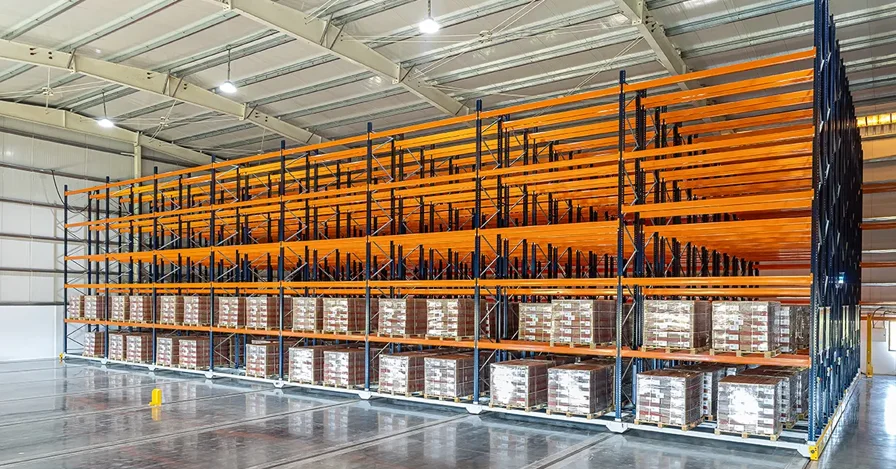
Drive-in racking trades individual pallet access for density, and for warehouses storing a few SKUs in high quantity, that trade almost always pays off. A forklift drives directly into the racking lane to place or retrieve pallets, eliminating the aisle space that selective racking needs between every row.
This guide covers how drive-in racking works, when it's the right choice over selective racking, and the Godrej drive-in racking system GENAVCO supplies across the UAE.
What Drive-In Racking Actually Does
Drive-in racking uses continuous rail-supported lanes rather than individual bays, letting a forklift drive directly into the structure to place pallets on rails at each level. Pallets are stored on a last-in-first-out (LIFO) basis within each lane, since the forklift can only access the lane from one end.
Drive-In Racking vs Selective Racking
| Factor | Drive-in racking | Selective racking |
| Storage density | High - no aisle needed between every row | Lower - aisle needed for every row |
| Pallet access | LIFO within each lane, limited selectivity | 100% direct access to every pallet |
| Best suited to | Few SKUs, high quantity per SKU, bulk storage | High SKU count, frequent individual pallet picking |
| Typical industries | Cold storage, FMCG, bulk manufacturing supply | Distribution, e-commerce, mixed-SKU warehousing |
Godrej Drive-In Racking Available in the UAE
| Product | Type | Suited to |
| Drive-in Pallet Racking | Dense storage racking | Few varieties of SKUs produced or dispatched in bulk |
1. Godrej Drive-In Pallet Racking
- Positioned by Godrej as: a dense storage system conceptualised for managing few varieties of SKUs produced or dispatched in bulk.
- Best suited to: operations storing high quantities of a small number of SKUs, where density matters more than individual pallet access.
Not sure whether drive-in racking suits your SKU profile?
Send us your SKU count, quantity per SKU and pallet weight - our team will confirm whether drive-in racking is the right fit.
How to Specify Drive-In Racking
- Step 1 - Confirm your SKU count and typical quantity held per SKU - drive-in racking suits few SKUs in high quantity, not wide product ranges.
- Step 2 - Accept the LIFO access pattern - drive-in racking isn't suited to stock requiring first-in-first-out rotation without careful lane management.
- Step 3 - Check forklift compatibility - drive-in lanes need a forklift sized and manoeuvrable enough to enter the lane safely.
- Step 4 - Plan lane depth against typical pallet quantity per SKU to avoid excess or insufficient lane length.
Drive-In Racking in UAE Warehouses
- Land cost favours dense storage: drive-in racking's high density per square metre is particularly valuable where UAE warehouse floor space is expensive.
- Bulk import and re-export operations: high-quantity, limited-SKU storage patterns common in UAE distribution and re-export suit drive-in racking well.
- Cold storage applications: drive-in racking is commonly used in UAE cold storage facilities where minimising exposed aisle space also helps temperature control.
Why Choose GENAVCO for Drive-In Racking in the UAE
- Part of Juma Al Majid Holding Group: decades of established presence in the UAE market and the stability of a major regional group.
- Authorised Godrej representation: genuine racking systems with engineered structural design, not generic catalogue components.
- Layout planning around your SKU profile: GENAVCO plans lane depth and configuration around your actual stock pattern, not a standard template.
- Installation and structural sign-off: GENAVCO manages installation and ensures racking is designed and certified as the load-bearing structure it is.
- Scheduled inspections: ongoing structural audits that keep dense storage systems safe and compliant over time.
Common Drive-In Racking Mistakes
- Choosing drive-in racking for high-SKU-variety stock: the LIFO access pattern penalises operations needing frequent access to many different SKUs.
- Ignoring lane depth planning: lanes too deep for typical SKU quantity waste capacity; lanes too shallow undersell the density benefit.
- Underestimating forklift manoeuvring requirements: not every forklift is suited to entering drive-in lanes safely - this should be confirmed at specification stage.
Frequently Asked Questions
What is drive-in racking used for?
Drive-in racking is used for dense bulk storage of a small number of SKUs held in high quantity, where a forklift drives directly into the racking structure to place or retrieve pallets, sacrificing individual pallet access for density.
What is the difference between drive-in and selective racking?
Drive-in racking maximises density with LIFO access within each lane and no aisle needed between rows. Selective racking gives 100% direct access to every pallet but needs an aisle for every row, reducing density.
Does GENAVCO supply genuine parts for Godrej drive-in racking?
Yes. As the authorised Godrej distributor in the UAE, GENAVCO holds genuine parts and provides structural inspection and maintenance support across our UAE-wide network.
Is drive-in racking suitable for cold storage?
Yes. Drive-in racking is commonly used in cold storage facilities, where its dense layout also helps minimise exposed aisle space relevant to temperature control.
Ready to Specify Your Drive-In Racking?
Drive-in racking works best where SKU count is low and quantity per SKU is high. GENAVCO supplies the Godrej drive-in racking system across the UAE, with layout planning, installation and structural support.
Tell us your SKU profile and quantity per SKU. We'll confirm whether drive-in racking fits and price it properly.
Serving Dubai, Abu Dhabi, Sharjah and the wider UAE.