Most warehouse cost conversations start and end with labour. Wages, shift patterns, headcount, these are the numbers everyone tracks. What often goes unmeasured is how much of that labour, and how much of every forklift's working hour, is spent simply travelling from one point to another rather than doing productive work. In a typical logistics warehouse, travel time can quietly consume a larger share of the operating budget than the payroll line it sits alongside.
Understanding where this hidden cost comes from, how warehouse design decisions quietly add to it, and what can be done to reduce it without expanding the building, gives operations teams a direct path to improving warehouse efficiency without spending on new space or new equipment.
The Hidden Cost of Forklift Travel
Every metre a forklift travels without contributing to an actual pick, put-away, or load is a metre that costs money without producing output. Because this cost is spread thinly across thousands of small movements a day, it rarely shows up as a single line item, which is exactly why it goes unaddressed for so long.
What Is Empty Forklift Travel?
Empty travel refers to any distance a forklift covers without a load, most commonly when returning from a drop-off point without picking up a new task along the way. In many warehouses, empty travel accounts for a significant share of total forklift movement, representing pure cost with no corresponding output.
How Excess Travel Time Impacts Warehouse Productivity
Excess travel doesn't just waste forklift hours, it extends order cycle times, increases the labour required to hit the same throughput target, and adds wear to equipment that could otherwise be doing productive work. Over a full year, even a small reduction in average travel distance per task can translate into meaningful gains in overall warehouse operations output without adding a single extra shift.
Warehouse Design Decisions That Increase Travel Time
Many of the biggest contributors to travel time are baked into the warehouse layout itself, decided once during design and rarely revisited as operations evolve. Our guide to how to choose the right forklift for warehouse operations covers how equipment choice and layout need to be considered together rather than separately.
How Poor Rack Placement Slows Material Movement
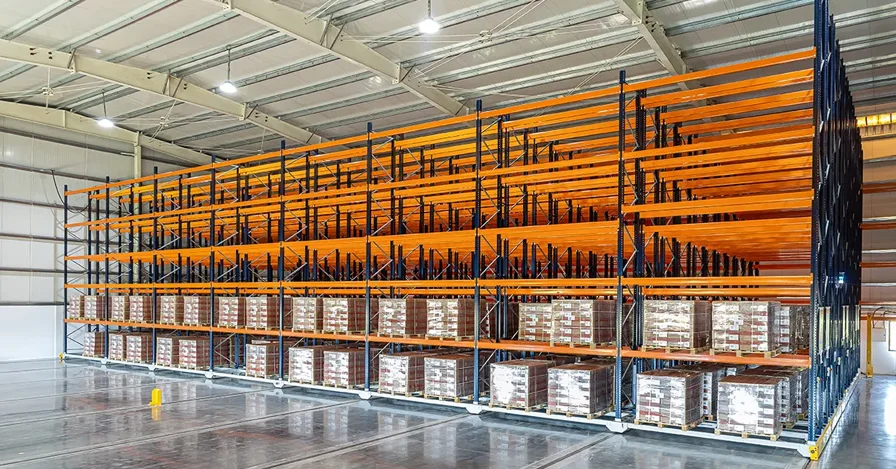
Storage locations placed far from primary aisles or dispatch points force every pick to cover more ground than necessary. Rack placement decisions made without reference to actual pick frequency data are one of the most common and most fixable sources of excess travel; our comparison of why pallet racking systems are essential for modern warehouses explains how racking configuration directly affects travel distance.
Why Loading Dock Layout Matters
Dock placement relative to high-turnover storage zones has an outsized effect on daily travel totals, since inbound and outbound movements happen at high frequency throughout every shift. Warehouses with docks positioned far from the zones they serve most often end up paying that travel cost thousands of times over across a single year of operation.
Reducing Travel Time Without Expanding Your Warehouse
The good news is that most travel time reduction comes from reorganising what's already there, rather than from a costly expansion or rebuild.
Warehouse Slotting Strategies That Reduce Travel Time
Slotting, matching storage location to pick frequency, is one of the fastest ways to cut travel distance without touching the building's footprint. Moving high-turnover stock closer to primary aisles and grouping items that are frequently picked together reduces the distance covered on each material handling task, often delivering measurable gains within weeks of implementation.
Using Heat Maps to Improve Warehouse Flow
Movement heat maps, built from forklift telematics or warehouse management system data, visually highlight where travel is concentrated and where it's disproportionately high relative to task volume. This makes it possible to identify specific aisles, zones, or workflows that are driving excess warehouse logistics cost, turning a vague sense that "travel feels slow" into a specific, addressable layout problem.
FAQs
How much does empty forklift travel typically cost a warehouse?
The exact figure varies by operation, but empty travel commonly accounts for a substantial share of total forklift movement in warehouses that haven't optimised slotting or task sequencing, representing cost with no offsetting output.
What is warehouse slotting and how does it reduce travel time?
Slotting assigns storage locations based on how frequently each item is picked, placing high-turnover stock closer to primary aisles and dispatch points. This reduces the average distance travelled per task without requiring any change to the building itself.
Do I need special software to build a warehouse heat map?
Many modern forklifts and warehouse management systems already capture the location and movement data needed to build a heat map. Dedicated analytics tools can simplify visualisation, but the underlying data is often already being collected without being actively used.
Conclusion
Travel time is one of the most expensive costs in a logistics warehouse precisely because it hides in plain sight, spread across thousands of small movements that never show up as their own line on a budget. Addressing warehouse design decisions around rack placement and dock layout, then using slotting and heat map data to keep refining flow, gives operations teams a realistic path to meaningfully lower cost and higher output without the expense of expanding the building itself.