Genavco has supplied and supported construction equipment across the UAE for decades, working directly with contractors on civil, infrastructure, and building projects throughout Dubai, Abu Dhabi, Sharjah, and the wider region. The guidance in this article draws on that hands-on experience — helping you understand site dumper categories, select the right machine for your UAE conditions, and integrate it effectively with your wider earthmoving equipment fleet.
Understanding the Role of Site Dumpers
A site dumper is a purpose-built machine for transporting bulk materials — excavated soil, concrete, aggregates, demolition debris, and granular fill — across a construction site. Unlike road-going trucks, site dumpers are engineered for unpaved terrain: soft ground, steep gradients, confined access routes, and the irregular surfaces that characterise active UAE construction sites. They are optimised for on-site stability, manoeuvrability, and payload efficiency rather than road speed or highway compliance, making them indispensable for the material handling link between your excavator and your disposal or placement point.
Applications in Construction Projects
On building sites, site dumpers transport excavated material from foundation and basement digs to stockpile areas or site skips. On UAE road and infrastructure projects, they move spoil from trench excavations and deliver granular fill to compaction zones. In landscaping and groundworks, they distribute topsoil and aggregate across areas that wheeled vehicles cannot access without damaging prepared surfaces. They are particularly valued on UAE projects with restricted access — confined urban plots, basement construction, utility works on live road corridors, and fit-out on upper floors of partially completed structures.
Benefits of Using Site Dumpers
A 1-tonne site dumper carries in a single cycle what requires 10 to 15 wheelbarrow loads. A 9-tonne articulated dumper moves material volumes comparable to a full-size truck but can access ground conditions that a rigid dump truck cannot navigate safely. Additional benefits include low capital cost relative to larger plants, low operating complexity suited to a broad range of operator skill levels, minimal maintenance requirements, and high availability — fewer complex systems mean less unplanned downtime on the material handling tasks that keep your site moving.
Different Types of Dumpers Used in Construction
The site dumper category covers a wide range of machine configurations, from compact 1-tonne forward-tip models to 9-tonne tracked articulated machines. Understanding the key types — and their specific performance characteristics for ground conditions, access, and payload — ensures the machine you select matches your site conditions and project requirements in the UAE.
Articulated Dumpers
An articulated dumper connects the cab unit and the load body through a central pivot joint. This allows the front and rear sections to move independently over uneven ground, maintaining four-wheel traction on soft, sloped, and irregular terrain. The articulated chassis distributes loaded weight more evenly across the wheelbase, preventing the chassis twist and differential slip that cause traction loss on rigid-frame machines.
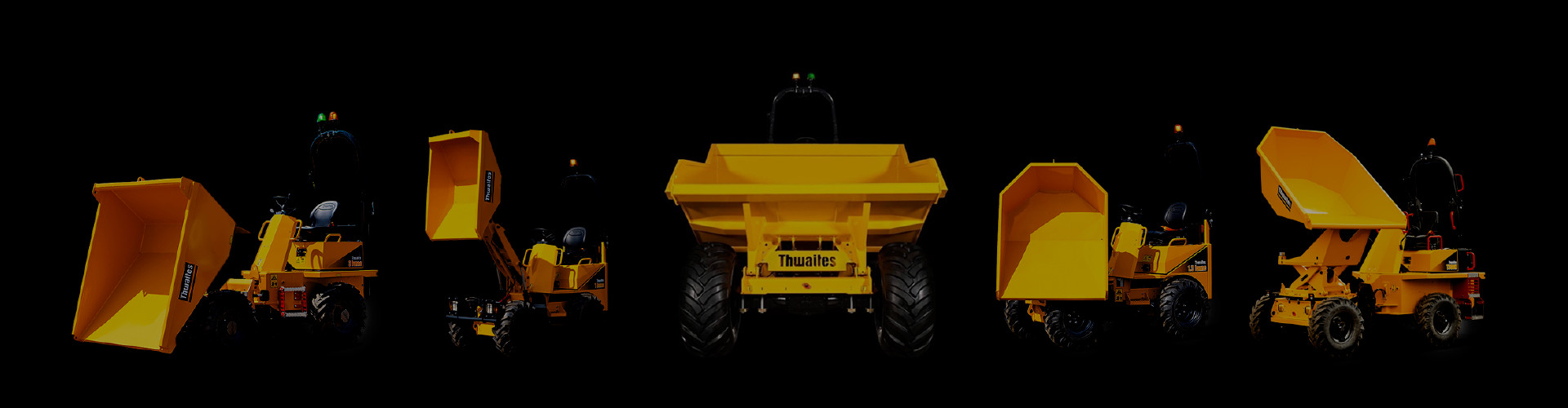
Thwaites articulated dumpers — available through Genavco — cover payload capacities from 1 tonne to 9 tonnes, with tracked and wheeled undercarriage options. Tracked articulated models provide the lowest ground pressure, making them the correct choice for soft sand, waterlogged ground, and recently placed fill that has not yet achieved bearing capacity.
High-Tip Dumpers
A high-tip dumper raises its skip to 1.5m to 2.5m above ground level, allowing direct discharge into waste skips, over site perimeter hoardings, or into elevated receiving hoppers. This eliminates secondary manual handling — both a productivity cost and a manual handling safety risk on UAE sites where occupational safety compliance is a contractual requirement. High-tip dumpers are particularly effective on refurbishment and fit-out projects where demolition waste must be loaded into perimeter skips, and on sites where the dumper is feeding an elevated hopper for concrete or aggregate distribution.
Improving Material Handling Efficiency
Material handling efficiency — measured as tonnes moved per hour or cost per tonne transported — directly determines programme speed and direct cost on earthmoving operations. A site dumper correctly matched to its feeding machine, loaded to its design payload, and operating on an efficient haul route with minimal cycle time delivers measurably lower cost per tonne than an over-specified, under-loaded, or poorly routed machine. This is where equipment selection, site layout, and operational management work together.
Reducing Project Delays
Material handling bottlenecks are one of the most common and costly causes of programme delay on UAE construction projects. When excavated material cannot be removed fast enough, the next construction activity is pushed back and the project sequence stalls. Site dumpers address this with reliable, high-cycle material transport at lower cost than full-size trucks, and with the ground access capability that trucks cannot match. Matching dumper payload and cycle time to excavator output rate is the critical sizing step — Genavco can assist with cycle time calculations and fleet configuration for any project scale.
Increasing Productivity on Site
Compact loaders paired with mini site dumpers provide an efficient solution for confined urban projects, landscaping applications, and restricted-access sites.
FAQs
What is the difference between a site dumper and an articulated dumper?
A site dumper is the broader equipment category. An articulated dumper is a specific type with a pivot-jointed chassis for improved traction on uneven ground. Forward-tip and swivel-skip dumpers on a rigid chassis are also site dumpers but are not articulated.
What payload capacity do I need for a UAE building project?
For foundation excavation on a standard UAE plot, 1 to 3 tonnes is typically sufficient. For major infrastructure earthmoving contracts where the excavator removes 80 to 150 tonnes per hour, a 6 to 9 tonne articulated dumper is required to match output rates.
Can site dumpers operate on sandy UAE terrain?
Yes. Tracked articulated dumpers provide low ground pressure for soft sand. Wheeled models with appropriate tyres perform well on compacted sand and gravel haul routes. Genavco can advise on the correct undercarriage for your specific ground conditions.
What earthmoving equipment is typically used alongside site dumpers?
Tracked and wheeled excavators are the most common loading machines for site dumpers. Compact wheel loaders and mini articulated loaders feed smaller dumpers in confined access situations. The Avant mini loader and Liebherr wheeled excavator — both available through Genavco — are regularly specified with Thwaites dumpers on UAE urban and infrastructure projects.
Thwaites, Avant & Liebherr at Genavco UAE
Compact loaders paired with mini site dumpers provide an efficient solution for confined urban projects, landscaping applications, and restricted-access sites.
Conclusion
Compact loaders paired with mini site dumpers provide an efficient solution for confined urban projects, landscaping applications, and restricted-access sites.
Contact Genavco today to discuss your site dumper requirement, request a specification comparison, or receive a competitive quotation for your UAE construction project.