Racking is usually budgeted as a one-time capital cost, but poorly designed industrial warehouse racking quietly becomes a recurring labour cost that never shows up on the original purchase invoice. Every extra metre a picker walks because a pallet racking system was laid out around convenience rather than pick frequency data is paid for, shift after shift, for as long as that layout stays in place.
This guide covers why warehouse racking design is genuinely a business decision, how warehouse racking systems support faster order fulfilment, and how drive in racking and cantilever racking prepare warehouse infrastructure for future growth.
Industrial Warehouse Racking and Pallet Racking Systems: Why Design Is a Business Decision
Racking design decisions made once during a fit-out continue affecting labour cost every single day the warehouse operates, which is exactly why they deserve more scrutiny than they typically receive.
How Industrial Warehouse Racking Layout Affects Labour Productivity
Aisle width, racking orientation, and the placement of high-turnover stock relative to dispatch points all directly determine how many steps a picker takes to complete each task. A layout that adds even a small amount of unnecessary travel per pick compounds into a significant share of total labour hours once multiplied across thousands of picks a day, month after month.
Pallet Racking System Mistakes That Increase Storage Costs
Sizing racking around the largest anticipated inventory volume rather than typical operating levels wastes both capital and floor space that could otherwise support faster-moving stock closer to primary aisles. Equally common is racking installed without reference to actual SKU dimensions, leaving wasted vertical clearance in every bay that a properly specified system would have captured as usable storage.
Warehouse Racking Systems That Support Faster Order Fulfilment
Fulfilment speed is largely decided by storage layout long before a single order is ever picked. Our broader look at why pallet racking systems are essential for modern warehouses covers the range of configurations available to support this kind of performance.
Choosing the Right Warehouse Racking Configuration
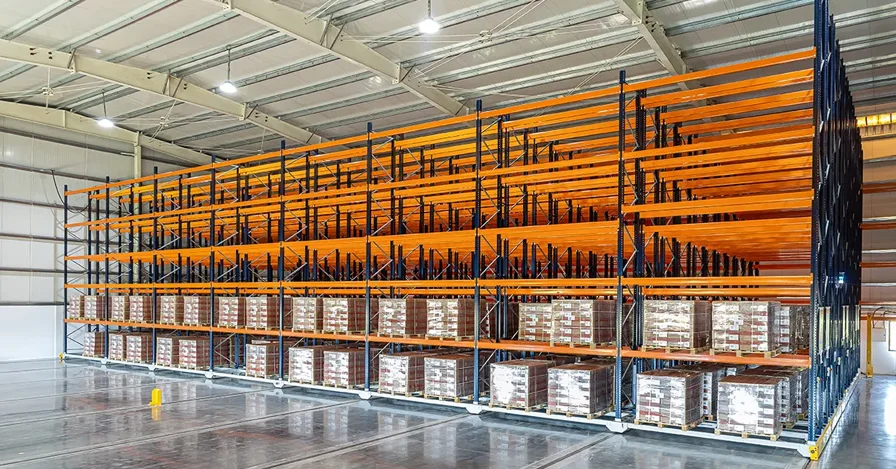
Selective, drive-in, and specialised racking formats each suit different combinations of SKU count, pick frequency, and storage density, and choosing the wrong configuration for a given fulfilment model creates friction that persists for the life of the installation. Matching configuration to actual order profile, rather than defaulting to whichever system looks most space-efficient on paper, is what actually determines fulfillment speed once the racking is in daily use.
Warehouse Racking Systems: Reducing Travel Distance Inside the Facility
Slotting high-velocity SKUs close to primary aisles and dispatch points reduces the distance covered on every pick, directly improving how many orders a picker can complete per hour without any change to headcount. This kind of data-driven slotting, revisited periodically as product mix shifts, keeps travel distance under control even as a warehouse's inventory profile evolves over time.
Drive-In and Cantilever Racking: Preparing Warehouse Infrastructure for Growth
Beyond standard racking, specialised systems give growing warehouses room to handle different product profiles without a disruptive layout overhaul each time inventory changes. Our guide to how to choose the right forklift for warehouse operations explains how equipment selection needs to stay aligned with these racking choices as both evolve together.
Drive-In Racking for Flexible Storage Planning
Drive-in racking gives high-volume, uniform SKUs a dense storage option that can be scaled up as those specific product lines grow, without requiring a redesign of the surrounding selective racking supporting the rest of the facility's mixed inventory. This flexibility lets a warehouse absorb growth in specific product categories without forcing a wholesale layout change across the entire building.
Cantilever Racking: Supporting Automation Through Better Layouts
Cantilever racking's open-arm structure, already well suited to long or irregular material, also integrates more cleanly with automated handling equipment than enclosed racking bays with obstructing columns. As warehouses increasingly layer automation onto heavy duty shelving and specialised racking, layouts designed with this future compatibility in mind avoid the costly rework of retrofitting automation into a structure that was never planned to support it.
FAQs
How much can poor racking layout actually add to labour costs?
Even small increases in travel distance per pick compound significantly across thousands of daily picks, and warehouses that review and correct slotting regularly often recover meaningful labour hours without adding staff or equipment.
How often should warehouse racking layout be reviewed?
A review every year or two, or whenever product mix or order volume changes significantly, helps catch labour cost and capacity issues before they become entrenched operational habits that are harder to correct later.
Does cantilever racking really matter for future automation plans?
Yes, for facilities storing long or irregular material. Its open structure integrates more cleanly with automated handling systems than enclosed racking, avoiding costly retrofitting if automation is introduced later.
Conclusion
Racking design is rarely treated as a labour cost decision, even though it directly shapes how much walking, searching, and repositioning happens on every single shift. Choosing warehouse racking systems configurations that match actual order profile, slotting stock to minimise travel distance, and planning drive in racking and cantilever racking for future growth all give warehouses a real, measurable lever over labour cost and fulfilment speed that most operations leave largely untouched.
Industries This Guidance Applies To
The principles in this guide apply across the range of industries GENAVCO supports with warehouse racking and storage systems, including third-party logistics and distribution centres, e-commerce fulfilment operations, retail and FMCG warehousing, manufacturing and industrial storage, and building materials and bulky goods storage. While layout priorities vary by sector, the underlying approach, designing racking around labour cost and fulfilment speed rather than storage density alone, holds across all of these operating environments.
Recommendations are informed by racking systems supplied and supported across these sectors in the UAE, giving practical grounding in how storage design decisions perform under real operating conditions rather than only in theory. Any specific racking configuration or layout change should still be validated against an individual facility's own labour and order data, since no general guide can substitute for a proper site-specific assessment.