Road construction is one of the most demanding sectors in the heavy equipment industry. From the first layer of subgrade to the final smooth asphalt wearing course, every stage of the process depends on the right machine working with precision. Whether you are managing a highway expansion, an urban resurfacing project, or a new airport runway, understanding the equipment available to you is the foundation of a successful project.
This guide covers the full range of road construction equipment — asphalt pavers, road rollers, soil compactors, and milling machines — and explains how to choose the right machine for every application.
Looking for road construction equipment in the UAE? Speak to Genavco's experts today — same-day quotations available.
What is Road Construction Equipment? An Overview
Road construction equipment refers to the specialised machines used at every phase of building, resurfacing, and maintaining roads. This includes machines that prepare the ground, lay asphalt or concrete, compact each layer to the required density, and recycle or remove existing pavement.
The three core categories are: paving equipment (which lays the road surface), compaction equipment (which densifies each layer), and milling machines (which remove or recycle old pavement). Together, these machines form a complete road-building system used on projects of every scale.
Types of Asphalt Pavers for Road Construction
Vogele Road Paver: Features & Applications
Vogele asphalt pavers are among the most widely specified paving machines on major infrastructure projects worldwide. Their precision screed technology, WITOS Paving Plus digital management system, and AutoSet Plus automatic configuration make them the benchmark for consistent mat quality. Vogele pavers are available in compact, mid-range, and Super Class configurations, covering paving widths from narrow urban lanes to full highway carriageways.
Key applications include highways, airport runways, car parks, and urban road resurfacing. In the UAE's extreme heat, Vogele's temperature management technology is especially critical for maintaining the asphalt within the correct compaction window.
Asphalt Pavers vs Concrete Pavers: Key Differences
Asphalt pavers lay bituminous mixes using a heated screed, while concrete slipform pavers extrude concrete continuously without formwork. Asphalt paving is faster and more flexible for repairs and overlays. Concrete paving — using machines like the Wirtgen SP 60i slipform paver — delivers higher long-term rigidity suited to heavily loaded roads and airport aprons. The choice depends on traffic loading, maintenance strategy, and project budget.
Road Rollers and Soil Compactors: Why Compaction Matters
Vibratory Rollers vs Tandem Rollers
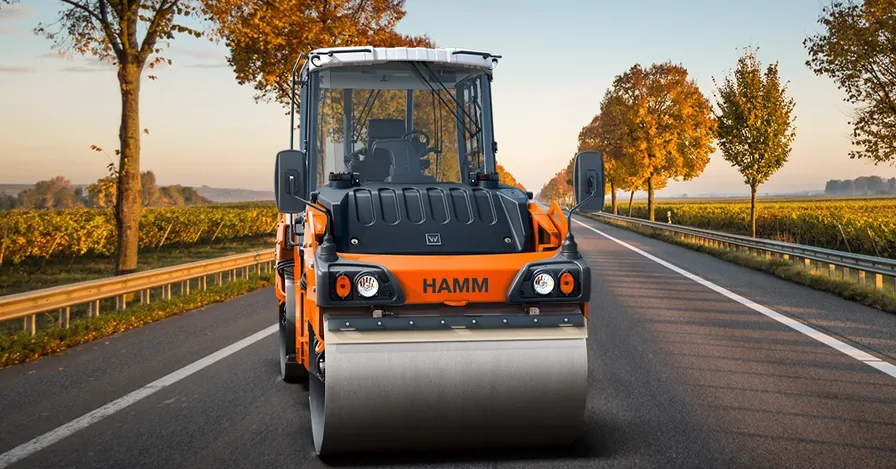
Vibratory rollers use a single or double drum with high-frequency vibration to achieve deep compaction of granular base courses and subgrade. HAMM single drum vibratory rollers are the standard for soil and aggregate layers, with compaction depths reaching up to 600mm depending on material and frequency settings.
Tandem rollers (double drum) are used for asphalt compaction — their equal-width drums deliver consistent pressure across the full mat width, ensuring even density and a smooth finished surface. HAMM tandem rollers feature the Hammtronic intelligent control system for automatic parameter optimisation.
Double Drum Rollers for Urban Roads
Double drum rollers are the preferred choice for urban resurfacing and car park projects where a smooth, tight surface finish is essential. Their compact footprint allows operation in confined spaces, and their low-vibration mode protects adjacent utilities and structures — a key advantage in city environments.
Pneumatic Tyred Roller: When to Use
Pneumatic tyred rollers (PTRs) use a series of rubber tyres to apply a kneading action on asphalt layers. This improves particle interlock and produces a denser, more waterproof surface. PTRs are particularly effective for chip seal and surface dressing applications, and are often used as the intermediate roller between the breakdown and finishing passes on highway projects.
Road Rollers and Soil Compactors: Why Compaction Matters
Compaction is arguably the most critical process in road construction. Insufficient compaction leads to rutting, potholing, and premature pavement failure. Every road authority in the UAE — including Dubai Municipality and ADAC — specifies minimum compaction density requirements (typically 98–100% of maximum dry density) that must be verified by nuclear density testing.
HAMM's HCQ Navigator intelligent compaction system records compaction values in real time across the entire lane width, providing a digital quality map that eliminates guesswork and supports formal QA documentation for project handover.
Asphalt Milling Machines: Road Recycling & Cold Milling
Cold Milling Machine vs Road Recycling Machine
Cold milling machines (such as the Wirtgen W series) remove asphalt layers with precision depth and grade control, typically in preparation for a new wearing course overlay. Milling depths of 0 to 330mm can be achieved in a single pass, with automatic cross-slope and longitudinal grade control ensuring a consistent profile.
Road recycling machines (such as the Wirtgen WR series) go deeper — stabilising and homogenising the existing base course material in place, adding binder if required. Recycling eliminates the cost of hauling away and replacing base material, making it significantly more economical for full-depth rehabilitation projects.
Slipform Paver for Concrete Road Projects
The Wirtgen SP 60i slipform paver is designed for continuous concrete extrusion on highways, airport runways, and heavy-duty industrial yards. Unlike traditional formed concrete paving, slipform technology requires no fixed formwork — the machine extrudes, vibrates, and profiles the concrete in a single continuous pass, delivering dramatically higher productivity and more consistent slab geometry.
How to Choose the Right Road Construction Equipment
Equipment selection for road projects should be based on four key factors:
- Project scale and paving width — compact urban lanes need different machines to multi-lane highways
- Material type — asphalt, concrete, granular sub-base, or stabilised soil each require specific equipment
- Required production rate — match machine output (tonnes/hour or m²/hour) to your project programme
- Site conditions — ground bearing capacity, access restrictions, and ambient temperature all influence choice
Consulting an equipment specialist before mobilisation avoids costly mismatches between machine capability and project demand.
Top Brands: Vogele, Hamm & Wirtgen in the UAE
All three brands — Vogele, HAMM, and Wirtgen — are part of the Wirtgen Group, now a John Deere company. This means shared engineering platforms, compatible technologies, and a unified after-sales network. In the UAE, Genavco is the authorised distributor for the complete Wirtgen Group range, providing genuine spare parts, factory-trained service technicians, and operator training programmes.
These brands are specified on the UAE's most demanding road and infrastructure projects, from Abu Dhabi's highway expansion programmes to Dubai airport runway works, backed by full local technical support.
Frequently Asked Questions
Q: What is the most important factor in asphalt paving quality?
A: Temperature management. Asphalt must be laid and compacted within a specific temperature window — typically 140–165°C for laying and above 80°C for final roller pass. In the UAE's ambient heat, this window can be extended, but proper screed heating and compaction speed remain critical.
Q: How many roller passes are needed for proper compaction?
A: This varies by material, roller weight, and vibration frequency. A typical asphalt compaction train uses breakdown, intermediate, and finishing passes — usually 3–5 passes total per compactor, confirmed by density testing.
Conclusion
Road construction quality begins and ends with equipment. The right asphalt paver ensures consistent layer thickness and smooth surface texture. The right road rollers achieve the compaction density that determines how many years a road will carry traffic before needing maintenance. And the right milling machine makes rehabilitation faster, more precise, and more cost-effective.
Whether you are specifying equipment for a new highway, a municipal resurfacing programme, or a full-depth rehabilitation project, Vogele pavers, HAMM rollers, and Wirtgen milling machines represent the highest standard available — and all are supported locally by Genavco across the UAE and GCC.
Ready to equip your next road project? Contact Genavco today for expert guidance, product demonstrations, and competitive quotations on the complete Wirtgen Group range in the UAE.
About This Content: This guide is produced by Genavco's technical team with direct experience supplying and supporting road construction equipment across major UAE infrastructure projects. All product claims are based on manufacturer specifications and verified field performance data.