Most warehouses lose a surprising amount of usable space to aisles. Standard racking layouts need wide enough aisles for conventional forklifts to turn and manoeuvre, and that aisle space, multiplied across every row in a facility, adds up to a significant share of the total footprint. A VNA configuration reclaims much of that lost space by narrowing aisles to widths only specialised trucks can operate in, packing more storage into the same building envelope.
Understanding what a VNA warehouse actually requires, the equipment it depends on, and how to maximize the return on the investment gives operations teams a clear picture of whether this approach fits their specific warehouse operations.
What Is a VNA Warehouse?
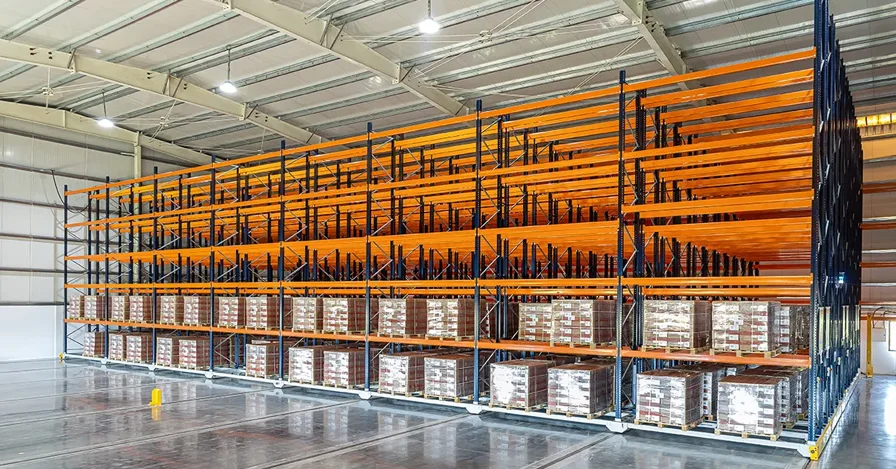
A very narrow aisle warehouse is designed around aisle widths roughly half that of a conventional layout, made possible by trucks purpose-built to operate in that confined space rather than by any change to the racking itself.
How Narrow Aisles Increase Storage Density
Narrowing aisle width from the roughly 3.5 metres a standard counterbalance forklift needs down to around 1.6 to 2 metres frees up a substantial share of floor area for additional warehouse racking systems rather than empty travel space. In many facilities, this conversion alone can increase usable pallet positions by 40 percent or more within the exact same building footprint.
Which Businesses Benefit Most from VNA Warehouses?
Businesses facing high real estate costs relative to storage demand, or those unable to expand their physical footprint, see the strongest case for converting to VNA. High-SKU-count operations that need dense storage of a wide product range, such as distribution centres and e-commerce fulfilment operations, also benefit significantly from the additional pallet positions VNA layouts unlock.
Equipment Required for VNA Warehouses
Converting to VNA isn't just a racking decision, it depends entirely on specialised trucks designed to operate safely and efficiently within the narrowed aisle width. Our guide to warehouse equipment for storage and material handling covers how this equipment fits within broader warehouse planning, and our comparison of why pallet racking systems are essential for modern warehouses looks at how racking choice interacts with the equipment operating around it.
Choosing the Right VNA Truck
VNA trucks typically use guided systems, either wire or rail guidance, to travel safely at speed through aisles too narrow for a human operator to steer manually with the same confidence. Selecting the right truck configuration depends on lift height, load capacity, and whether the operation needs the truck to also handle order picking tasks or purely pallet movement.
Why Order Pickers Improve High-Level Picking
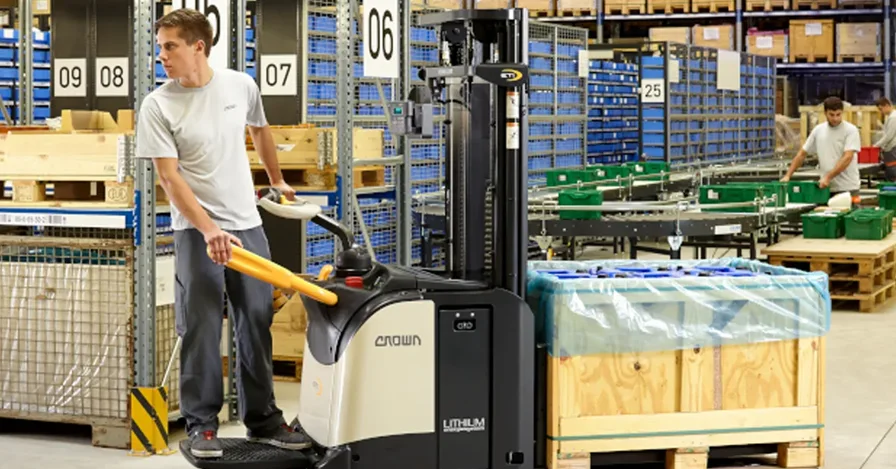
VNA racking often extends well beyond standard reach heights, making a dedicated order picker essential for accessing individual items stored at height rather than only full pallets. These trucks raise the operator alongside the load, allowing accurate, safe picking from levels that would otherwise require awkward workarounds or additional handling steps.
Maximising ROI from a VNA Warehouse
The capacity gains from VNA are significant, but realising the full return depends on how well the system is operated once it's installed.
Reducing Picking Time in Narrow Aisles
Guided VNA trucks can travel at higher speeds within aisles than an operator would attempt manually, since the guidance system removes the steering uncertainty that would otherwise force a cautious pace. Combined with a thoughtful pallet racking system layout that places high-turnover stock at more accessible levels, this speed advantage helps offset the additional care VNA operations require compared with open, conventional aisles.
Future-Proofing Warehouse Storage
Because VNA systems unlock substantially more storage from the same building, they give growing businesses meaningful headroom before a facility expansion or relocation becomes necessary. This is particularly valuable for operations managing industrial warehouse racking at scale, where the cost and disruption of moving to a larger site far exceeds the investment required to convert an existing layout to VNA and lift overall warehouse productivity within the same four walls.
FAQs
How much extra storage capacity can a VNA layout provide?
Many facilities see a 40 percent or greater increase in usable pallet positions when converting from a conventional layout to VNA, though the exact gain depends on the original aisle width and racking configuration.
Do VNA trucks require special operator training?
Yes. VNA trucks require training specific to guided operation and the confined working environment, which differs meaningfully from standard forklift training even for experienced operators.
Is VNA storage worth the investment for a smaller warehouse?
VNA typically makes the strongest financial sense where real estate costs are high relative to storage demand or where physical expansion isn't feasible. Smaller operations with room to grow conventionally may see a longer payback period on the conversion cost.
Conclusion
Very narrow aisle warehousing turns wasted aisle space into usable storage capacity, often unlocking a substantial increase in pallet positions without moving a single wall. The investment in specialised trucks and operator training pays off most clearly for businesses facing real space or cost constraints on expansion, where converting existing warehouse racking systems to a VNA configuration delivers meaningfully more capacity from the same footprint than any layout adjustment within a conventional aisle structure could achieve.