Buying an electric forklift looks straightforward until the options are actually laid out: mast height, battery type, aisle clearance, attachment compatibility, and a dozen other specifications that all interact with each other. Get the match right and a forklift becomes one of the most productive assets on the floor. Get it wrong, and the mismatch quietly costs money for years through lost productivity, avoidable downtime, and equipment that never quite fits the job it was bought for.
This guide covers what to check before buying an electric forklift, how forklift choice actually connects to warehouse productivity, and when equipment beyond the standard forklift, powered pallet trucks, order pickers, and stackers, is the better fit for a specific task.
Electric Forklifts: What to Check Before You Buy
Electric forklifts have become the default choice for most indoor warehouse operations, but the details of battery, charging, and specification still make the difference between a good purchase and a costly mismatch.
Electric Forklift Battery Life and Charging Considerations
Battery type, capacity, and charging strategy all need to match actual shift patterns rather than being chosen generically. Lithium-ion batteries suit operations needing opportunity charging across multiple shifts, while conventional lead-acid batteries remain a practical option for single-shift operations with predictable, scheduled charging windows already built into the working day.
Forklift Buying Mistakes That Cost Warehouses Later
Buying based on lowest purchase price rather than total operating cost, choosing mast height without checking actual racking clearance, and ignoring aisle width requirements are among the most common and most expensive forklift buying mistakes. Each of these shortcuts saves time during the purchase decision while creating a persistent operational cost that outlasts the initial savings many times over.
Forklifts and Warehouse Productivity: The Real Connection
Forklift choice isn't just an equipment decision, it has a direct and measurable effect on how much a warehouse can actually move in a shift. Our guide to how to choose the right forklift for warehouse operations covers this selection process in more depth.
How the Right Forklift Improves Warehouse Productivity
A forklift matched to actual task demand completes more cycles per hour than one that's oversized, undersized, or simply the wrong configuration for the layout it's working in. This productivity gain compounds daily, meaning a small mismatch at purchase can cost significant cumulative output over a machine's working life without ever appearing as a single obvious problem.
Building a Material Handling Equipment Fleet That Fits Your Operation
A well-planned material handling equipment fleet mixes machine types deliberately rather than defaulting to a single forklift model for every task in the warehouse. Matching each machine to the specific combination of load, height, and aisle width it will actually face avoids both wasted capacity and persistent bottlenecks caused by forcing one equipment type to do everything. Our comparison of why pallet racking systems are essential for modern warehouses explains how racking configuration and equipment fleet planning need to be considered together.
Powered Pallet Trucks, Order Pickers and Stackers: Choosing Beyond the Forklift
A standard forklift isn't always the right tool, and several other equipment categories often outperform it for specific tasks within the same warehouse.
When a Powered Pallet Truck Is a Better Fit Than a Forklift
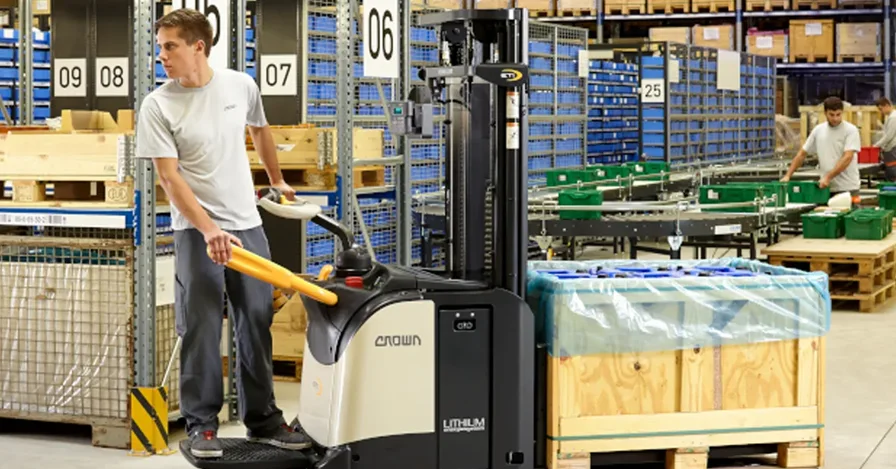
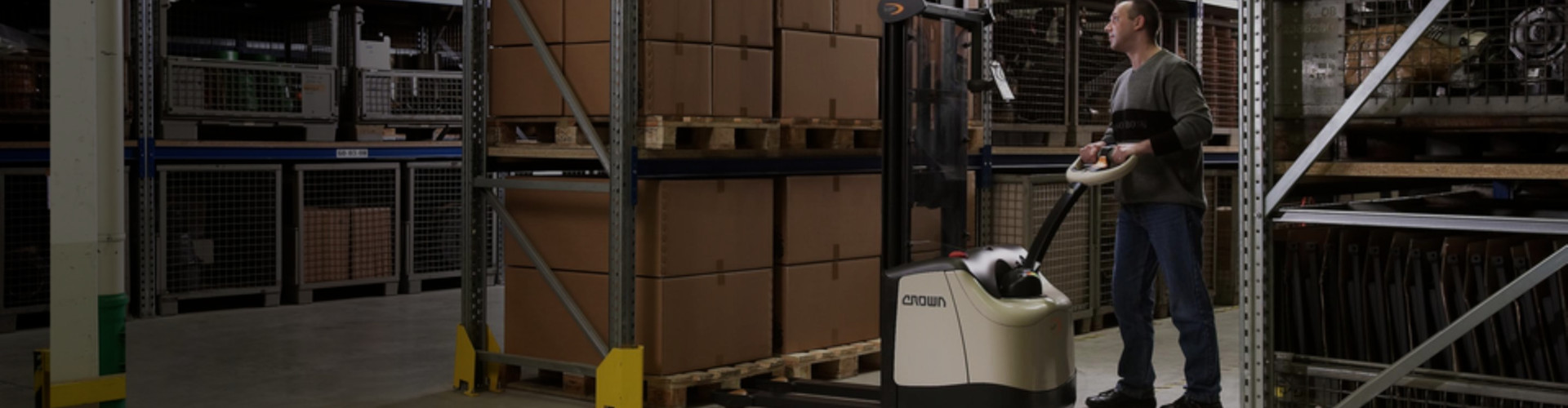
A powered pallet trucks configuration suits horizontal pallet movement at floor level, offering a lower-cost, more manoeuvrable alternative to a full forklift whenever tasks don't require lifting pallets into racking. Warehouses that only occasionally need racking-height access can often meet most of their day-to-day handling needs with powered pallet trucks alone, reserving forklifts for the smaller share of tasks that genuinely require them.
Order Picker vs Stacker: Matching Equipment to Picking Height
An order picker raises the operator alongside the load for accurate individual-item picking at height, while a stacker is built for lower-level pallet lifting without the operator elevation an order picker provides. Choosing between the two comes down to whether the primary task is piece-picking at height or straightforward pallet placement at lower racking levels.
FAQs
Should I choose lithium-ion or lead-acid batteries for an electric forklift?
Lithium-ion suits multi-shift operations needing opportunity charging during short breaks, while lead-acid remains a practical, lower-cost choice for single-shift operations with a predictable, dedicated charging window already built into the schedule.
What is the biggest mistake buyers make when purchasing a forklift?
Focusing on purchase price rather than total operating cost is the most common and costly mistake, since fuel or charging expense, maintenance, and productivity losses from a poor equipment match typically far exceed any upfront savings.
Do I need a full forklift, or would a powered pallet truck or order picker be enough?
This depends on whether tasks require lifting into racking. If most work is floor-level pallet movement, a powered pallet truck may suffice; if high-level piece-picking is the main task, an order picker is often better suited than a general-purpose forklift.
Conclusion
The right forklift purchase depends on far more than horsepower and lift capacity on a spec sheet. Matching battery strategy, mast height, and machine type to the actual tasks a warehouse needs done, and considering powered pallet trucks, order picker, and stacker options alongside a standard forklift, consistently delivers a better-performing, lower-cost fleet than defaulting to one machine type for every job in the warehouse.
Industries This Guidance Applies To
The principles in this guide apply across the range of industries GENAVCO supports with forklifts and material handling equipment, including third-party logistics and distribution centres, e-commerce fulfilment operations, retail and FMCG warehousing, manufacturing and industrial storage, and cold chain and food distribution facilities. While the specific equipment mix varies by sector, the underlying approach, matching machine type and battery strategy to actual task demand, holds across all of these operating environments.
Recommendations are informed by equipment supplied and supported across these sectors in the UAE, giving practical grounding in how forklift and material handling decisions perform under real operating conditions rather than only in theory. Any specific equipment purchase should still be validated against an individual facility's own layout and task requirements, since no general guide can substitute for a proper site-specific assessment.