A submersible pump sits in the liquid it moves. That single design decision changes everything about how it behaves — no suction lift to lose, no priming to fail, no long inlet pipe to air-lock, and the surrounding liquid cooling the motor continuously.
It also means the pump has to survive whatever is in that liquid. Sewage, storm water, sludge, industrial effluent and slurry all contain solids, fibres and abrasives that will find any weakness in the hydraulic design. Which is why the impeller — not the motor rating — is the decision that determines whether a pump runs for years or blocks every fortnight.
This guide covers how a submersible water pump works, what each impeller type is built to handle, how to read flow and head correctly, and the Flygt pump range GENAVCO supplies in the UAE.
How a Submersible Pump Works
The pump and motor are built into one sealed unit designed to operate fully immersed. A rotating impeller accelerates liquid outward, converting motor rotation into flow and pressure, and discharges it into the rising main.
Three consequences follow from the submerged design, and all three matter commercially.
- No suction lift limitation: A surface pump has to draw liquid up to itself, and atmospheric pressure caps how far. A submersible pump is already in the liquid, so it pushes rather than pulls and that ceiling disappears entirely.
- No priming: Surface pumps lose prime, air-lock and run dry. A submerged pump is primed by definition, which is why unattended installations — sewage stations, storm sumps, wet wells — use them almost exclusively.
- The liquid cools the motor: Surrounding liquid carries heat away continuously, which allows a compact unit to deliver substantial power. It also means running a submersible pump dry is a genuine risk rather than an inconvenience.
The seal system is what makes all of this possible. A double mechanical seal arrangement keeps liquid out of the motor, and seal condition is the single most important maintenance item on any submersible installation.
Impeller Types: The Decision That Matters Most
Two pumps with identical flow and head figures can behave completely differently in the same wet well, because the impeller determines what the pump can pass without blocking.
| Impeller type | Handles | Typical application |
|---|---|---|
| Non-clog | Solids-bearing liquid, rag and fibre | Wastewater, storm water, raw water, sludge |
| Channel | Wide performance range, general solids | Municipal sewage, industrial effluent, process water |
| Cutter / chopper | Fibrous material, cuts solids down to size | Toughest wastewater duties, high rag content |
| Grinder | Solids-bearing liquid in small volumes | Residential, commercial and agricultural |
| Propeller | Very high flow at low head | Irrigation, flood control, storm and raw water |
| Slurry | Abrasive solids in suspension | Treatment plants, fly ash, industrial slurries |
The practical rule: match the impeller to what is actually in the liquid, then check that flow and head fall within the range. Selecting on flow and head first, then discovering the impeller cannot pass the solids, is the most common and most expensive sequence error in pump specification.
Reading Flow and Head Correctly
Every pump curve trades one against the other, and quoted maximums are rarely achievable together.
- Flow is volume per unit time: Usually litres per second in this sector. It answers how much liquid the pump moves.
- Head is the height the pump can lift against: Measured in metres. It answers how far up, and how hard the pump has to push against the resistance of the system.
- They are inversely related: A pump quoted at a maximum flow and a maximum head does not deliver both simultaneously. Maximum flow occurs at minimum head, and maximum head at minimum flow. The duty point is where your system requirement intersects the curve.
- Total head includes friction, not just height: Static lift is only part of it. Pipe friction, bends, valves and discharge losses all add resistance the pump must overcome. Undersized or overlong discharge pipework is a frequent cause of a correctly selected pump underperforming.
Specify the duty point — the flow you need at the head your system imposes — rather than a headline figure from either end of the curve.
Advantages of Submersible Pumps
These are the characteristics that make submersible the default in wastewater and drainage installations.
- No suction lift limit: The pump is in the liquid, so it pushes rather than pulls and the atmospheric limit that constrains surface pumps does not apply.
- No priming required: Permanently primed by immersion, which is what makes unattended and automatic operation reliable.
- Continuous motor cooling: Surrounding liquid carries heat away, allowing high power output from a compact unit.
- Quiet operation: The liquid absorbs noise, which matters in residential-adjacent pumping stations and enclosed plant rooms.
- Compact installation footprint: No pump house, no suction pipework and no separate motor foundation — the wet well is the installation.
- Protected from weather and dust: Sealed and immersed, so the machine is unaffected by the surface conditions that shorten life on exposed equipment.
- Impeller choice for every liquid: A single technology covers clean water through to abrasive slurry by changing the hydraulic end.
- Straightforward removal for service: Guide rail systems allow the pump to be lifted for maintenance without draining the well or entering it.
Flygt Submersible Pumps Available in the UAE
GENAVCO supplies Xylem Flygt pumping solutions in the UAE. Four series cover the main impeller types for wastewater, sewage and process duties.
1. Flygt N-Series — non-clog, self-cleaning

Built around patented N-technology, where the impeller geometry actively moves rag and fibrous material through rather than allowing it to accumulate on the leading edge.
- Impeller: Patented N-technology with non-clog N-type impeller
- Behaviour: Self-cleaning pumps with sustained high efficiency
- Applications: Waste water, storm water, raw water, sludge
- Range: Small, medium and large capacity pumps
- Flow: Up to 3,200 l/s
- Head: Up to 130 m
- Motor power: 1.7 kW to 680 kW
The phrase worth weighting is "sustained high efficiency". A conventional impeller loses efficiency as material builds on it, so power consumption climbs steadily between cleanouts. A self-cleaning design holds its efficiency, and across a pump running continuously for years that difference in energy cost dwarfs the purchase price.
View Flygt N-Series non-clog pumps
2. Flygt C-Series — channel impeller, widest performance range

The general-purpose series, with a channel-type impeller and an extensive performance range covering most municipal and industrial pumping duties.
- Impeller: Channel type impeller
- Applications: Municipal sewage, industrial effluent, process water, storm water
- Range: Small, medium and large capacity pumps
- Flow: Up to 3,000 l/s
- Head: Up to 100 m
Breadth is the point of this series. Where an operator runs pumping stations of varying size and duty, standardising on one series across the estate simplifies spares holding and technician familiarity considerably.
View Flygt C-Series channel impeller pumps
3. Flygt F-Series — cutter impeller for the toughest wastewater
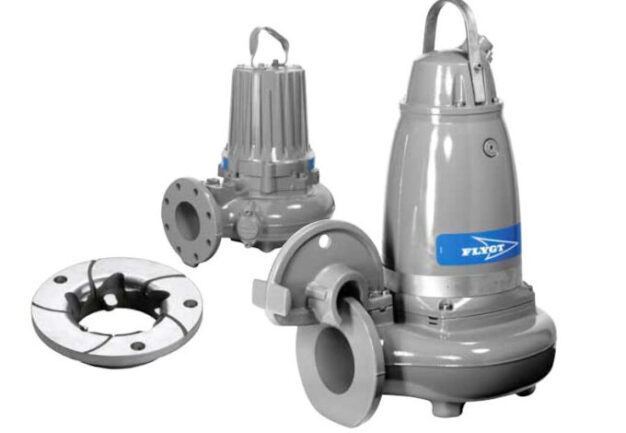
Where the liquid contains fibrous material that would defeat a conventional impeller, the cutter design reduces solids before they reach the pumping section.
- Impeller: Cutter type impeller
- Action: Cuts solids or fibres down to size, ensuring reliable and trouble-free operation
- Construction: Rough and rugged, built for the toughest wastewater challenges
- Flow: Up to 150 l/s
- Head: Up to 40 m
Note the flow range relative to the N and C series. Cutter pumps trade throughput for the ability to handle material that would block anything else — they are specified for difficult liquid, not for volume.
View Flygt F-Series cutter impeller pumps
4. Flygt M-Series — grinder impeller for small-volume duties
High-efficiency submersible centrifugal pumps with a grinder impeller, suited to solids-bearing liquids at low volume where discharge is through small-bore pipework.
- Impeller: Grinder type impeller
- Type: High-efficiency submersible centrifugal
- Handles: Solids-bearing liquids
- Applications: Residential, commercial and agricultural
- Flow: Up to 14 l/s
- Head: Up to 20 m
Grinding solids to a fine slurry is what allows discharge through small-diameter pipe over distance, which is the whole reason this class exists — it makes pressure sewer systems viable where gravity drainage is not.
View Flygt M-Series grinder pumps
Not sure which impeller your liquid needs?
Send us what is in the liquid, your required flow, the static lift and the discharge pipe run — our team will select the pump and return a cost proposal.
How to Specify a Submersible Pump
Step 1 - Characterise the liquid first. Solids content, particle size, fibre and rag content, abrasiveness and chemistry. This determines the impeller, and the impeller determines everything else.
Step 2 - Establish the required flow. What volume has to move, and over what period. For intermittent duties, the inflow rate and the acceptable level range in the well set the requirement rather than a peak figure.
Step 3 - Calculate total head, not static lift. Add friction losses through the discharge pipe, bends, valves and fittings to the vertical lift. Long or undersized pipework can add more resistance than the lift itself.
Step 4 - Find the duty point on the curve. The pump should operate near its best efficiency point, not at either extreme. A pump running far from that point consumes more energy and wears faster.
Step 5 - Plan the installation and removal method. Guide rail systems, lifting arrangements and access determine whether routine service is a straightforward lift or a confined space entry.
Step 6 - Specify control and protection. Level control, dry-run protection and seal monitoring are what prevent the failure modes that account for most submersible pump losses.
Submersible Pumping in UAE Conditions
- High ambient temperature reduces cooling margin: Motor cooling depends on the surrounding liquid carrying heat away. Warm liquid, or a pump partially exposed at low level, reduces that margin considerably. Minimum submersion levels matter more here than in temperate climates.
- Sand and grit are present in most site water: Fine abrasive material accelerates impeller and seal wear. Where sand content is high, the specification should account for it rather than assuming clean water performance.
- Salinity affects material selection: Coastal groundwater and brackish liquid are corrosive. Material specification for casings, impellers and fasteners should reflect the actual chemistry, not a default.
- Intermittent duty risks dry running: Where inflow is variable, level control and dry-run protection prevent the single most damaging failure mode for a submersible pump.
Why Choose GENAVCO as Your Pumping Partner in the UAE
Buying the pump is the easy part. What determines whether the installation performs is everything that happens afterwards.
- Part of Juma Al Majid Holding Group: Decades of established presence in the UAE market and the financial stability that comes with a major regional group — this matters when you are signing multi-year service agreements.
- Authorised Xylem Flygt representation: Genuine equipment, factory-backed specification and full warranty integrity — not grey-market imports with uncertain parts availability.
- Seals and wear parts held locally: Seals and bearings are the routine service items on any submersible installation. Our genuine spare parts operation holds stock in-country so a scheduled service is not delayed waiting on shipment.
- Installation and certified service: Installation handled by technicians who work with these machines daily, with scheduled servicing and breakdown response through our repairs and maintenance division across Dubai, Abu Dhabi, Sharjah and the wider UAE.
- Operator training: Level control setup, dry-run protection and seal monitoring prevent most failures. Our operator training centre covers correct operation and routine checks.
- Selection against the liquid, not a catalogue: We specify the impeller against what is actually in the liquid, then check the duty point, rather than matching a flow figure and hoping the solids pass.
- Depth across site equipment: Pumping alongside our wider earthmoving and light construction equipment range — one supplier relationship across the site.
Common Submersible Pump Problems
- Repeated blocking: The impeller type does not suit what is in the liquid. This is a selection issue rather than a pump fault, and no amount of cleaning resolves it permanently.
- Flow lower than expected: Usually total head higher than calculated — friction in the discharge pipework rather than static lift. Check the pipe run before questioning the pump.
- Rising power consumption: Material building up on the impeller, or wear opening internal clearances. Both reduce efficiency progressively rather than suddenly.
- Seal failure: The most common submersible pump failure. Frequently follows dry running or abrasive liquid, both of which are preventable through control and correct specification.
- Motor overheating: Insufficient submersion, so the liquid is not carrying heat away. Level control settings are usually the cause.
- Short bearing life: Often a pump operating far from its best efficiency point, which imposes hydraulic loads the bearings were not selected for.
Frequently Asked Questions
How does a submersible water pump work?
The pump and motor are built into a single sealed unit that operates fully immersed in the liquid. A rotating impeller accelerates liquid outward and discharges it into the rising main. Because the pump is already in the liquid it pushes rather than pulls, which removes the suction lift limit and the need for priming.
Which impeller type do I need?
It depends on what is in the liquid. Non-clog impellers suit wastewater, storm water and sludge; channel impellers suit municipal sewage and industrial effluent across a wide performance range; cutter impellers handle fibrous material by cutting it down to size; grinder impellers suit small-volume solids-bearing duties.
What is the difference between flow and head?
Flow is the volume of liquid moved per unit time, usually litres per second. Head is the height the pump can lift against, measured in metres. They are inversely related, so a pump does not deliver its maximum flow and its maximum head simultaneously — the duty point is where your system requirement meets the curve.
Why does my submersible pump keep blocking?
Almost always because the impeller type does not match what is in the liquid. Rag and fibrous material defeat conventional impellers, which is why non-clog and cutter designs exist. This is a selection problem rather than a maintenance one.
Can a submersible pump run dry?
It should not. The surrounding liquid cools the motor, so running dry causes overheating and is the most common cause of seal failure. Level control and dry-run protection should be specified with the pump rather than added later.
Does GENAVCO supply spare parts and servicing for Flygt pumps in the UAE?
Yes. GENAVCO holds genuine parts in-country and operates a certified service network covering Dubai, Abu Dhabi, Sharjah and the wider UAE, with installation, preventive maintenance programmes and breakdown support.
Ready to Select Your Pump?
Submersible pump selection starts with the liquid and ends with the duty point. Get the impeller right for what is actually being pumped, calculate total head honestly, and the installation runs for years instead of becoming a maintenance commitment.
GENAVCO supplies the full Flygt range across the UAE — non-clog, channel, cutter, grinder, propeller and slurry pumps, plus mixers — backed by installation, genuine parts and certified service.
Tell us what is in the liquid and your duty requirement. We will select the pump and price it properly.
ENQUIRE NOW — GET YOUR PUMP SELECTION
Serving Dubai, Abu Dhabi, Sharjah and the wider UAE.